Why the Whippet Standard Cares So Much About the Topline
Many Whippet owners, or those simply admiring these elegant dogs, might find themselves scratching their heads when breeders and enthusiasts talk endlessly about the "topline." It sounds technical, almost like jargon, and it's easy to dismiss it as just another show ring eccentricity. But really, the Whippet standard's intense focus on the topline isn't about vanity; it's deeply rooted in the breed's history, function, and overall health. This guide will unravel the mysteries of the Whippet topline, explaining why this specific curve is so crucial to the breed's identity and well-being.
Understanding the Whippet Standard's Purpose
The breed standard for any dog breed is essentially a blueprint, describing the ideal characteristics that embody that breed's original purpose, temperament, and health. For Whippets, a sighthound developed for speed and agility, every detail in the standard points back to these fundamental traits. It’s not just a beauty contest; it’s a living testament to what makes a Whippet, a Whippet. When the standard emphasizes something as specific as the topline, it’s because that feature is intrinsically linked to the dog's ability to perform its historical function and live a healthy, active life.
More Than Just Pretty Looks: Functionality First
It’s a common misconception that breed standards are solely about aesthetics, crafting a dog that looks good in a show ring. While show dogs certainly aim for that polished appearance, the deeper truth is that every aspect described in a well-written standard, especially for a working breed like the Whippet, serves a functional purpose. The particular shape of a Whippet's topline, for example, isn't just a pretty curve; it's an engineering marvel designed for explosive speed and efficient movement.
Think of it like a finely tuned athletic machine. Each part has a role to play. If one part is off, the entire mechanism suffers. For the Whippet, that means a topline that allows for maximum reach and drive, absorbing impact and propelling the dog forward with incredible power. Without that specific structure, the dog might still run, but it wouldn't run with the same effortless grace or blistering speed that defines the breed. The standard, therefore, safeguards the functional integrity of the breed.
This functional emphasis also extends to the dog's endurance and ability to withstand the rigors of its activities, whether that's lure coursing, racing, or simply a spirited dash in a safe, fenced area. A correctly constructed topline helps distribute forces evenly across the spine and musculature, reducing strain and the risk of injury. It's about building a resilient athlete, not just a statue, capable of enjoying an active lifestyle well into old age.
The Historical Context: Speed and Agility
To truly appreciate the Whippet's topline, we need to look back at its origins. Developed in Victorian England by working-class miners, the Whippet was affectionately known as the "poor man's racehorse." These dogs were bred for speed over short distances, often chasing a rag or lure in fierce, competitive races. Every physical attribute that contributed to quick acceleration, tight turns, and explosive bursts was prized. The Poor Man's Racehorse: Whippets in the Northern Coalfields delves further into this fascinating history, highlighting how critical form was to function.
The specific arch in the Whippet's loin wasn't an accidental feature; it was a deliberately selected trait that enhanced their athletic prowess. Imagine a coiled spring, ready to release energy. That's precisely what the Whippet's arched back allows it to do. It enables a greater reach of the hind legs underneath the body during the double suspension gallop, increasing stride length and power. This powerful, flexible back allows them to extend and contract their bodies with incredible efficiency, crucial for those lightning-fast sprints.
Without this historical context, the insistence on a particular topline might seem pedantic. But when you understand that generations of Whippets were literally bred and selected based on their ability to perform, it becomes clear that this structural detail is fundamental to their very identity. It’s a legacy of speed and agility, etched into their physical form, passed down through careful breeding.
Deconstructing the Whippet Topline: What It Actually Means
When the Whippet standard talks about the topline, it’s referring to the outline of the dog's back from the shoulder blades to the tail. But unlike many breeds that call for a level back, the Whippet standard specifically describes a characteristic arch. This isn't just a gentle curve; it has specific points of origin and culmination, all contributing to the breed's signature movement and athleticism. Understanding these nuances is key to appreciating a well-constructed Whippet.
The "Roach" or Arch Over the Loin
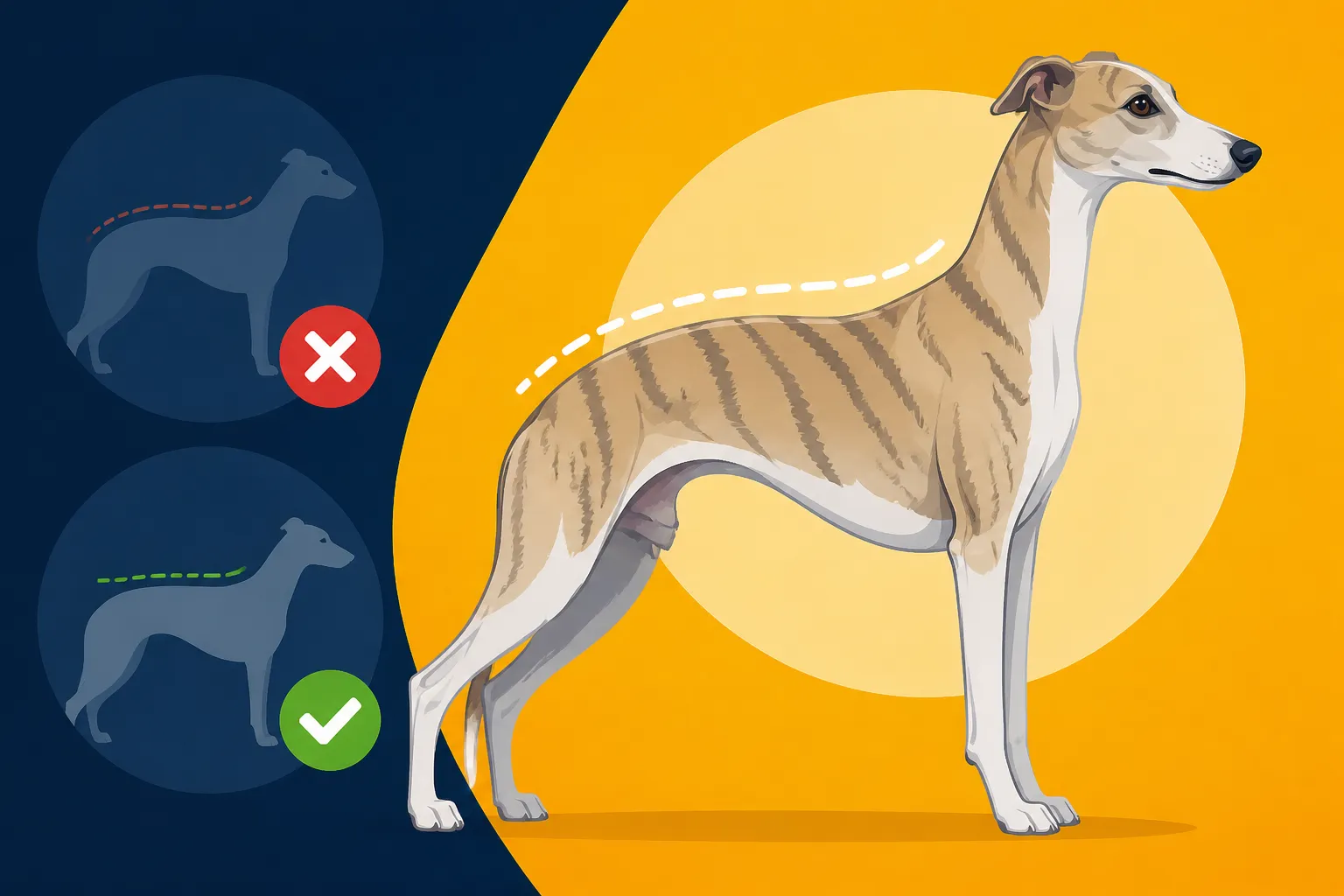
The most distinguishing feature of the Whippet's topline is the graceful arch, often referred to as a "roach" or "arch over the loin." This arch is not meant to be extreme or start immediately behind the shoulders. Instead, the standard describes it as rising gradually over the loin and then gracefully curving into the set-on of the tail. It's a smooth, continuous line, a testament to the seamless integration of muscle and bone that provides power. What the Whippet Standard Says About the Arch details this further, emphasizing the flow and proportion of the curve.
This arch acts like a flexible bow, loading and releasing kinetic energy with each stride. When the Whippet runs, its spine flexes and extends dramatically. The arch allows for a greater degree of flexion, enabling the hind legs to reach further forward under the body, which then pushes off with immense power. This creates the incredible elastic spring that gives Whippets their distinctive and efficient double-suspension gallop. It's not a rigid arch but a dynamic one, constantly changing shape with movement, storing energy and then explosively releasing it.
Crucially, this arch should not be confused with a "wheel back" or "hump back," which would indicate structural fault or weakness. A correct Whippet roach is fluid, proportional, and merges smoothly with the rest of the dog's anatomy, never appearing abrupt or exaggerated. It's a sign of strength and flexibility, not a weakness that could lead to discomfort or injury over time.
The Level Back Myth
One of the biggest misconceptions about the Whippet's back is that it should be flat or level. This is absolutely incorrect and a departure from the breed standard. While many breeds value a level topline for stability in certain working capacities, for a sighthound designed for explosive speed, a level back would be a severe structural disadvantage. It would limit the crucial spinal flexion and extension necessary for their unique gait, hindering their ability to perform.
A Whippet with a truly level back would struggle to achieve the same powerful, ground-covering stride as one with a proper arch. Imagine trying to run a sprint race with a stiff, inflexible spine; it would be awkward and inefficient. Similarly, a level-backed Whippet would expend far more energy to achieve less speed, putting unnecessary strain on its joints and muscles. This is why breeders who adhere strictly to the standard understand that a level topline is a fault, not a desirable trait. Whether a Flat Backed Whippet Is Faulted explores this concept in more depth, underscoring its impact on their athleticism.
It's important for prospective owners and even some casual judges to understand this distinction. A dog that appears to have a level back might look "normal" to someone unfamiliar with sighthound conformation, but it’s actually a deviation from what makes a Whippet a superior athlete. This is why knowledgeable Whippet enthusiasts pay such close attention to this specific detail when evaluating a dog.
The Importance of the Tuck-Up
While not strictly part of the topline itself, the Whippet's deep tuck-up is intrinsically linked to the overall silhouette and functional efficiency, playing a crucial role in how the topline appears and performs. The tuck-up refers to the significant upward curve of the abdomen, rising sharply from the bottom of the ribcage towards the loin. This creates a distinctive, wasp-waisted appearance that is characteristic of sighthounds.
A pronounced tuck-up provides several functional advantages. Firstly, it reduces overall body weight and minimizes resistance during high-speed movement. Less bulk in the abdominal area means less drag, allowing the dog to be more aerodynamic, cutting through the air with greater ease. Secondly, and perhaps more importantly in relation to the topline, a deep tuck-up allows for maximum clearance of the hind legs during the extreme flexion phase of the gallop. This prevents interference between the powerful hindquarters and the abdomen as the legs swing far forward under the body, facilitating a longer stride. Whether a Whippet's Tuck Up Can Be Too Deep might be helpful here for those wondering about the perfect proportionality.
Combined with the arched loin, the tuck-up contributes to the Whippet's remarkable flexibility and athleticism. It completes the picture of a body specifically adapted for explosive acceleration and agile turns. A Whippet lacking this deep tuck-up would not only look less typical of the breed but would also be functionally compromised in its characteristic movement, making their signature gait less efficient.
The Biomechanics Behind the Arch: A Spring for Speed
The Whippet's arched topline isn't just an arbitrary aesthetic; it's a marvel of natural engineering, a key component in its extraordinary speed and agility. This specific conformation allows for highly efficient locomotion, transforming the dog's body into a powerful, spring-loaded mechanism. Understanding the biomechanics reveals the true genius of the Whippet's design.
How the Topline Contributes to Gait and Stride
The defining gait of a Whippet, especially during a full sprint, is the double suspension gallop. This is where all four feet are off the ground twice during each stride cycle – once when fully extended, and once when gathered under the body. The arched topline is absolutely critical for achieving this spectacular motion. As the dog gathers its body for the powerful push-off, the arch allows the spine to flex dramatically, bringing the hind legs far forward, almost underneath the chest. This flexion stores elastic energy in the muscles and ligaments of the back and loin.
Then, as the dog extends its body, this stored energy is released, propelling the hind legs powerfully backward and driving the dog forward. The arch straightens and then reforms, acting like a spring that is compressed and then released. This incredible flexibility and power in the back are what allow a Whippet to achieve such an astonishing stride length and explosive acceleration. Without that particular arch, the ability to store and release energy in this way would be severely hampered, making their stride less efficient and their speed diminished. It's a fundamental part of How Fast a Whippet Actually Runs.
This isn't just about straight-line speed either. The flexibility provided by the arched topline also aids in agility, enabling quick changes of direction and tight turns, which are vital when chasing a live or artificial lure. The ability to coil and uncoil rapidly is paramount for these maneuvers, allowing them to adjust their trajectory instantly.
The Role of the Spine and Muscles
The Whippet's spine is not a rigid structure; it's a highly flexible column, especially in the thoracic and lumbar regions. The muscles surrounding this spinal column – particularly the powerful muscles of the loin and hindquarters – are designed to work in conjunction with the arched shape. When the Whippet's spine flexes into a deeper arch, these muscles stretch and load with potential energy, similar to a stretched rubber band. This elasticity is crucial for efficient movement.
As the dog extends, these muscles contract explosively, providing immense propulsive force. The specific conformation of the vertebrae and the attachment points of these muscles are all optimized for this dynamic flexing action. It's a synergistic relationship: the bone structure provides the framework for the arch, and the musculature provides the power and control to utilize that arch effectively. A Whippet with a well-developed, correctly conformed topline will exhibit strong, supple musculature along its back, visibly contracting and expanding with each powerful bound.
This interplay ensures not only peak performance but also helps distribute stress across a wider area, rather than concentrating it on a single point. This inherent design protects the spine and associated soft tissues during the high-impact activity of sprinting, contributing to the dog's overall soundness and well-being throughout its life.
Why a Flat Back is a Disadvantage
In contrast to the functionally superior arched topline, a flat or level back in a Whippet is a significant disadvantage, hindering its natural athleticism and potentially leading to health issues. A flat back restricts the degree of spinal flexion and extension necessary for the double suspension gallop. Without the ability to effectively coil and uncoil, the dog cannot generate the same explosive power from its hindquarters, compromising its genetic blueprint.
This results in a shorter, less efficient stride, requiring the dog to take more steps to cover the same distance, thus expending more energy for less speed. It's like trying to jump without bending your knees – you lose all the spring and power. Furthermore, a flat back can concentrate impact forces more directly on the spinal column, as there's less flexibility to absorb shock. Over time, this can lead to increased wear and tear on the vertebrae and intervertebral discs, potentially predisposing the dog to back pain or injuries.
For a breed whose entire identity is built around speed and effortless movement, a flat back fundamentally compromises their ability to be a Whippet as nature intended. It diminishes their athleticism and goes against generations of selective breeding for functional excellence. This is why the standard is so uncompromising on this point, recognizing that form truly dictates function for this swift sighthound.
Health Implications of an Incorrect Topline
While the visual appeal of a correctly arched topline is undeniable, its importance extends far beyond aesthetics and athletic performance. An incorrect topline can have profound health implications for a Whippet, affecting its comfort, longevity, and susceptibility to injury. Breeders striving for healthy, long-lived dogs pay close attention to this structural detail for these crucial reasons.
Potential for Injury and Stress
A Whippet's body is a finely tuned instrument, and if one part is structurally unsound, it can create a ripple effect of strain and injury throughout the musculoskeletal system. A topline that is too flat, too exaggerated, or improperly constructed can significantly increase the risk of injury, especially for a dog that loves to run and play hard. Without the natural "spring" of a correct arch, the spine absorbs more direct impact during running, jumping, and sudden stops. This can lead to stress fractures, muscle strains, or even more serious spinal issues like disc problems.
For example, a Whippet with a relatively flat back might experience increased stress on its lumbar vertebrae and the muscles surrounding them, as these areas are forced to compensate for the lack of natural flexibility. This compensation can lead to chronic soreness, inflammation, and a higher propensity for muscle pulls, particularly in the hindquarters. Similarly, an overly exaggerated or abrupt arch could also lead to issues, creating uneven stress distribution and potentially pinching nerves or causing disc problems over time.
Think about a bridge: if it’s designed with the wrong curve or support, it becomes prone to collapse under stress. A Whippet's back is no different. It needs the right architecture to handle the extreme forces it's subjected to during its characteristic bursts of speed and agility.
Impact on Longevity and Comfort
The long-term comfort and lifespan of a Whippet can also be significantly impacted by its topline. A dog that experiences chronic pain or recurrent injuries due to poor conformation is unlikely to live as comfortably or as long as one with a sound structure. Persistent pain can lead to a reduced quality of life, diminished desire to exercise, and a need for ongoing veterinary care, which can be both emotionally and financially draining for owners.
Imagine an older Whippet trying to navigate stairs or jump onto the sofa with a constantly aching back. It profoundly affects their daily joy and ability to participate in family life. While The Twelve to Fifteen Years a Whippet Lives is typical, structural problems can unfortunately shorten that lifespan or at least reduce the quality of those later years, making simple movements a chore rather than a pleasure. A dog with structural issues might develop premature arthritis in its spine or hips, for instance, limiting its mobility and enjoyment of life far earlier than a properly built dog.
Reputable breeders aim to produce dogs that are not only beautiful and perform well but can also enjoy a full, active, and comfortable life into their senior years. A correct topline, therefore, is an investment in the dog's future health and happiness, helping to ensure they can continue to be those forty-mile-an-hour couch potatoes we all adore, free from preventable structural pain.
Assessing a Whippet's Topline: For Owners and Breeders
Whether you're a prospective puppy owner, a seasoned Whippet enthusiast, or a breeder, understanding how to assess a Whippet's topline is a valuable skill. It helps you recognize good conformation, appreciate the breed standard, and make informed decisions about health and breeding. It’s not about being overly critical, but about recognizing the hallmarks of a healthy, functional Whippet that aligns with the breed's historical purpose.
What to Look For in a Puppy
Assessing a Whippet puppy's topline requires a keen eye, as their bodies are still developing. While the full arch won't be as defined as in an adult, you should still be able to see the beginnings of that graceful curve. Look for a topline that rises gently over the loin, rather than appearing completely flat or having an abrupt, humped appearance. The overall impression should be one of fluidity and balance, suggesting healthy growth and development. A puppy that looks disproportionately long or short in the body, or whose back seems stiff, might be a cause for closer inspection.
Beyond the visible curve, pay attention to how the puppy moves. A well-constructed puppy will move freely and easily, with no stiffness or awkwardness in its back. Watch them trot and canter – their back should engage dynamically, not remain rigid. While it’s hard to predict exact adult conformation in a very young puppy, experienced breeders often have a good sense of how a puppy's structure will mature. They often emphasize slow growth to ensure proper joint and bone development, which indirectly supports a healthy topline. Raising a Whippet Puppy Without Wrecking Its Joints discusses this important aspect of puppy care.
It's always a good idea to see both parents if possible, or at least photos and videos, to get an idea of the genetic predisposition for topline and overall structure. Discuss this openly with the breeder, as they should be able to explain why their puppies possess certain structural qualities in relation to the breed standard.
Evaluating an Adult Whippet's Conformation
Evaluating an adult Whippet's topline is where the nuances of the standard truly come into play. A mature Whippet should exhibit that characteristic arch over the loin, flowing smoothly from behind the withers and gently descending towards the tail set. The highest point of the arch should be over the loin, not directly behind the shoulders (which would be a humped back) and certainly not a flat plane. The ribs should be well-sprung, and the tuck-up should be deep, complementing the arch and completing the picture of athleticism.
To properly evaluate, observe the dog from the side while it's standing naturally, not posed. Its head should be up, and its weight distributed evenly. Then, watch the dog move at a walk and a trot. Does the back move fluidly? Does the arch engage and release? A good topline will be evident in the dog's effortless, ground-covering stride and powerful rear drive. Any stiffness, lack of flexibility, or awkwardness in movement can be a red flag. When considering feeding or general care, even a place like Chewy might highlight products that support overall skeletal health, which indirectly benefits the topline by maintaining good condition.
A good way to visualize the standard is to look at images of champion Whippets or ask experienced mentors to point out the features. Don't be afraid to ask questions. Understanding the subtleties is part of appreciating the breed's unique design and its functional excellence.
The Difference Between a Show Topline and a Performance Topline
Sometimes, new owners hear about "show lines" versus "racing lines" or "performance lines" in Whippets and wonder if the ideal topline differs between them. While there might be subtle differences in emphasis or interpretation, the fundamental principles of the Whippet standard for the topline are the same, rooted in optimal functionality for speed and agility. Both endeavors ultimately seek a sound, efficient dog.
Nuances in Interpretation and Practicality
In the show ring, judges are looking for a Whippet that closely adheres to the written breed standard, which includes a specific description of the topline. This means they are seeking that elegant arch over the loin, combined with proper angles, muscle development, and overall balance. A show Whippet's topline is assessed both in repose (standing) and in motion (trotting around the ring). The emphasis is on a harmonious picture of elegance and athletic potential, where every part of the dog contributes to its overall functional beauty.
However, in the field, whether it's lure coursing, racing, or Fast CAT, the ultimate test is performance. While a sound structure is critical, minor deviations that don't impede speed or agility might be overlooked if the dog is exceptionally fast. A racing Whippet might carry a fraction more muscle, which can subtly alter the visual presentation of the topline compared to a show dog conditioned for a different aesthetic, but the underlying mechanics are still there. Whether a Show Whippet Can Still Race delves into how these lines intertwine, often showing that excellence crosses disciplines.
The reality is that a truly functional topline, one that allows for explosive speed and effortless movement, will naturally be a beautiful topline. The best show Whippets are often also excellent performers, demonstrating that the standard's requirements for structure are inherently functional and not just for looks.
How Form Dictates Function in the Ring vs. the Field
The adage "form dictates function" is particularly true for Whippets and their topline. In the show ring, a judge evaluates the "form" – the dog's physical structure – and mentally assesses its potential "function." A correct topline signals to the judge that this dog possesses the anatomical tools for peak sighthound performance. It suggests power, flexibility, and efficiency, all crucial for the breed's purpose.
In the field, it's the "function" itself that is on display. A Whippet with a correct topline will visibly demonstrate its advantages through its speed, agility, and endurance during a chase. The fluid extension, the powerful drive, the tight turns – these are all manifestations of a well-constructed back at work, showing the practical application of the standard. A dog with a less-than-ideal topline might still run, but it will likely be less efficient, slower, or more prone to fatigue and injury, regardless of its desire to chase. Why a Whippet Enjoys Racing is a good read if you're interested in their drive and how it interacts with their physical capabilities.
Ultimately, the best Whippets, regardless of whether their primary focus is showing or performance, will possess a topline that allows them to excel in their natural abilities. The standard exists to preserve these functional attributes, ensuring that the Whippet remains the incredible athlete it was bred to be, capable of both beauty and breathtaking speed.
Common Misconceptions About the Whippet Topline
Despite the clear directives in the breed standard, the Whippet topline is often misunderstood, even by those who love the breed. These misconceptions can lead to incorrect assessments of a dog's conformation and a misunderstanding of what constitutes a healthy, functional back. Let's clear up some of these common errors that often crop up in conversations among owners.
The "Too Much Arch" Fallacy
One prevalent misconception is that "more arch is always better," or conversely, that any noticeable arch is "too much." Neither of these is accurate. The Whippet standard calls for a gradual arch over the loin, smoothly curving into the tail set. It's about proportionality and fluidity, not an exaggerated hump. A topline that is too abrupt, too high, or starts too far forward (often referred to as a "wheel back" or "roach back" in a negative sense) is actually a fault, indicating an imbalance rather than superior structure.
An overly arched back can be as detrimental as a flat one, leading to structural imbalances. It might indicate weakness in the core muscles or an improperly angled pelvis, both of which can compromise spinal integrity and flexibility. Such a dog might struggle with extension, or experience undue strain on its vertebrae and ligaments, potentially leading to pain or injury. The ideal is a balanced arch that is strong and flexible, enabling dynamic movement without compromising stability. It's about the right amount, in the right place, not simply "more" for the sake of it.
This nuanced understanding is crucial for breeders aiming for sound conformation. They are not chasing the biggest arch, but the correct arch, as defined by the standard and validated by functional performance and the overall health of the dog.
Confusing Roaching with Poor Posture
Another common error is confusing a correct, natural topline arch with poor posture or a dog tucking its tail, especially when nervous or cold. A Whippet, like many sighthounds, can sometimes "tuck up" or lower its back when feeling anxious, cold, or submissive. This might temporarily give the impression of an exaggerated or incorrect arch. However, this is a behavioral response, not a structural one, and will typically resolve once the dog is comfortable and warm.
When assessing a topline, it’s vital to observe the dog when it is relaxed, confident, and standing naturally. Its natural stance will display its true conformation. If a dog is hunched, shivering, or appears uncomfortable, its posture can temporarily distort the appearance of its back, making it seem more arched than it truly is, or even making a correct arch look like a fault. Telling a Cold Whippet From a Nervous One is an interesting read here, explaining how their physical responses can sometimes be misinterpreted.
Experienced Whippet owners and judges learn to differentiate between a dog's temporary posture and its underlying skeletal structure. It requires patience and observation to see the dog in its most natural, uninhibited form to truly evaluate its topline according to the breed standard, rather than being swayed by transient emotional or environmental factors.
Living with a Whippet: When the Topline Becomes Real Life
Beyond the show ring and the race track, the Whippet's unique topline has practical implications for everyday life. Understanding its significance helps owners provide the best care, support their dog's natural athleticism, and recognize when something might be amiss. It’s about more than just looking good; it’s about enabling a full, happy, and healthy life for your beloved Whippet, ensuring their unique structure is well-supported.
Supporting Your Whippet's Natural Structure
A Whippet's naturally flexible and somewhat delicate spine, combined with its lack of padding and insulation, means that careful consideration for its physical environment is crucial. Providing proper support while resting is paramount. This means offering soft, supportive beds everywhere your Whippet likes to lounge. Hard floors offer no cushioning for their bony prominences or their spine, and can lead to pressure sores on elbows or hips, and discomfort for their back. The Beds a Whippet Owner Keeps Buying is a very relatable topic for many Whippet owners, highlighting the constant search for the perfect comfort.
Consider orthopedic dog beds, memory foam, or even multiple layers of soft blankets. These help to evenly distribute weight, protect joints, and support the natural curve of their spine while they sleep or relax. Even when choosing a crate, make sure it has a thick, comfortable pad. A well-supported spine while at rest aids in recovery from exercise and helps prevent chronic stiffness or discomfort that could impact their topline's health. You can find excellent options for supportive bedding on sites like Chewy, offering a wide range of choices for every budget.
Moreover, be mindful of how your Whippet jumps on and off furniture. While they are agile, repeated high-impact jumps, especially from high places, can put strain on their delicate back. Consider providing ramps or steps for older or smaller Whippets to safely access beds and sofas, minimizing unnecessary impact.
Exercise and Conditioning for a Healthy Back
A healthy topline is not just about genetics; it's also maintained through appropriate exercise and conditioning. Regular, varied exercise that builds core strength and flexibility is vital for supporting the Whippet's back muscles and keeping the spine supple. This doesn't mean constant sprinting (though they love that!). It means a balanced routine that includes brisk walks, controlled trotting, and opportunities for safe, off-leash running in secure areas where they can truly open up and utilize their natural gait.
Activities like lure coursing or Fast CAT, when performed responsibly and with proper warm-ups and cool-downs, are excellent for allowing a Whippet to express its natural athleticism and maintain powerful back musculature. These sports encourage the full flexion and extension of the spine, which is essential for preserving the integrity of their topline. Warming Up a Whippet Before It Runs is key to preventing injury, ensuring their muscles are ready for action.
Just as a human athlete conditions their core, a Whippet benefits from strong core muscles to support its dynamic spine. Avoid excessive, repetitive movements on hard surfaces, which can be jarring. Instead, encourage running on softer ground like grass or sand when possible. A strong, well-conditioned back helps maintain the correct topline, ensuring it remains robust and functional throughout the Whippet's life, allowing them to enjoy their zoomies for years to come.
Choosing Equipment That Respects Conformation
When selecting collars and harnesses for your Whippet, remember their unique anatomy, including their slender necks and deep chests, which are closely related to their topline and overall structure. A standard flat collar can easily slip off a Whippet's narrow head and wide neck, posing a safety risk. A martingale collar is almost universally recommended for Whippets because it tightens gently when pulled, preventing escape without choking the dog. Whether a Whippet Needs a Martingale explains this further, providing insight into why this specific collar style is so important for the breed.
Harnesses can also be tricky. Many harnesses are designed for more barrel-chested breeds and can rub on a Whippet's delicate skin or restrict shoulder movement, which is crucial for their running gait. If a harness interferes with their shoulder articulation, it can alter their natural movement and potentially put strain on their back, impacting their topline's health. Look for harnesses specifically designed for sighthounds or those with a Y-front design that allows for full range of motion without impinging on the shoulder blades.
The right equipment not only ensures your Whippet's safety but also supports their natural conformation, allowing them to move and live without unnecessary restriction or discomfort. Brands available at retailers like Chewy often offer a variety of sighthound-specific collars and harnesses designed with their unique physique in mind, making it easier to find appropriate gear.
Whippet Topline at a Glance
For a quick reference, here's a table summarizing the key aspects of the Whippet's topline:
| Feature | Ideal Whippet Topline | Incorrect Topline (Faulted) | Functional Impact (Ideal) | Potential Issues (Incorrect) |
|---|---|---|---|---|
| Spine/Back Outline | Gentle, continuous arch over the loin. | Flat, straight, or abruptly humped (wheel-back). | Stores and releases elastic energy for powerful gallop. | Restricted spinal flexion, reduced stride, higher impact. |
| Arch Location | Highest point over the loin, flowing from Withers. | Arch starts too far forward, or is evenly flat. | Optimal leverage for hindquarter drive and extension. | Imbalanced forces, inefficient movement, compensatory strain. |
| Flexibility | Supple, dynamic, engages visibly during movement. | Stiff, rigid, or appears fixed. | Allows for extreme spinal flexion and extension. | Limited mobility, increased risk of muscle strains. |
| Overall Impression | Elegant, athletic, balanced, powerful. | Weak, awkward, rigid, or disproportionate. | Efficiency in speed, agility, and endurance. | Reduced performance, discomfort, increased injury risk. |
| Tuck-Up | Deep and well-defined, rising sharply from ribcage. | Shallow or lacking definition. | Aerodynamic, allows hind leg clearance, complements arch. | Increased drag, hind leg interference, less athletic appearance. |
Disclaimer
This article is for general informational purposes only and does not constitute professional advice. Laws, prices and regulations vary by location and change over time. Consult a qualified professional for guidance on your specific situation.