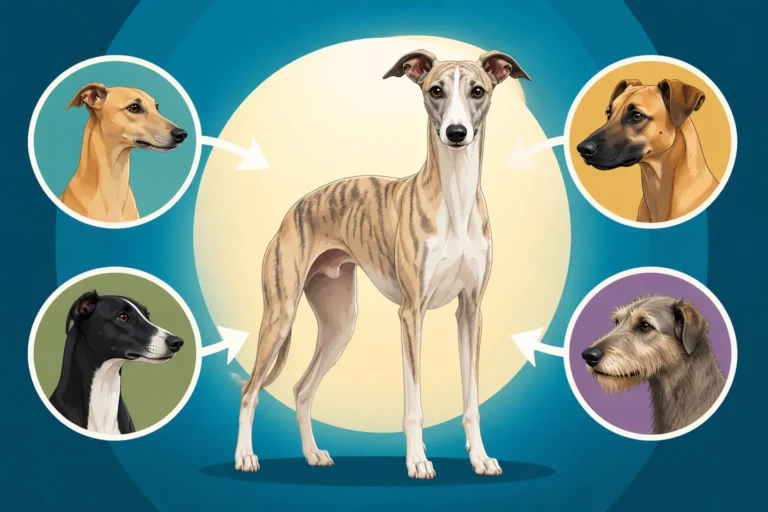
Whether Whippet Markings Are Faulted
A white blaze, brindle patches, or a mostly white coat can make a Whippet look distinctive—and may leave you wondering whether those markings count against the dog in the show ring. In most cases, they do not: Whippet standards allow a broad range of colors and patterns. Here’s how to tell accepted markings from a genuine concern.
Are Whippet markings a fault in the show ring
What the breed standard says about color and markings
For Whippets, coat color and markings are generally not treated as faults under major breed standards. The American standard accepts any color or combination of colors, and the UK standard is similarly broad. That means a Whippet can have white markings, brindle stripes, patches, or a mixture of shades without being disqualified simply for its appearance.
This is one reason two excellent Whippets can look dramatically different. One might be solid fawn, another black with white on the chest, and another mostly white with brindle patches. Those differences are about coat pattern, not proof that one dog is more correct or better bred than the other. For a fuller overview of accepted shades, see Which Colors the Whippet Standard Allows and The Colors a Whippet Comes In.
A standard is a description of the breed’s desired overall structure and type. Judges assess the dog as a whole, including movement, proportions, topline, head, and temperament. A striking pattern may catch the eye, but it does not replace those structural qualities. Likewise, an unusual-looking marking does not automatically make a Whippet a poor example of the breed.
| Marking or coat description | Generally considered a color fault? | What to keep in mind |
|---|---|---|
| White on the chest, feet, or face | No | Common white markings are accepted |
| Brindle stripes or patches | No | Brindle is an established Whippet pattern |
| Mostly white coat with colored patches | No | A white-based pattern is not automatically a fault |
| Solid white coat | No, under broad color standards | White coat color alone does not establish health or ancestry |
| Blue or dilute coloring | Not typically a show fault by itself | Color alone cannot tell you whether a dog is purebred or healthy |
| An unusual pattern such as merle | Not automatically a formal fault everywhere | It is uncommon in the breed and deserves careful questions about ancestry and breeding |
Standards and show rules can differ between organizations and countries, so check the rules that apply to the event you plan to enter. But for an ordinary pet owner, there is no reason to think that a white sock, facial blaze, or patch of brindle makes a Whippet defective.
What judges evaluate instead
A judge does not assess a Whippet by asking whether its coat looks plain enough. The breed standard places much more emphasis on the dog’s balanced, athletic outline and its ability to move efficiently. A dog with accepted markings may still have structural traits that make it less competitive; a dog with a simple, solid coat may be beautifully put together. Color does not cancel out those distinctions.
This can be confusing when people describe a dog as having a “fault.” In everyday conversation, they may mean a feature they personally dislike, a departure from an ideal outline, or a rule specific to a particular show. That is not the same as saying the dog’s color is officially disallowed. If a breeder or exhibitor calls a marking a fault, it is fair to ask which standard or show rule they mean.
The same distinction matters when selecting a puppy. If you want a companion, focus on health, temperament, responsible breeding, and whether the dog suits your home. If you plan to show, ask the breeder about the standards and classes relevant to your region, and discuss the puppy’s overall construction—not just the coat pattern. A marking that photographs beautifully is not a substitute for sound movement or a suitable temperament.
Common Whippet patterns and what they mean
White markings, patches, and mostly white coats
White can appear in small or large areas on a Whippet. A dog might have a narrow blaze between the eyes, a white chest, a few white toes, or broad white areas across the body. A coat that is mostly white with colored patches is often described as parti-colored or piebald. These are descriptions of appearance, not diagnoses and not automatic signs of poor quality.
The word “piebald” can sound alarming if you have only heard it used in connection with other breeds or genetic discussions. In Whippets, a white-based coat with colored patches is simply one of the patterns people may encounter. The pattern itself does not tell you whether the dog is well bred, healthy, or suitable for a particular home. For more detail, see The Piebald Whippet and Whether a Whippet Can Be Solid White.
White fur also does not reliably tell you what the skin underneath looks like. Some pale areas may have more exposed or lightly pigmented skin, while other white-haired areas may not be especially sensitive. If your Whippet enjoys sunbathing by a bright window or lying outside on a warm patio, check the skin rather than assuming that every white patch needs the same care. Ask your veterinarian what protection is appropriate for your dog, especially if the skin becomes red, sore, or irritated.
Brindle, solid colors, and dilute shades
Brindle is a pattern of darker stripes over a lighter base color. It can appear across much of the body or in patches, and the contrast can range from subtle to pronounced. Some brindle Whippets look almost dark from a distance; others have clearly visible stripes. The pattern’s visibility can also change with lighting, coat length, and the dog’s age. Brindle is a familiar Whippet pattern, not a reason to assume the dog is mixed. You can read more at Whether a Brindle Whippet Is Common.
Whippets also come in many solid colors and combinations, including shades commonly described as fawn, red, black, blue, and white. Everyday color labels are not always used consistently: one person’s “cream” may be another person’s very pale fawn, for example. If exact color terminology matters for registration or a show entry, use the wording accepted by the relevant organization rather than relying on a casual description.
Blue is a dilute coat color, generally appearing as a softened or grayish version of black. A blue Whippet is not automatically a crossbreed, and color alone cannot confirm a dog’s pedigree. If someone is selling a dog as “rare” solely because of its shade, treat the sales language cautiously and ask for the same evidence of responsible breeding you would expect for any puppy. Whether a Blue Whippet Is Purebred and What Colors a Whippet Cannot Be offer useful context.
When an unusual marking deserves a closer look
Color is not the same as health or pedigree
Most ordinary markings—white trim, brindle, spots, and mixed colors—are not a cause for concern by themselves. Still, coat appearance can prompt useful questions when a pattern is unusual for the breed or when a seller makes dramatic claims about rarity. Ask about the parents, their health, the breeder’s records, and how the puppy was raised. A responsible breeder should be willing to discuss those details without making color the whole story.
Merle is a good example of why it helps to separate “is this a formal show fault?” from “is this pattern typical of the breed?” Merle is not a usual Whippet pattern. A dog advertised as a merle Whippet deserves careful questions about its ancestry and breeding choices. The pattern alone does not prove a particular pedigree, but it is sensible to ask for documentation and to seek advice from a knowledgeable breed organization or veterinarian rather than relying on a seller’s explanation.
Also pay attention to the dog, not just its coat. A Whippet with normal markings that has a persistent skin rash, itchy patches, sores, or hair loss should be assessed for the actual skin problem. Conversely, a healthy Whippet with an unusual-looking patch is not necessarily unwell. Color and health are separate questions, and one should not be used as a shortcut for judging the other.
When color may affect care
A coat pattern rarely changes everyday care on its own. What matters more is the individual dog’s skin, exposure to sun, comfort, and response to weather. If your Whippet has pale or exposed skin, ask your veterinarian whether you should limit direct sun at certain times or use a dog-safe protective option. Never assume that a human sunscreen is suitable for a dog; check with your veterinarian before applying a product.
If you are comparing sun-protective clothing or other basic care items, a retailer such as Chewy may be one place to browse, but read the product details and confirm fit carefully. Whippets have a deep chest and narrow waist, so a garment that fits a broader-bodied dog may rub or slip. The goal is comfortable protection, not buying something just because the dog has a white patch.
You may also see dog sunscreen or protective clothing listed through retailers such as Chewy. Availability and product details can vary, so check the label and discuss ingredients with your veterinarian—especially if your dog licks its coat or has sensitive skin. If the skin looks painful or changes suddenly, skip home experiments and ask a veterinary professional what to do.
Choosing or showing a Whippet with markings
Questions to ask a breeder
If you are choosing a puppy, it is completely reasonable to have a favorite color. Just try not to let the coat pattern crowd out more important questions. Ask how the breeder evaluates health and temperament, what support is available after the puppy comes home, and whether the puppy’s likely adult needs fit your household. A responsible breeder should be able to explain their choices without promising that a particular marking guarantees superior health, speed, or show success.
For a show prospect, ask how the breeder assesses the puppy’s structure and movement and whether they believe the puppy is suitable for the ring. Color may be part of the description, but it should not be the whole explanation. If you are uncertain about a specific pattern, ask the breeder to identify the relevant standard and consult the organization under which you hope to show.
Be wary of sales pitches that call a color “rare” and use that claim to justify an inflated price or pressure you to decide quickly. Rarity is not the same as quality. A puppy should be evaluated as an individual, with clear information about its background and care, rather than treated as a fashion item because its coat photographs well.
How to describe markings accurately
When talking with a breeder, veterinarian, or show organizer, simple descriptions are usually enough: “white blaze,” “white chest,” “brindle patches,” or “mostly white with fawn markings.” If you need an official color entry, check the registration or event guidance instead of guessing. Everyday terms can overlap, and describing what you see is often clearer than trying to assign a technical label.
For a vet visit, mention a marking only if it helps identify the location of a skin concern. “The red spot is on the white patch near her left shoulder” is useful. The coat color itself is not a diagnosis, so include the changes you have noticed—such as itching, pain, swelling, or a change in the skin’s appearance.
In short, Whippet markings are generally accepted across a wide range of colors and patterns. A blaze, white socks, brindle stripes, or large patches do not make a Whippet faulty simply because they are visible. For show questions, confirm the rules for the organization involved; for health questions, focus on the dog’s actual condition rather than the color of its coat.
Disclaimer
This article is for general informational purposes only and does not constitute professional advice. Laws, prices and regulations vary by location and change over time. Consult a qualified professional for guidance on your specific situation.