Whether a Female Whippet Is Much Smaller
It's a really common question, and one that often leads to a bit of head-scratching when you're trying to picture your future companion: are female Whippets significantly smaller than males? You might have heard anecdotes, or maybe you've only seen one or two Whippets in person and are trying to gauge the typical size. This guide will dive deep into the nuances of Whippet size, exploring breed standards, typical variations, and what these differences mean for you as an owner.
Deciphering the Whippet Breed Standard
When we talk about a dog's size, the first place many people look is the breed standard. This is the blueprint, if you will, that breed clubs like the American Whippet Club or The Kennel Club (UK) establish to describe the ideal characteristics of a Whippet, including its size. It's not just about aesthetics; these standards often reflect the historical function and health considerations of the breed.
Official Height Guidelines for Both Sexes
The breed standard for Whippets typically defines a height range rather than a precise number. For males, this range usually falls between 19 and 22 inches at the shoulder, also known as the withers. Females, on the other hand, are generally expected to be a little shorter, often within the 18 to 21-inch range. Now, immediately, you can see there's an overlap. A male at the lower end of his acceptable height might be 19 inches, while a female at the higher end could be 21 inches. This means that, purely by the tape measure, you could easily have a female Whippet who is taller than some males. The standard provides a guideline, an ideal, but it doesn't mean every single Whippet will fit perfectly into the middle of that range, nor that a slight deviation is a flaw. It's more about ensuring the dog retains the athletic build and proportions necessary for its purpose as a swift, agile sighthound.
Think about it like this: just as humans come in a range of heights, so do dogs, even within the same breed. A responsible breeder aims for the middle, but genetic variation is always at play. It's crucial to understand these ranges so you don't get hung up on a specific inch, but rather appreciate the overall picture of a healthy, well-proportioned Whippet.
Understanding the Ideal Weight Range
Unlike height, which is measured quite precisely at the withers, weight in the Whippet standard is often described in terms of condition rather than a specific numerical range. This is because a Whippet's ideal weight is very much tied to its body condition and muscle mass, which can fluctuate with activity levels and individual metabolism. Generally, a male Whippet might weigh anywhere from 25 to 45 pounds, while a female could be 20 to 35 pounds. However, these are extremely broad estimates. What's truly important is that the Whippet is lean, muscular, and athletic, with ribs easily felt but not visibly protruding, and a distinct waistline when viewed from above.
A Whippet that is "too heavy" for its frame is not just carrying extra fat; it could be stressing its joints and compromising its natural athleticism. Conversely, a Whippet that is genuinely "too thin" might lack muscle, indicating undernourishment or an underlying health issue. The weight, therefore, isn't a fixed target but a reflection of the dog's overall health and fitness. When you're assessing a Whippet's weight, it's about looking at the whole picture: their muscle tone, energy levels, and how easily you can feel their bony landmarks. Don't be surprised if a vet, particularly one familiar with sighthounds, gives a different assessment of ideal weight than someone unfamiliar with the breed's naturally lean physique. A good breeder will emphasize health and proper conditioning over hitting an arbitrary number on a scale. You can find more details on this topic in articles like What a Whippet Actually Weighs.
The Importance of Overall Conformation and Balance
Beyond just height and weight, the breed standard places immense importance on overall conformation and balance. This means how all the parts of the dog fit together to create a harmonious and functional whole. A Whippet is built for speed and agility, and its structure reflects this. A male might be slightly broader in the chest or have a more pronounced crest on his neck, giving him a more powerful appearance. A female might appear more refined, with a slightly more delicate bone structure and a more feminine head. However, both sexes should exhibit the classic Whippet outline: a long, muscular neck, a deep chest, a strong back that arches gracefully over the loin, and long, well-muscled hindquarters.
The arch over the loin, often called the "roach," is a signature feature and crucial for powerful propulsion. Why the Whippet Standard Cares So Much About the Topline explains this in detail. A well-balanced Whippet, regardless of sex, will move with grace and efficiency, able to gallop and turn with ease. It's not just about being "big" or "small"; it's about being correctly put together for the job it was bred to do, which, even for a beloved pet, is to be a picture of athletic elegance. When evaluating a puppy or an adult Whippet, always look at the proportions and how they move rather than obsessing over a half-inch difference in height.
The Real-World Size Difference Between Males and Females
While breed standards provide a framework, real-world experience with Whippets often shows a spectrum of sizes within and between sexes. It's rare that you'll see two Whippets, male and female, stand side-by-side and immediately declare a drastic size disparity. The differences are typically subtle and can often be overshadowed by individual variation.
The General Rule: Males Tend to Be Larger
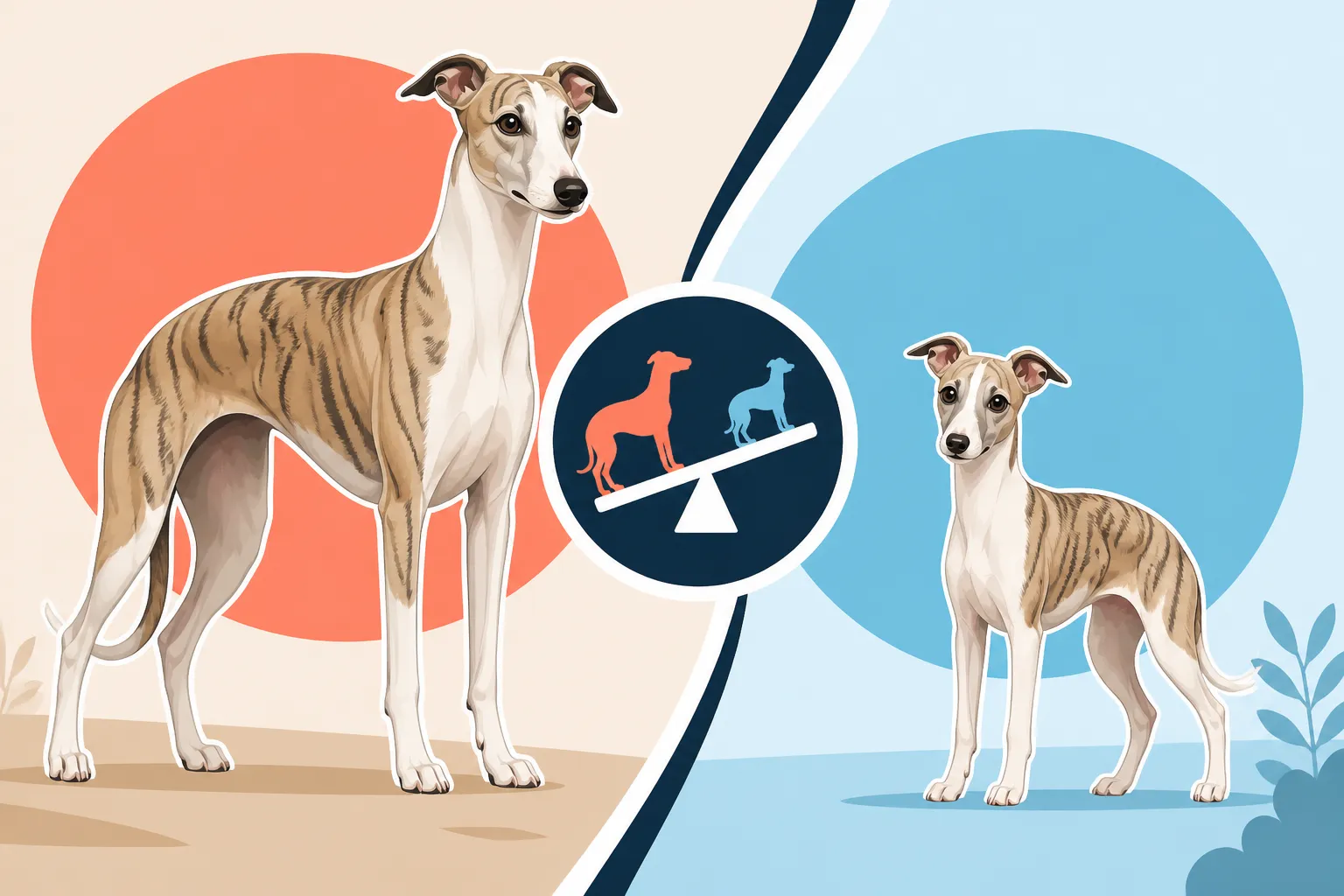
Yes, as a general rule, male Whippets do tend to be a touch larger, taller, and heavier than their female counterparts. You might notice that a male typically has a more substantial frame, with slightly heavier bone and a bit more muscle mass, particularly across the shoulders and neck. This is a common pattern across many dog breeds, often related to sexual dimorphism where males are built to be more robust. If you're comparing two Whippets from the same litter, raised in the same environment, the male puppy will usually mature into a slightly larger adult.
For instance, you might encounter a lovely male Whippet at 21 inches tall, weighing in at a fit 38 pounds. His sister, from the same litter, might be 20 inches and 30 pounds. This difference, while noticeable when they stand together, is not so profound that it makes them feel like different breeds. The "larger" aspect often manifests as a bit more substance and presence rather than a dramatic increase in height or bulk. It's important to keep this general tendency in mind, but also be prepared for exceptions, which are quite common in the Whippet world.
Where the Sizes Overlap: When a Female Isn't "Small"
Here's where it gets interesting and sometimes confounds expectations: there's a significant overlap in the size ranges of male and female Whippets. It's entirely possible, and not at all uncommon, for a well-grown female Whippet to be larger than a smaller, more finely built male. Imagine a robust female from a strong line, perhaps one bred for performance, standing at 21 inches and a solid 34 pounds. Now picture a male from a more petite lineage, maybe only 19 inches and 30 pounds. In this scenario, the female is unequivocally larger.
This overlap is due to several factors, including genetic predispositions, individual growth rates, and even the "type" of Whippet. Some lines are known for producing larger dogs overall, while others might consistently produce smaller ones. So, if you have your heart set on a specific size, whether larger or smaller, it's far more important to look at the size of the parents and grandparents, and consider the individual puppy's projected growth curve, rather than relying solely on its sex. A good breeder can usually give you an idea of a puppy's likely adult size based on its pedigree and their experience. The idea that all females are dramatically smaller is a myth that often gets dispelled once you've spent time around a variety of Whippets.
Key Factors That Shape a Whippet's Final Size
While genetics lays the foundation, a Whippet's eventual size isn't solely determined by whether it's male or female. Several other critical factors play a significant role in how large, or small, your Whippet will ultimately become. Understanding these can help you better appreciate the variation you see within the breed.
The Blueprint: Genetics and Lineage
Genetics is the primary driver behind your Whippet's potential adult size. Just like us, a Whippet inherits its physical traits from its parents. If both parents are on the smaller end of the breed standard, their puppies are likely to follow suit. Conversely, if the parents are larger, you can expect the puppies to have the potential to be larger as well. Reputable breeders are keenly aware of the size and conformation of their breeding stock and can give you a good estimate of what to expect.
Beyond immediate parentage, the specific "lineage" of a Whippet can also influence size. Some breeding programs, for instance, might focus on producing dogs closer to the maximum height and substance allowed by the standard, often for show ring presence. Others might prioritize a slightly smaller, more compact dog for certain performance events. The historical purpose also played a role; early Whippets were bred for speed and agility, not necessarily bulk. If you look at How Show Whippets Differ in Size From Racing Whippets, you'll see how even within the breed, different focuses can lead to subtle variations. A puppy's genes will largely dictate its growth plates' potential and how tall or stout it can become.
Fueling Growth: Nutrition and Exercise
Proper nutrition during a Whippet's growth phase is absolutely vital for healthy development and reaching its genetic potential. Overfeeding a puppy in an attempt to make it "bigger" can actually be detrimental, potentially leading to rapid growth that stresses developing joints and bones. Similarly, underfeeding or providing inadequate nutrition can stunt growth and impact overall health. A high-quality puppy food, appropriate for their size and activity level, is essential. Your vet can provide specific feeding guidelines, but generally, steady, consistent growth is preferred over fast, explosive gains.
Exercise also plays a role, though perhaps not as directly on final size as on muscle development and bone density. Too much strenuous exercise too early in life can be harmful to a growing Whippet's joints. Whippet puppies need plenty of appropriate play and opportunities to run, but forced, long-distance running or high-impact activities should be avoided until their growth plates have closed. This typically happens around 12-18 months of age, but can vary. A well-exercised Whippet will be lean and muscular, which can make them appear larger due to good condition, even if their skeletal size is within the standard. You might want to read Whether a Whippet Puppy Should Grow Slowly for more on healthy development.
Hormonal Influences: The Role of Spay/Neuter
The timing of spaying or neutering can subtly affect a Whippet's final adult size, particularly its height. If a Whippet is spayed or neutered before puberty (often around 6-12 months of age), when their growth plates are still open, the removal of sex hormones can delay the closure of these plates. This can result in the long bones growing for a slightly longer period, potentially leading to a dog that is a tiny bit taller than they would have been if left intact or altered later. This isn't a dramatic difference, usually an inch or less, but it's a measurable one that some owners and veterinarians consider.
Beyond height, these hormonal changes can also impact body composition. Neutered dogs, both male and female, can have a tendency to gain weight more easily due to changes in metabolism and activity levels. This doesn't make them "bigger" in the skeletal sense, but they might appear heavier or stockier if their diet and exercise aren't adjusted accordingly. Weight Gain in a Neutered Whippet touches on this important consideration. Discussing the optimal timing for spay/neuter with your veterinarian, taking into account breed-specific considerations, is always a good idea.
Practical Considerations for Living with a Whippet of Any Size
Regardless of whether you end up with a male or female, or one on the larger or smaller end of the spectrum, living with a Whippet comes with specific considerations. While size differences between sexes are often subtle, they can still influence day-to-day choices about gear, home setup, and how you interact with your beloved sighthound.
Outfitting Your Whippet: Collars, Coats, and Beds
When it comes to outfitting your Whippet, whether male or female, specific considerations for sighthounds generally outweigh the subtle differences between sexes. However, if you have a particularly petite female or a very substantial male, you'll certainly notice the need for different sizes in accessories. For collars, all Whippets, regardless of sex, benefit from a martingale collar because of their slender necks that are wider than their heads, preventing them from slipping out. A large male might need a 14-16 inch martingale, while a petite female might be comfortable in a 12-14 inch. Whether a Whippet Needs a Martingale delves into this in more detail.
Coats are another big one, as Whippets notoriously lack body fat and insulation. While both sexes will need coats in cooler weather, a larger male might fill out an "L" more robustly than a smaller female. Again, it's about individual measurements rather than simply labeling by sex. Many owners find brands that cater specifically to sighthound body shapes, with deeper chests and narrower waists. You might find a great selection of coats and other accessories on sites like Chewy that offer diverse sizing to accommodate the unique Whippet physique, from petite females to more muscular males. Which Coat Brand Fits a Whippet's Deep Chest can help guide your choices. Even for beds, while all Whippets love soft, plush surfaces, a larger male might appreciate a slightly bigger bed to sprawl out on.
Space Planning: Fitting a Whippet into Your Home
One of the wonderful things about Whippets is their adaptability to various living situations. Whether male or female, their "40-mile-an-hour couch potato" reputation means they are generally quite content to curl up indoors, even in smaller spaces, provided they get their bursts of outdoor exercise. So, in terms of sheer floor space, the difference between a male and female Whippet is usually negligible. A 30-pound female and a 40-pound male aren't going to significantly alter your furniture layout.
However, if you're living in a tiny apartment, a slightly smaller female might feel marginally less "present" than a larger male when they're stretched out on the sofa or trying to navigate a narrow hallway. More importantly than their sex is their individual personality and energy level, which can vary wildly. A more active female might feel larger in a small space than a calm, sleeping male. The key takeaway is that both sexes are generally excellent apartment dwellers. Whether a Whippet Suits an Apartment further explores how well these dogs integrate into various home environments, emphasizing that their size is rarely the limiting factor for living comfortably in close quarters.
Handling and Perceptions of Fragility
Whippets, by their very nature, are elegant, fine-boned, and have delicate skin. This can lead to a common perception that they are fragile, and while they are not as robust as some bully breeds, they are far from "glass" dogs. A male Whippet, being slightly larger and often more muscular, might project an image of being less delicate, but their skin is just as thin and prone to tears as a female's. Conversely, a smaller female isn't necessarily more fragile simply because of her size.
Both sexes require careful handling, particularly around children, and caution when playing in rough terrain where their thin skin can easily be cut or bruised. The Thin Skin That Sends a Whippet to the Vet for Stitches is a must-read for any Whippet owner. It's not the sex that dictates fragility, but the inherent characteristics of the breed. Teaching children how to interact gently with a Whippet, regardless of its sex, is crucial. Moreover, when picking up a Whippet, always support their long bodies properly to avoid injury, especially to their backs. The perception of fragility often has more to do with their lean physique than their actual robustness for their build. Whether a Whippet Is Fragile Around Children offers more guidance on this sensitive topic.
Comparing Male and Female Whippet Characteristics
To provide a clear picture, let's look at some typical comparisons between male and female Whippets. Remember, these are generalizations, and individual dogs will always vary.
| Characteristic | Typical Male Whippet | Typical Female Whippet |
|---|---|---|
| Height (at withers) | 19-22 inches (48-56 cm) | 18-21 inches (46-53 cm) |
| Weight | 25-45 lbs (11-20 kg), well-muscled and lean | 20-35 lbs (9-16 kg), well-muscled and lean |
| Build/Bone | Generally slightly heavier bone, more muscular | Often more refined bone, slightly less muscle mass |
| Head Shape | Can appear slightly broader or more masculine | Typically more refined and delicate, feminine |
| Temperament | Can be a bit more boisterous or "goofy" | Often perceived as slightly more independent or reserved |
| Hormonal Influence | Intact males may mark more, higher drive initially | Intact females have heat cycles, potential for phantom pregnancies |
It's important to reiterate that these are typical observations. You will find sweet, reserved males and boisterous, playful females. The overall Whippet temperament – gentle, affectionate, quiet indoors, and prone to bursts of speed outdoors – holds true for both sexes.
The Overall Whippet Experience: Beyond Size
Ultimately, the decision to bring a male or female Whippet into your home should not hinge primarily on a few inches difference in size. While males tend to be a little bigger and heavier, the overlap is significant enough that individual variation often trumps sex as a determinant of overall size.
What truly matters is the individual dog's personality, its health, and how well it integrates into your lifestyle. Both male and female Whippets offer the same wonderful traits: they are loyal, affectionate, clean, relatively quiet, and wonderfully athletic. They make superb companions for active individuals and families, thriving on companionship and a comfortable spot on the sofa.
Spend time getting to know individual puppies or adult Whippets if you have the opportunity. Talk to experienced breeders and owners about their experiences with both sexes. A good breeder will match you with a puppy based on temperament and your lifestyle, rather than simply its sex or size. Whether you choose a male or a female, you'll be welcoming a loving, elegant, and speedy sighthound into your life, bringing immense joy and, no doubt, prompting many inquiries about their svelte form.
Disclaimer
This article is for general informational purposes only and does not constitute professional advice. Laws, prices and regulations vary by location and change over time. Consult a qualified professional for guidance on your specific situation.