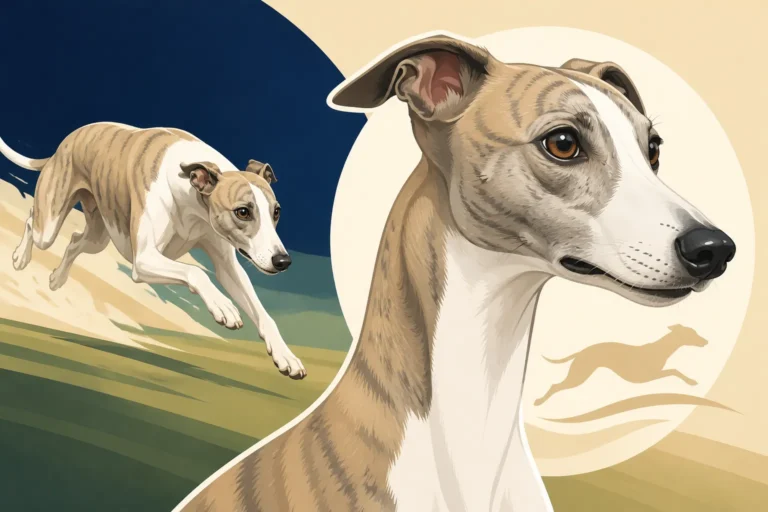
How Show Whippets Differ in Size From Racing Whippets
A show Whippet may look taller, heavier, or more substantial than a racing Whippet, but there is no single size that defines every dog in either group. Show breeding follows a conformation standard; racing breeding prioritizes athletic performance within a particular racing community. This guide explains what those differences mean—and how to compare individual Whippets fairly.
What size means in a Whippet
Height, weight, and build are different measurements
When people ask whether show Whippets are bigger than racing Whippets, they may mean height, weight, bone, muscle, or the overall impression a dog makes. Those aren’t interchangeable. A Whippet can stand taller but remain lean, or weigh more because of muscle and frame without looking bulky.
In dog shows, height is assessed at the withers, the point where the shoulder blades meet the neck. Breed standards set acceptable height ranges, though the exact figures depend on the kennel organization and country. A show judge looks at more than the number on a measuring stick: the dog’s outline, proportions, movement, and balance all matter. For a broader overview of height and proportions, see How Tall a Whippet Stands.
Weight is a less straightforward comparison. A scale reading can change with a dog’s sex, frame, muscle, age, conditioning, and even how recently the dog ate. Whippet standards generally emphasize a sound, athletic shape rather than one ideal weight for every adult. That’s why a single number rarely tells you whether a dog is correctly built or in good condition. What a Whippet Actually Weighs explores the factors behind those differences.
The show standard is a guide, not a target to overshoot
A show-bred Whippet is selected to fit the breed standard, which describes an elegant, balanced sighthound—not a dog that should be made as large or heavy as possible. A breeder aiming for the show ring considers the whole dog: structure, movement, temperament, and how closely the dog fits the standard. Being at the upper end of a height range does not automatically make a dog better.
Sex can influence average size, but it does not create a simple rule that every male is larger than every female. Individual dogs overlap, and a tall female may be bigger than a smaller male. The relevant standard may also set different height ranges for males and females. For details on that overlap, see Whether a Female Whippet Is Much Smaller.
A show Whippet should not be judged as “too big” merely because it looks more substantial than a particular racing dog. Nor should a racing Whippet be considered undersized just because it differs from the dog someone is used to seeing in a show ring. To compare fairly, identify what you’re comparing: height at the withers, body weight, or overall structure.
How show and racing breeding shape size
Show breeding prioritizes conformation
Show breeders select dogs with the aim of producing offspring that meet the breed standard and can move soundly. Size is part of that picture, but it is not the only goal. A well-made show Whippet should look athletic and balanced, not exaggerated in either direction.
A dog’s appearance can also give a misleading impression of its actual size. A deeper chest, longer-looking legs, a strong topline, or well-developed muscle may make one Whippet seem larger beside another, even when their measured heights are close. Coat color and markings can affect the visual impression, too. Stand two dogs side by side and the more substantial-looking one may not be the taller one.
Show lines are not a single uniform type. Different families and breeders can produce dogs that vary in height, bone, and build while still aiming for the same general standard. That variety is one reason it’s more useful to look at a particular dog’s measurements and structure than to assume all show Whippets share one size.
Racing breeding prioritizes performance, not a single overall size
“Racing Whippet” covers dogs bred and trained within different racing traditions. There is no universal racing size that applies to every club, country, or type of competition. Rules and race formats can vary, and some settings may group or handicap dogs in ways that account for size or weight. Others may focus on different competition requirements.
Breeders selecting for racing performance may pay close attention to speed, drive, soundness, and the physical traits that support a dog’s work. That does not necessarily mean selecting only smaller dogs. Racing Whippets can vary in height, frame, and muscle, just as show dogs do. A lean appearance may be associated with conditioning and body composition rather than a fundamentally smaller skeleton.
The difference between the two populations is better understood as a difference in breeding priorities than a fixed size divide. The Split Between Racing and Show Whippets gives more context on how those breeding purposes developed. And the relationship is not an absolute either-or: Whether a Show Whippet Can Still Race addresses how a show-bred dog may take part in racing.
Comparing the two types fairly
Use measurements and condition rather than first impressions
If you’re comparing two Whippets, start with the basics. Measure height at the withers using a consistent method, and record body weight on a reliable scale. Then look at body condition and structure. Is the dog lean and muscled? Does it have a deeper or broader frame? Is the apparent difference mostly posture or coat and markings? These observations help separate true size from a visual impression.
A Whippet’s ribs may be visible without the dog being unhealthy or underweight. The breed’s naturally lean outline can surprise people who expect a more padded-looking pet dog. On the other hand, “racing fit” should not be used as an excuse to overlook a dog that is losing weight, lacking muscle, or showing signs of illness. Body condition should be assessed for that dog, ideally with guidance from a veterinarian familiar with sighthounds.
When shopping for practical items, use the individual dog’s measurements rather than choosing by “show type” or “racing type.” For a coat, measure the back length, chest, and neck as the maker instructs; a deep chest and tucked-up waist can make standard sizing awkward. Listings on Chewy may include brand-specific sizing charts, so check the garment’s measurements rather than relying only on a weight range. The same goes for a harness: Whippet proportions can make a generic fit loose at the neck or restrictive across the chest. A Chewy product listing can be a useful place to review the manufacturer’s fit guidance, but the dog’s actual measurements should decide the size. If one size seems to fit the chest but not the neck, compare the product’s adjustment range before ordering through Chewy.
| What you are comparing | What to check | Why appearance alone can mislead |
|---|---|---|
| Height | Measure at the withers | Posture and proportions can change how tall a dog looks |
| Weight | Use a reliable scale and consider the dog’s frame | Weight reflects more than height, including muscle and body condition |
| Build | Look at bone, chest, topline, and overall balance | A deeper or more muscular dog may look larger without standing taller |
| Conditioning | Assess muscle and body condition over time | A lean outline can be normal, but health and fitness still matter |
| Equipment fit | Use the maker’s measurement chart | Labels such as “show” or “racing” do not guarantee a good fit |
Avoid treating a broad tendency as a rule
You may meet racing Whippets that look lighter and more sharply conditioned than show Whippets. You may also meet racing dogs that are tall or strongly muscled, and show dogs that are fine-boned and exceptionally athletic. Those examples don’t contradict the general difference in breeding purpose; they show why labels cannot predict an individual dog’s measurements.
It is also worth separating a dog’s size from its ability. A larger dog is not automatically faster, and a smaller one is not automatically better suited to racing. Performance depends on many factors, including sound structure, fitness, training, health, and the dog’s individual ability. Likewise, ring success is not determined by height alone. Whether a Racing Whippet Is Leaner Than a Show One looks more closely at the distinction between body condition and type.
Breeding fashions and personal preferences can influence what people notice, but the standard is not an invitation to keep pushing size upward. When considering claims that Whippets should be bred larger, it helps to ask what evidence supports the claim and whether the dog remains balanced and sound. The Push to Breed Bigger Whippets explores that debate. A Whippet’s curved topline and overall outline are also part of how its structure is understood; What a Whippet's Arch Actually Does provides useful context beyond height alone.
Choosing or evaluating a Whippet by size
If you are choosing a puppy, ask about the family
A puppy’s adult height and weight cannot be predicted precisely from a quick look at its paws or from one parent’s size. Growth is influenced by inherited traits, nutrition, health, and individual development. A breeder can explain the size and build seen in the puppy’s parents and relatives, and can discuss what traits they prioritize—whether their dogs are bred primarily for showing, racing, or another purpose.
Ask specific, practical questions: How tall are the parents? What do mature dogs from previous litters tend to look like? Are the dogs measured, or is the estimate based on visual impression? Do the parents have a history of sound movement and activity? A thoughtful breeder should be able to talk about variation rather than promising an exact adult size.
Think about what you need the dog to do, too. If you want a companion, a dog’s temperament, health, and suitability for your home matter more than whether it is at the high or low end of a height range. If you are interested in racing or showing, ask about the relevant club rules and the breeder’s experience with that activity. “Racing bred” and “show bred” can provide helpful context, but neither label guarantees a particular adult size or personality.
If an adult Whippet looks unusually large or small
First, make sure you’re comparing measurements taken in the same way. A dog measured at the shoulder while standing squarely may seem quite different from one slouching or stretching. Weight should be considered alongside frame and body condition rather than treated as a pass-or-fail number.
If a Whippet’s size seems to be changing unexpectedly, or the dog appears to be gaining or losing weight, discuss it with a veterinarian. A healthy adult may naturally be lean, but sudden changes, reduced appetite, weakness, or difficulty exercising deserve attention. Breed type does not explain away a health concern.
Ultimately, show Whippets are not reliably bigger or smaller than racing Whippets as a universal rule. Show breeding emphasizes conformity to a written standard; racing breeding emphasizes performance within a particular racing community. There can be tendencies in how individual dogs look, but the overlap is real. Compare the dog in front of you—measured height, frame, condition, and purpose—rather than relying on the label alone.
Disclaimer
This article is for general informational purposes only and does not constitute professional advice. Laws, prices and regulations vary by location and change over time. Consult a qualified professional for guidance on your specific situation.