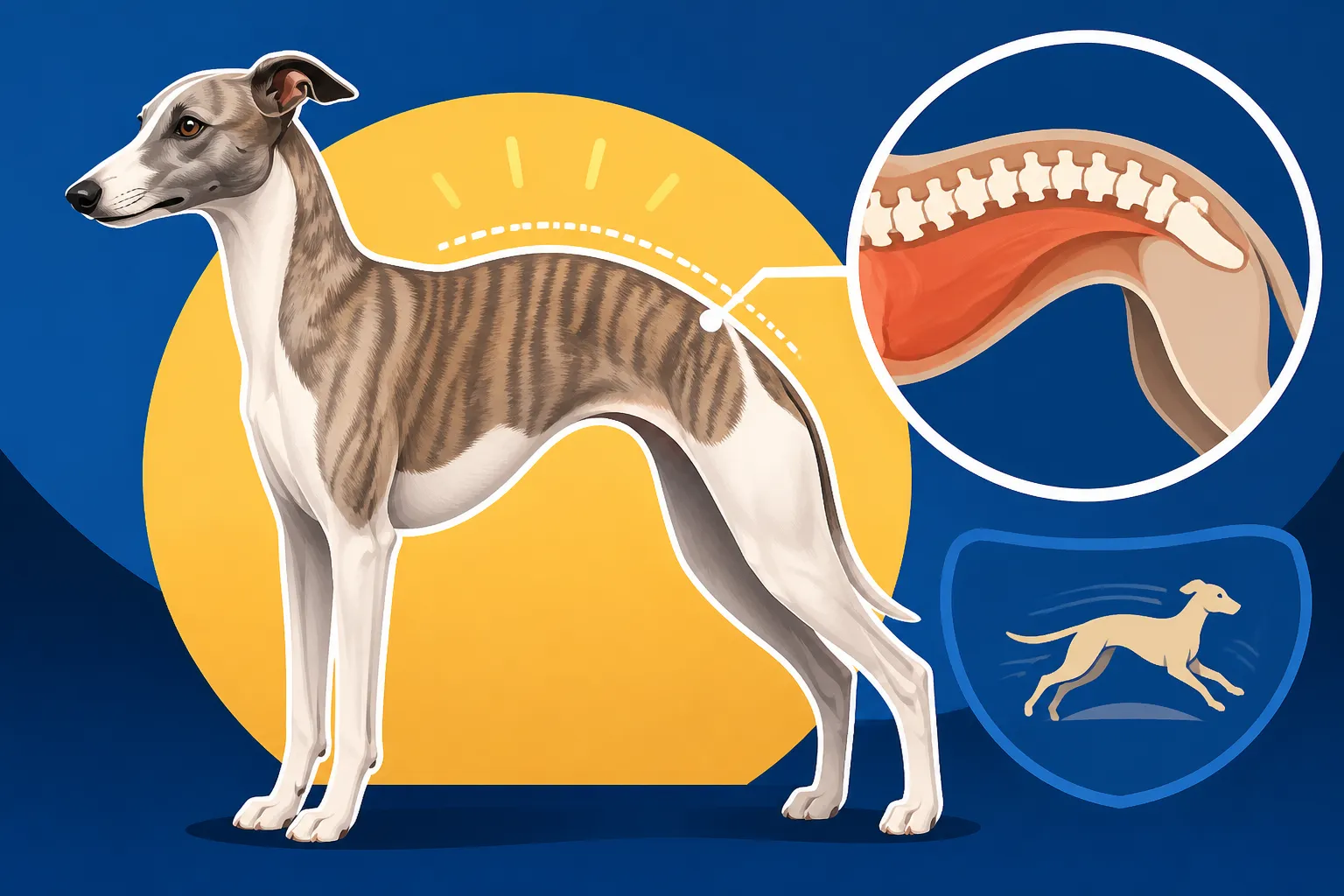
What a Whippet’s Arch Actually Does
A Whippet’s arched back can look dramatic, especially when the dog is standing alert or stretching into a run. It is not simply a curved spine or a sign that the dog is unusually muscular. This guide explains where the arch belongs, how it helps the Whippet move, what it does not tell you, and when a change in your dog’s back deserves attention.
What a Whippet’s arch looks like
The arch is part of the topline
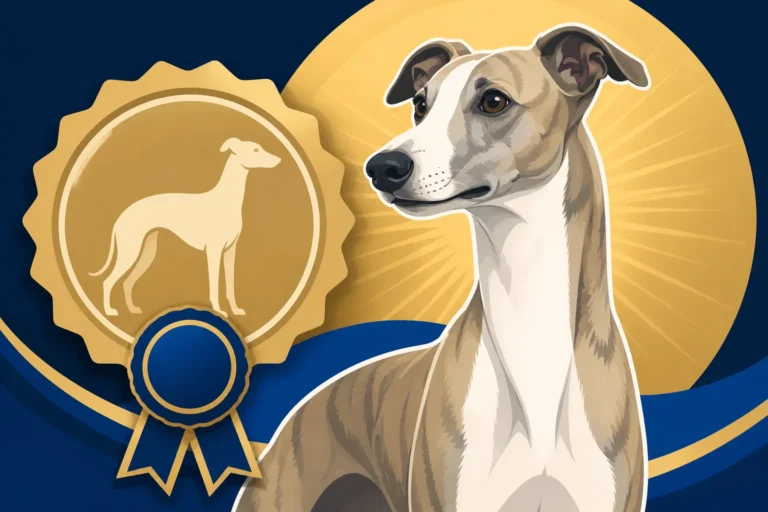
The topline is the outline of a dog’s back when viewed from the side. In a Whippet, it is not meant to run perfectly level from the shoulders to the tail. The breed’s characteristic outline typically rises gently over the loin, the short section of the back between the rib cage and pelvis, then slopes down toward the hindquarters. The shape should appear smooth and balanced rather than like a sharp hump.
The arch is best understood as a feature of the whole outline, not as a single bone sticking up. The spine, surrounding muscles, rib cage, pelvis, and the dog’s posture all influence what you see. A Whippet may show the curve more clearly when standing at attention and less clearly when relaxed, lying down, or viewed from an angle.
That is why one snapshot can be misleading. A dog standing with its rear legs tucked under itself, for example, may appear to have a different back shape from the same dog standing naturally. Coat, muscle condition, age, and body condition can also affect how prominent the topline looks. The breed’s outline is discussed in more detail in Why the Whippet Standard Cares So Much About the Topline and What the Whippet Standard Says About the Arch.
A gentle rise is not the same as a roached back
People sometimes use “arch,” “roach,” and “hump” as though they mean the same thing. They do not always describe the same appearance. A Whippet’s standard topline includes a gentle rise over the loin. A roached appearance may describe a more conspicuous or differently shaped curve, and its meaning depends on where the curve begins, how pronounced it is, and what the rest of the dog looks like.
A naturally shaped topline should flow into the shoulders and hindquarters. If the back looks abruptly peaked, uneven, or sharply rounded, that visual impression alone does not establish why it looks that way. It may reflect stance, muscle, age, or an individual structural difference; it can also be a reason to ask a veterinarian or knowledgeable breed professional for an assessment. A photograph cannot diagnose pain or determine whether a dog’s spine is healthy.
When comparing outlines, look at the full side profile rather than focusing on one high point. Consider the dog standing comfortably on a level surface, with its legs placed naturally. For a closer look at the terminology and its breed context, see Whether a Whippet’s Back Should Be Roached and Whether a Flat Backed Whippet Is Faulted.
| What you notice | What it may mean | What to check next |
|---|---|---|
| A smooth rise over the loin while the dog stands comfortably | A typical Whippet topline may be visible | Look at the whole outline and the dog’s movement |
| The arch looks stronger in one pose than another | Posture or muscle tension may be changing the appearance | Observe the dog standing and walking naturally |
| A sudden change in back shape | Could have several causes, including pain or injury | Contact a veterinarian, especially if movement or comfort has changed |
| A sharply peaked or uneven outline | Appearance alone cannot identify the cause | Ask a veterinarian or experienced breed professional to assess the dog |
| A Whippet moves freely and comfortably despite a subtle arch | The outline should be considered alongside function | Avoid judging health or athletic ability from topline alone |
What the arch does when a Whippet moves
It is part of a flexible, athletic body
A Whippet’s body is built for short, fast bursts of movement. During a gallop, the dog’s spine flexes and extends as the limbs gather under the body and then reach out. The loin’s shape and the muscles around it are part of that coordinated movement. The back is not a rigid platform; it moves with the rest of the body.
Think of the arch as one piece of a connected system. The hindquarters generate force, the trunk helps transmit it forward, and the limbs interact with the ground. The dog’s movement depends on how those parts work together, not on the arch in isolation. A well-balanced outline can be consistent with an athletic build, but the outline by itself does not tell you how efficiently the dog runs.
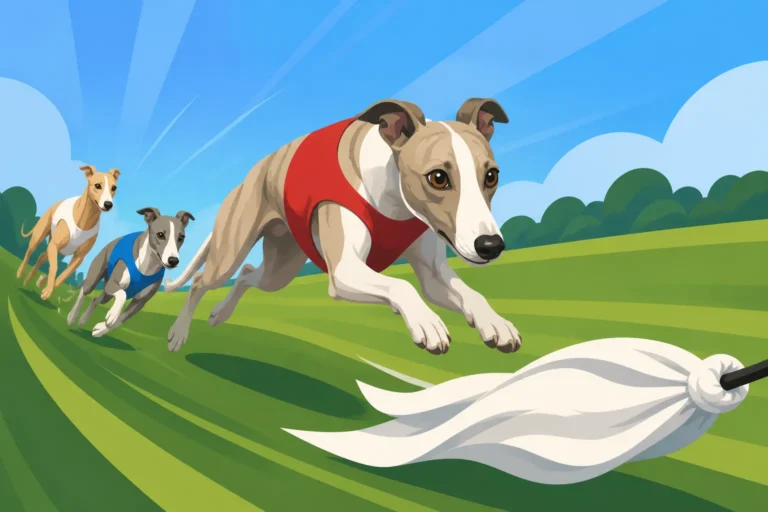
A Whippet stretching into a gallop may look quite different from one standing still in the living room. In motion, the topline changes as the body gathers and lengthens. That visible change is part of the way a flexible running dog moves; it is not automatically evidence of a problem. To understand where the curve is expected to appear, see Where a Whippet’s Arch Should Begin.
It does not work like a spring that guarantees speed
It is tempting to say that the arch makes a Whippet fast, as if a more curved back automatically produces a quicker dog. That is too simple. Speed and athletic movement involve many factors, including overall structure, muscle, coordination, conditioning, health, motivation, and the surface under the dog’s feet. A single feature cannot predict performance on its own.
An exaggerated curve is not a shortcut to athleticism. A dog with a striking topline may not be especially fast, and a dog whose arch is less obvious in a particular pose may still move beautifully. The practical question is whether the dog can move comfortably and freely, not whether its back looks dramatic in a photograph.
This distinction is useful when evaluating a puppy, an adult dog, or a show photograph. Compare the dog’s outline with its movement and comfort. Does it walk and run without obvious stiffness? Does it use both sides of its body evenly? Does its posture change suddenly, or does it appear relaxed? How a Whippet’s Roach Affects Its Speed explores the relationship between topline and movement without treating one body feature as a performance guarantee.
What the arch does not tell you
It is not a reliable stand-alone health test
A visible arch does not, by itself, confirm that a Whippet has a healthy back. Nor does a less obvious arch prove that something is wrong. Conformation is a description of body shape; a veterinary examination considers the dog’s health, comfort, history, and movement.
Pay attention to changes from your own dog’s normal. A Whippet that has always had a gentle rise but moves happily is different from one whose back suddenly looks guarded after a hard run. Be alert to reluctance to jump or climb, stiffness after rest, sensitivity when touched, a hunched posture, weakness, or an unusual change in gait. These signs do not point to one specific diagnosis, but they are good reasons to seek veterinary advice rather than trying to interpret the topline at home.
A quick comparison can help: is the dog’s shape different only in a photograph or stance, or does the dog also seem uncomfortable? If the outline changes together with reduced activity, a yelp, trouble rising, or clear pain, arrange prompt veterinary assessment. Keep the dog from sprinting or jumping while you are waiting for guidance if movement seems painful.
It is different from the tuck-up and visible bones
The arch is often confused with the Whippet’s deep tuck-up. The tuck-up is the rise of the abdomen behind the rib cage when viewed from the side. It is a separate feature from the topline, even though both contribute to the breed’s distinctive silhouette. A dog can have a visible tuck-up and a gentle rise over the loin; one does not explain the other.
Whippets are naturally lean, and their ribs or hip bones may be more apparent than those of a heavily coated or stockier breed. Still, the topline is not a substitute for assessing body condition. If you are worried that your Whippet has lost weight, feels unusually bony, or has developed a different outline, check the change with your veterinarian rather than deciding from the arch alone. Whether a Whippet’s Tuck Up Can Be Too Deep looks specifically at the abdominal outline.
For a useful comparison, observe your dog from the side and from above, then feel gently along the ribs and body as your veterinarian has shown you. Look for changes over time rather than comparing one dog’s shape with a stranger’s photograph. Body condition and topline are related only in the broad sense that both contribute to appearance; neither should be used as the sole measure of health.
How to assess your Whippet’s topline at home
Watch the dog standing and moving naturally
For a simple observation, choose a level, non-slippery surface and let your dog stand in a relaxed position. Avoid pulling the head up or placing the feet into a show stance, because that can alter the outline. Look at the dog from the side and notice whether the rise over the loin appears smooth, where it begins, and how it blends into the shoulders and hindquarters.
Then watch the dog walk at an easy pace. You are not trying to judge a competition gait or measure speed. Notice whether the dog moves comfortably, uses its limbs evenly, and appears willing to turn and change direction. If the back looks different while moving, that can be normal because the spine and body are not static. If movement seems stiff, uneven, or painful, prioritize the behavior over the appearance.
Take note of the context if you see a change. Has your Whippet just sprinted, slipped, or had a fall? Is the dog tired, tense, or standing awkwardly? Does the difference persist after the dog has rested? A short record of what you noticed and when it happened can help your veterinarian understand the concern. Do not repeatedly press or manipulate the spine to “test” for pain.
Get help when the shape or comfort changes
A breed-savvy judge or experienced Whippet breeder can help explain how topline terminology is used in conformation. That can be helpful if you are comparing breed outlines or trying to understand why a dog’s shape looks different from another Whippet’s. It is not a replacement for a veterinary evaluation when the dog may be sore or unwell.
If you are shopping for everyday equipment, do not use a photo of a Whippet’s arch to decide what size harness or coat to buy. Measure your individual dog and follow the product’s sizing instructions. A retailer such as Chewy may list different styles, but fit should come from your dog’s measurements and the manufacturer’s guidance, not from breed appearance alone. If ordering from Chewy, check the item details and the retailer’s current policies before choosing equipment.
A coat, bed, or harness should not be used to correct the topline. Choose gear for comfort and fit, and stop using anything that rubs, restricts movement, or causes your dog to avoid wearing it. When browsing options at Chewy or another retailer, compare the sizing information carefully; a deep chest and narrow waist can make a generic size chart less reliable than a proper measurement. If your Whippet’s back has changed or the dog seems painful, take that concern to a veterinarian rather than attempting to manage it with equipment from Chewy.
Disclaimer
This article is for general informational purposes only and does not constitute professional advice. Laws, prices and regulations vary by location and change over time. Consult a qualified professional for guidance on your specific situation.