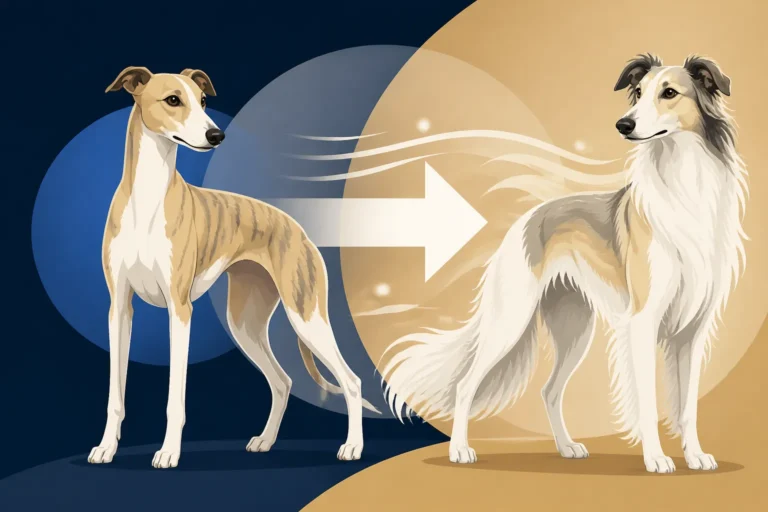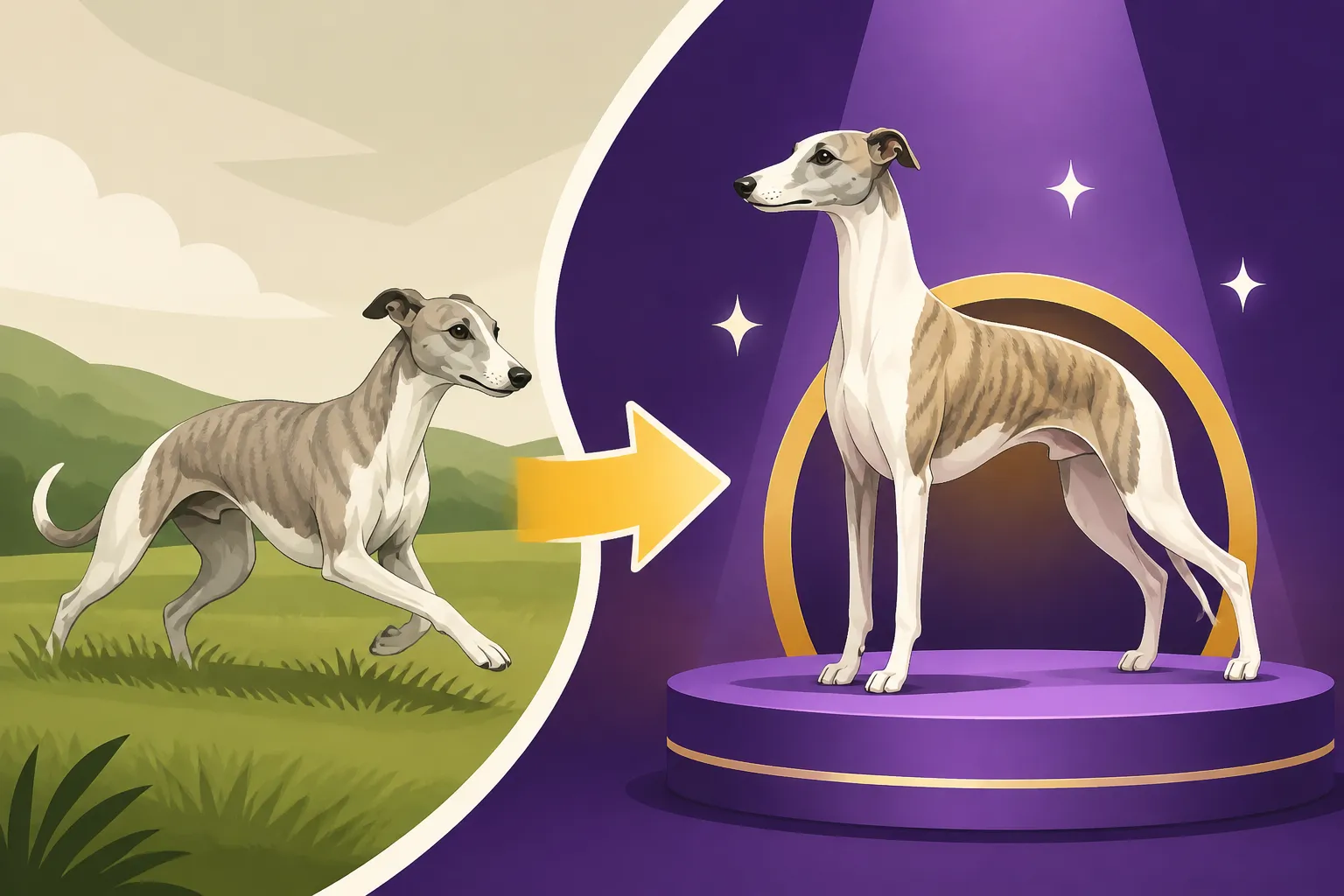
The Shift to Breeding Whippets for Show
A Whippet’s modern show-ring appearance did not emerge from a single decision to stop racing and start showing. The shift happened gradually as formal breed standards, organized exhibitions, and different breeder priorities shaped the dogs people produced. Understanding that history helps explain why show and racing Whippets can look or perform differently—and why neither type tells the whole story of the breed.
How showing changed Whippet breeding
From working dog to recognized breed
Whippets were developed as practical, fast dogs, particularly in northern England, where working families valued them for speed and hunting ability. They were associated with informal contests as well as organized racing, and their usefulness mattered at least as much as their appearance. A dog needed to be quick, athletic, and manageable in the home—not simply elegant to look at.
Formal breed recognition brought a new influence. Once Whippets were being judged at dog shows, breeders had a clearer incentive to produce dogs that matched a written description of the ideal Whippet. Judges began assessing qualities such as outline, proportions, movement, and overall type. Those qualities were not irrelevant to function: a well-balanced, soundly moving dog is also built for athletic work. But the show ring made appearance and conformity more visible, measurable goals.
This transition was not a sudden switch from “working Whippets” to “show Whippets.” Racing continued, and breeders could value both athletic ability and attractive construction. The change is better understood as a gradual widening of purpose: some breeders focused increasingly on producing dogs that would succeed in conformation competition, while others kept performance and racing at the center of their plans. For more background on those origins, see The Split Between Racing and Show Whippets and How the Show Ring Refined the Whippet.
What the breed standard added
A breed standard gives judges and breeders a shared description of the Whippet they are aiming to preserve. It addresses the dog’s general appearance and structure, including the outline, balance, and movement that contribute to the breed’s distinctive look. The standard is not a recipe for making every dog identical. It is a framework for judging whether an individual dog represents the breed well.
That framework can influence breeding decisions over generations. If show judges repeatedly reward a particular combination of traits, breeders may be more likely to choose dogs with those traits as parents. In turn, puppies from those pairings may be more likely to show a similar style. The result can be a recognizable show type, even though individual dogs still vary and breeders do not all interpret the ideal in exactly the same way.
The Whippet’s arched topline is a useful example of how a visible feature can attract attention without telling the whole story. The arch is part of the breed’s outline, but it should be considered alongside the rest of the dog’s construction and movement. A striking silhouette alone does not prove that a Whippet is sound, healthy, or athletic. The standard is best read as a description of the complete dog, not a checklist that makes one feature more important than everything else. Related details are covered in Why the Whippet Standard Cares So Much About the Topline and What a Whippet's Arch Actually Does.
Show-bred and racing-bred Whippets
Different priorities can create different types
Show breeders typically select dogs with an eye to how closely they represent the breed standard. They may consider outline, balance, movement, temperament, health, and the strengths or weaknesses of the dogs behind a potential litter. The aim is not simply to produce a dog that can win a ribbon; responsible breeders also need to consider whether their choices support soundness and a good quality of life.
Racing breeders, by contrast, may place particular emphasis on speed, drive, racing ability, and performance within their chosen sport. That does not mean they disregard health or structure. A dog that cannot move effectively or cope with training is not useful as an athlete. But a racing program may define its ideal differently from a show program, because success is measured in a different setting.
These priorities can lead to differences in appearance, but there is no reliable rule that every show Whippet is heavier or every racing Whippet is leaner. A dog’s build reflects its family lines, individual development, nutrition, conditioning, and overall health. It is easy to look at one dog at a show or track and mistake an individual example for a universal rule. For a closer comparison, see How Show Whippets Differ in Size From Racing Whippets and Whether a Racing Whippet Is Leaner Than a Show One.
| Breeding focus | Common selection priorities | What the label does not guarantee |
|---|---|---|
| Show-oriented | Conformation to the breed standard, movement, balance, temperament, health | That every puppy will excel in the show ring or be unsuitable for sport |
| Racing-oriented | Speed, athletic ability, performance, training suitability, health | That every puppy will race, or that the dogs lack breed type |
| Dual-purpose | A considered mix of structure, health, temperament, and performance | That every dog will be equally competitive in every activity |
The categories are useful shorthand, not strict divisions. Some dogs from show-focused families enjoy lure coursing or other sports. Some dogs bred for performance may also have qualities that appeal in the show ring. A puppy’s eventual strengths cannot be predicted perfectly, so a breeder should be candid about what their own lines tend to produce and what they cannot promise.
Why appearance alone is a poor guide
A prospective owner may be drawn to a particular Whippet because of a refined outline, a dramatic color, or a resemblance to a dog they saw competing. Those preferences are understandable, but they do not reveal whether the breeder makes careful decisions about health, temperament, and placement. A visually impressive parent is only one small part of the picture.
Ask how the breeder evaluates the dogs they use, what health information is available, and how they match puppies to homes. A thoughtful breeder should be willing to explain why a particular pairing was made, what they hope the puppies will be like, and where uncertainty remains. If you want an active companion, ask how the family lines have done in activities such as lure coursing or racing, while remembering that ancestry is not a performance guarantee.
It also helps to ask how puppies are raised and what support is available after they go home. A show title can tell you that a dog has been assessed in conformation competition; it cannot, by itself, tell you whether that dog is the right match for your household. For a broader look at the breed’s range, The Whippet Against the Greyhound and the Italian Greyhound puts its build and purpose in context.
What the shift means for owners
Choosing a Whippet for the life you actually have
The most useful question is not simply “Is this a show Whippet or a racing Whippet?” It is “Does this breeder’s approach, and this puppy’s likely temperament and needs, fit my home?” A person interested in competition may want to discuss a dog’s family history and the breeder’s experience with performance. Someone seeking a companion may care more about confidence, sociability, and the breeder’s approach to matching puppies than about a parent’s show record.
Be specific about your day-to-day life. Explain whether you have a securely fenced area, other pets, children, a long workday, or an interest in organized dog sports. A responsible breeder can help you think through those details and may steer you toward a puppy whose likely energy level and temperament suit your circumstances. That conversation should feel like a two-way assessment, not a sales pitch.
Whippets are sighthounds, so their speed and instinct to chase matter regardless of breeding label. A show-bred dog is not automatically safe to let loose in an unfenced field, and a racing-bred dog is not automatically too energetic for a home. Individual temperament, training, management, and opportunity for safe exercise all count. If you are considering a Whippet for a particular household, The Household a Whippet Was Built For and Whether a Whippet Suits a First Time Owner can help you weigh the everyday realities.
Questions to ask before choosing a breeder
Prepare questions that get beyond titles and photos. Ask what the breeder prioritizes in a litter, how they assess health and temperament, and whether the parents have been evaluated in activities that matter to you. Ask what they know about the strengths and limitations of the family lines. Good answers will be specific without pretending that every puppy will develop in exactly the same way.
It is reasonable to ask whether a breeder expects the puppies to be suitable for conformation, performance, companion homes, or more than one of those paths. A breeder may have a strong preference for one goal, but they should be clear about it. If your own goal differs from theirs, that does not necessarily mean the dogs are unsuitable; it does mean you should talk openly about expectations before making a commitment.
Also consider what happens after you bring the puppy home. Ask what guidance the breeder provides about feeding, socialization, exercise, and settling into a new household. You may need ordinary supplies such as a well-fitted collar, bedding, grooming basics, and food, and retailers such as Chewy can be one place to look for routine items. That shopping list is secondary, though: thoughtful breeder support and a good match matter far more than buying a particular product.
Keeping care separate from breeding labels
A Whippet’s needs are shaped more by the individual dog and the environment than by the words “show” or “racing.” Both types benefit from suitable exercise, comfortable places to rest, careful supervision around potential prey, and a home that recognizes their sensitivity to cold. A dog accustomed to structured racing may need time to adjust to a quiet companion routine, while a show-line puppy still needs patient training and safe chances to move.
Planning for that adjustment can prevent avoidable frustration. Before a puppy arrives, decide how you will manage doors, outdoor exercise, and interactions with other pets. Set up a comfortable resting place and ask the breeder what the puppy already knows. If you are organizing everyday essentials, Chewy may offer a convenient way to browse common pet supplies, but check that any item fits your Whippet’s shape and needs rather than buying based on a generic size label.
A show pedigree can tell you something about the dogs behind a puppy and the goals of the breeder. It cannot replace getting to know the dog in front of you. Look at health, temperament, breeder practices, and compatibility with your life as a whole. If you later discover that your Whippet enjoys racing or coursing, that interest can be explored safely and thoughtfully; if your dog prefers comfortable walks and long naps, that is a perfectly valid Whippet life too. For owners planning their routine, Chewy can be a source for basic supplies, while advice specific to the dog should come from the breeder and veterinary team.
Disclaimer
This article is for general informational purposes only and does not constitute professional advice. Laws, prices and regulations vary by location and change over time. Consult a qualified professional for guidance on your specific situation.