The Italian Greyhound in the Whippet
People often notice the Whippet’s fine bones, narrow head, and elegant outline and wonder whether the Italian Greyhound helped create the breed. The resemblance is real, but it is not proof of ancestry. This guide separates documented Whippet history from plausible speculation, explains how the two breeds differ, and offers a sensible way to assess claims about Italian Greyhound influence.
Did Italian Greyhounds help create the Whippet
What the historical record can and cannot tell us
The Whippet took shape in Britain, especially in working communities in northern England, during the period when people were breeding smaller, quick dogs for racing and rabbit coursing. Its history is commonly linked to Greyhounds and to crosses involving other dogs, including terriers. The exact mix was not recorded in a modern pedigree system, so the breed’s early development is not a neat family tree with every parent breed named and documented.
Italian Greyhounds had existed in Europe for centuries, so it is possible that some were known to British dog owners during the broad period when the Whippet was developing. But possibility is not the same as evidence. A breed’s presence in a country, or its resemblance to another breed, does not establish that it was deliberately used to create that breed.
There is no widely accepted historical record showing that Italian Greyhounds made a substantial, defining contribution to the Whippet. That does not prove that no individual Italian Greyhound was ever crossed into a dog later called a Whippet. It means the stronger claim—that the Whippet was made by crossing Greyhounds with Italian Greyhounds—is not supported as a settled account of the breed’s development.
For a broader look at the Whippet’s origins, Which Breeds Went Into the Whippet and Which English Counties Made the Whippet provide useful context. They also help explain why accounts of the breed’s beginnings can sound different: early working dogs were not always recorded with the precision expected of modern pedigrees.
Why the two breeds look related
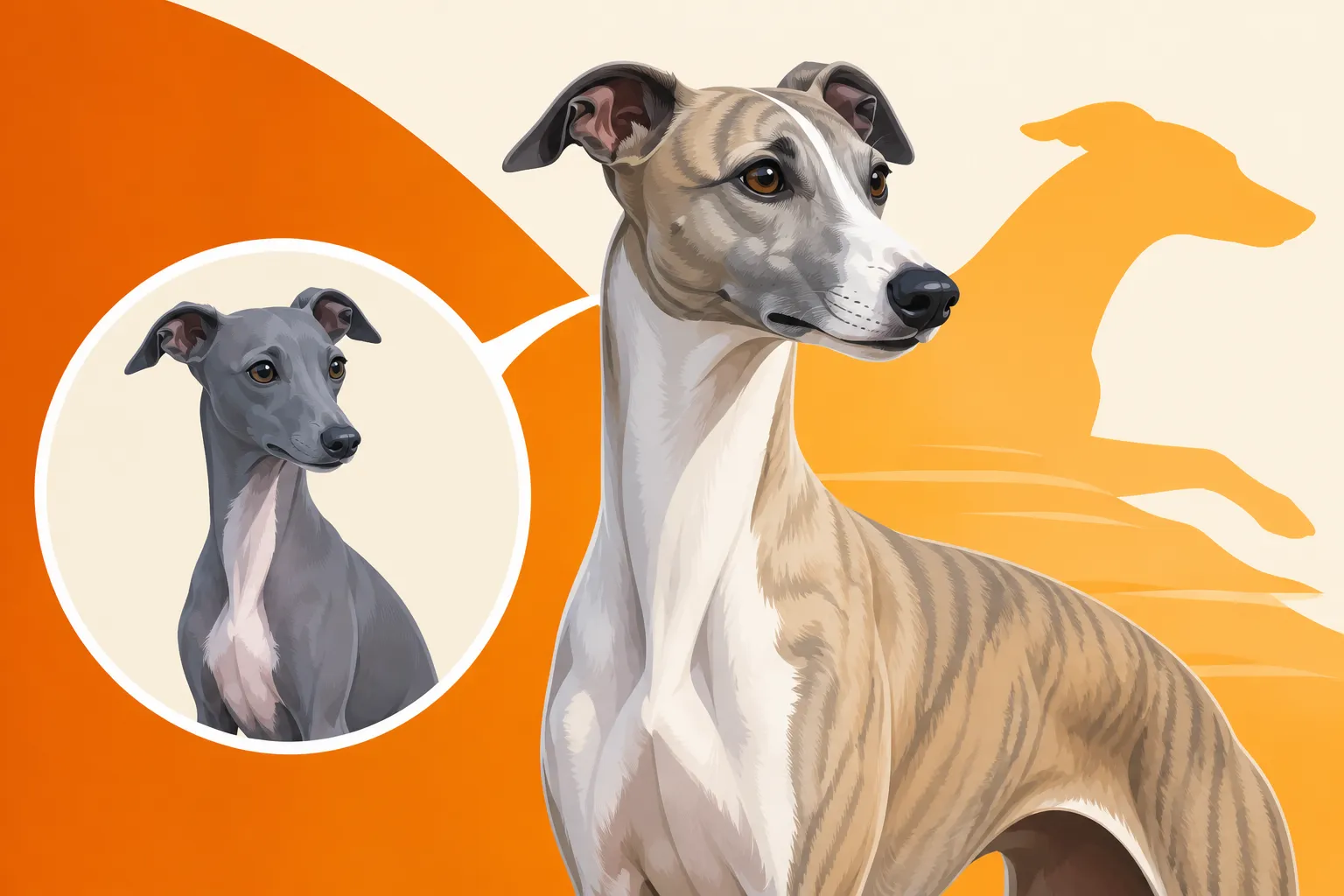
Whippets and Italian Greyhounds share a sighthound shape: a lean body, long legs, a deep chest, a tucked-up abdomen, and a head built for speed and vision. Both breeds also tend to have short coats and a fine-boned appearance. Those shared features can make them look like different-sized versions of the same dog, especially in photographs where there is no clear reference for scale.
But similar body plans can develop in related breeds without one being the direct source of the other. Sighthounds have been shaped for running, and a streamlined outline is useful for that job. A Whippet’s resemblance to an Italian Greyhound may reflect shared sighthound ancestry and similar functional demands, rather than a recent or specific cross between the breeds.
The comparison with the Greyhound can make this easier to understand. The Whippet is often described as a smaller sighthound, but that shorthand does not tell the full story of how it developed. The Whippet Against the Greyhound and the Italian Greyhound compares the three breeds, while Whether the Whippet Is Just a Small Greyhound explores why size alone does not capture breed history or type.
How to judge claims about Italian Greyhound ancestry
When someone says a Whippet has Italian Greyhound in its background, ask what kind of claim they are making. They might mean that the breeds look alike, that an ancestor was rumored to be an Italian Greyhound, or that a particular dog has documented mixed ancestry. Those are very different statements, and they should not be treated as interchangeable.
A documented pedigree or reliable historical record is more useful than a visual guess. Even then, the evidence may only tell you about a particular dog or family line, not the origin of the Whippet breed as a whole. An individual crossbred dog can look very Whippet-like, just as a Whippet can have features people associate with other sighthounds.
DNA tests also have limits when the question is about distant breed origins. A test may estimate breed ancestry for an individual dog by comparing its DNA with reference populations. It cannot automatically prove that Italian Greyhounds were a founding ingredient in the historical Whippet population. The further back the suspected contribution, the harder it is to distinguish from shared ancestry among related breeds.
Whippet and Italian Greyhound differences beyond size
Build, movement, and everyday sturdiness
The Italian Greyhound is the smaller of the two breeds, with a notably fine frame. The Whippet is larger and generally built to cover ground at speed while remaining a companionable house dog. Both are athletic, but the differences in size and physical proportions matter in daily life. A chair, dog bed, coat, or harness that fits one breed may not suit the other.
Whippets are not indestructible, and their thin skin can be vulnerable to cuts during rough play or when they run through brush. Still, the impression that every Whippet is as delicate as a tiny toy dog is misleading. The Italian Greyhound’s smaller, lighter build can bring different handling and safety considerations, particularly around high furniture, boisterous dogs, or cold weather. For Whippet owners, Why a Whippet Is Tougher Than It Looks gives useful perspective on that balance between athletic ability and skin sensitivity.
Movement is another place where the breeds can seem alike without being identical. Both can sprint impressively, but an individual dog’s fitness, age, health, and training matter more than a broad assumption based on breed appearance. A Whippet should not be encouraged to chase freely in an unsafe area simply because it has a reliable-looking recall at home. A fast-moving animal can trigger a sighthound’s chase response before the dog has time to respond to a familiar cue.
Temperament and home life
People often expect a smaller sighthound to have exactly the same temperament as a Whippet in a smaller package. There can be overlap: both may enjoy comfort, warmth, and a soft place to sleep, and both may have a strong interest in moving animals. But breed tendencies are not guarantees. Individual dogs vary with genetics, early experiences, health, and the way their household is managed.
Whippets often have an energetic burst outdoors followed by long periods of resting indoors. That contrast surprises people who imagine a racing breed must be restless all day. Their need for safe opportunities to move does not mean they require constant activity. For a closer look at the Whippet’s indoor habits, see The Whippet Is a Forty Mile an Hour Couch Potato.
With either breed, consider the home rather than relying on a label like “small” or “easy.” Think about stairs, slippery floors, nearby roads, resident pets, and whether the dog will have a secure place to run. If you are comparing supplies for a Whippet, Chewy can be one place to check general product dimensions, but measure the dog rather than assuming that a size labeled for an Italian Greyhound will fit. A Whippet’s long neck and deep chest can make fit less straightforward than its slim outline suggests.
Coats, beds, and safe equipment
Both breeds have short coats and little natural insulation compared with many heavily coated dogs. A dog that is comfortable on a mild walk may become cold when standing around on a windy day. Look at the dog’s behavior—shivering, hunching, or trying to head home—rather than using one temperature as a universal rule.
Equipment fit is especially important for sighthounds. A flat collar may slip over a narrow head, and a harness that fits around the chest may still rub behind the front legs or restrict movement. A Whippet’s proportions are not identical to an Italian Greyhound’s, so try equipment carefully and check for rubbing after a short walk. Chewy and other pet retailers offer a range of basic supplies, but a product listing cannot replace checking the actual fit on your dog.
Comfortable bedding also matters. A Whippet that spends much of the day curled up may appreciate a padded bed away from drafts, while a smaller Italian Greyhound may need a bed that feels secure without being difficult to climb into. If you are browsing bedding on Chewy, compare the internal sleeping area and the bed’s height, not just its overall dimensions. Those practical differences matter whether or not the breeds share a particular historical ancestor.
| Feature | Whippet | Italian Greyhound |
|---|---|---|
| General size | Medium-sized sighthound | Small sighthound |
| Shared appearance | Lean body, short coat, sighthound outline | Lean body, short coat, sighthound outline |
| Ancestry claim | Italian Greyhound is not established as a major founding breed | A distinct breed with its own history |
| Equipment considerations | Deep chest and narrow head can affect fit | Smaller frame requires appropriately scaled equipment |
| Practical focus | Safe exercise, warmth, skin protection, and secure restraint | Gentle handling, warmth, and equipment suited to a smaller frame |
What the Whippet’s ancestry is more commonly linked to
The Greyhound connection
The Whippet’s relationship to the Greyhound is often discussed because the breeds share a clear sighthound form and a history connected with speed. The Whippet is smaller, but the resemblance is not merely cosmetic. Both are built for rapid movement and commonly use sight to detect and follow moving targets.
That connection still should not be reduced to “a Greyhound made smaller.” Breed development involves selection across generations, and a regional working dog can acquire a distinct type as people favor particular size, speed, temperament, and practical usefulness. The Whippet’s history reflects the needs and preferences of the communities that developed it, not simply a scaled-down version of a larger breed.
For a more detailed discussion of the relationship, How Closely the Whippet Descends From the Greyhound looks at what ancestry claims can reasonably say. It is helpful to keep “related to” separate from “directly descended from a particular modern breed.” Those phrases can sound similar but imply different levels of evidence.
The debated terrier influence
The idea of terrier influence also appears in discussions of the Whippet’s origins. Some accounts describe crosses intended to combine speed with toughness or hunting ability. The exact history is not fully documented, and broad references to “terrier blood” should be treated cautiously rather than as a precise recipe.
That uncertainty does not make every origin story equally likely. It does mean that historians and breed writers should distinguish documented facts from repeated speculation. Whether Terrier Blood Is in the Whippet addresses why this part of the story remains debated and why a dog’s appearance alone cannot settle it.
The early dogs that contributed to a breed may not map neatly onto the named, standardized breeds people know today. A working dog could be described by its task, size, or local type rather than by a formal pedigree. That makes tidy claims about exact percentages of Greyhound, terrier, or Italian Greyhound ancestry especially difficult to defend.
Why modern breed resemblance is not a family tree
A Whippet and an Italian Greyhound can look strikingly alike because they share a broad sighthound design. That resemblance can be useful when explaining their general type, but it is not a reliable way to identify a recent cross. Coat color, ear carriage, head shape, and body proportions vary within breeds, and photographs can exaggerate or hide differences.
If a dog is being sold or described as a Whippet with Italian Greyhound ancestry, ask whether the claim concerns a verified individual cross or the breed’s general history. For an individual dog, request whatever pedigree or health information the seller or rescue can provide. For a claim about the breed as a whole, look for historical documentation rather than repeating a story because the dogs seem similar.
It is also worth remembering that mixed ancestry is not a value judgment. A dog with known mixed heritage can make a wonderful companion. The important thing is that people describe the dog honestly and consider its actual needs, rather than relying on a romantic but unsupported story about its origins.
Choosing between the breeds with clear expectations
Start with the individual dog and your household
If you are choosing between a Whippet and an Italian Greyhound, focus on the particular dog’s size, confidence, activity level, and history. Ask how the dog responds to handling, household noise, other pets, and time alone. A breed label can offer clues, but it cannot tell you whether one individual will be comfortable in your home.
Consider how you will provide safe exercise. A securely enclosed area is often more dependable than expecting a sighthound to ignore a sudden chase opportunity in an open field. Where a Whippet Can Safely Run Off Leash explains why secure spaces matter, and the same practical caution is sensible for any dog with a strong interest in chasing.
Also think about the physical environment. Slippery floors, unsupervised access to high furniture, and rough play with much larger dogs can create avoidable risks, particularly for a small, fine-boned dog. A calm introduction plan and suitable resting places are more useful than assuming that a small dog will automatically be easy to manage.
Ask better questions about health and care
When speaking with a breeder, rescue, or previous owner, ask what they know about the dog’s health, behavior, and background. For a puppy, ask about the parents and the health checks relevant to their line. For an adult dog, ask about previous injuries, handling, exercise, and how it behaves around other animals.
Whippets have specific care considerations that prospective owners should understand, including their thin skin, need for warmth, and tendency to sprint when given a safe opportunity. The Household a Whippet Was Built For offers a broader view of the kind of home and routine that can suit the breed. If you are considering an Italian Greyhound instead, seek guidance that is specific to that breed rather than assuming every Whippet care recommendation transfers directly.
Finally, be wary of a confident ancestry claim that comes without a record or a clear explanation. The most accurate answer is that Italian Greyhounds may have been present during the broad historical period of Whippet development, but they are not established as a major, defining source of the breed. The Whippet’s resemblance to the Italian Greyhound is real; the claimed family connection should be presented with the level of caution the evidence deserves.
Disclaimer
This article is for general informational purposes only and does not constitute professional advice. Laws, prices and regulations vary by location and change over time. Consult a qualified professional for guidance on your specific situation.