How Closely the Whippet Descends From the Greyhound
A Whippet can look like a Greyhound in a smaller frame, so it is natural to wonder whether one breed simply came from the other. The real story is less like shrinking a Greyhound and more like developing a related British sighthound for different people and purposes. This guide explains what is known about their shared ancestry, how the Whippet became distinct, and what “descended from” really means.
How closely are Whippets related to Greyhounds
They share sighthound ancestry
Whippets and Greyhounds are close relatives within the sighthound family. Both have the long, narrow build, flexible spine, deep chest, and keen eyesight associated with dogs bred to pursue visible prey at speed. Their resemblance reflects shared ancestry and similar working purposes, not just coincidence.
That relationship does not mean every Whippet is a direct, recent descendant of a Greyhound. Dog breeds develop over generations from populations of related dogs, and the historical records for early Whippets are incomplete. It is more accurate to think of the Whippet as a distinct breed shaped from Greyhound-like sighthounds and other local dogs than as a miniature Greyhound created in one deliberate breeding program.
The distinction matters because “closely related” and “directly descended” are not interchangeable. Two breeds can share ancestors and physical traits without one being a simple offshoot of the other. For a broader comparison of their builds and temperaments, see The Whippet Against a Greyhound.
The Whippet is not simply a small Greyhound
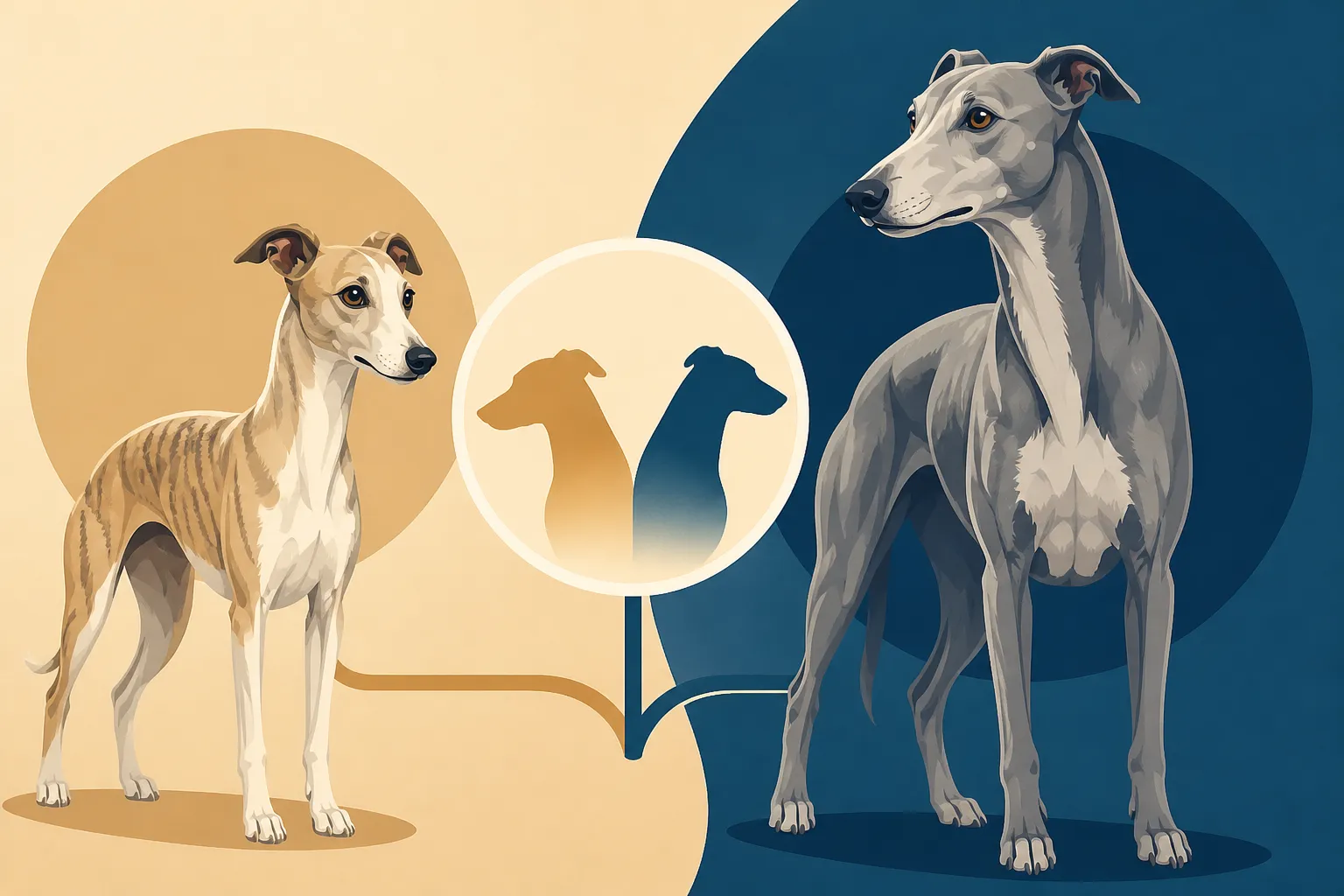
At a glance, a Whippet may look like a Greyhound scaled down. Both have a streamlined outline and a pronounced waist, and both can sprint with remarkable speed. But breed identity is not determined by size alone. Whippets have their own established type, history, and breed standard.
The small-Greyhound description also glosses over the Whippet’s working background. Whippets were valued as fast, manageable dogs by people who did not necessarily need or keep the larger Greyhounds used in other settings. Their development involved selection for a particular size and role, rather than simply breeding a Greyhound puppy to stay small.
Their similarities are real, but they do not erase the differences. If you want to explore why the “miniature Greyhound” label is incomplete, read Whether the Whippet Is Just a Small Greyhound. For a look at size specifically, How Much Smaller a Whippet Is Than a Greyhound focuses on that comparison.
How the Whippet developed as a distinct breed
A British breed shaped by working life
The Whippet’s history is strongly associated with northern England, where working-class owners valued a fast dog that could be kept in a more modest home than a large Greyhound. Whippets became known for racing and for coursing small game. In some accounts of their history, they are linked with rag racing, where a dog chased a waving cloth toward its handler.
The conditions that shaped the breed were practical. A useful dog had to be quick, athletic, and small enough to fit the lives and resources of its owners. Over time, people bred for a recognizable type rather than simply keeping any small sighthound they could find. That process helped establish the Whippet as a breed in its own right.
The broad story is easier to describe than every detail of the breed’s origin. Historical records do not provide a complete family tree for the earliest Whippets, and claims about a precise recipe of breeds should be treated cautiously. For more on the possible influences, see Which Breeds Went Into the Whippet.
Selection turned resemblance into breed type
When breeders select dogs for a consistent purpose over generations, they shape more than height. They influence proportions, movement, temperament, coat, and the balance of traits that make a dog useful in a particular setting. Whippet breeders selected for a smaller, agile sighthound with the speed and visual hunting style associated with the broader Greyhound family.
That selection produced a dog that could resemble a Greyhound while remaining recognizably different. A Whippet is not merely a Greyhound puppy whose growth was stopped; it belongs to a population bred to reproduce Whippet traits. The difference is similar to how related breeds can share a basic body plan while developing distinct sizes, proportions, and typical roles.
Breed standards later helped define what breeders and judges considered characteristic. They did not create the Whippet from nothing, but they provided a shared description of the breed’s desired form. The Whippet became a distinct breed through sustained selection, community recognition, and breeding practices—not through a single cross or a single moment of invention.
What the family resemblance tells you
Similar shape does not mean identical behavior
Both breeds are sighthounds, so they share a tendency to notice movement and a capacity for sudden, fast pursuit. That heritage can influence everyday life: a Whippet may fixate on a rabbit or a running cat and be less responsive to a recall cue once the chase begins. A Greyhound may show similar instincts, though individual dogs differ.
The shared ancestry does not make every behavior predictable. Early experiences, training, health, temperament, and the dog’s individual history all matter. A Whippet raised around cats may learn to live peacefully with a household cat, but that does not guarantee the same dog will ignore an unfamiliar cat darting across a field. The same caution applies to any broad claim about Greyhounds.
This is one reason it helps to understand Whippets as sighthounds rather than as small versions of another breed. Their instincts are part of a wider working heritage. Why the Whippet Is a True Sighthound explains how sight-led hunting differs from relying mainly on scent.
Shared ancestry does not make care interchangeable
The breeds’ similar builds can make their needs look interchangeable, but a dog’s care should be based on the individual animal and veterinary guidance. For example, both breeds are lean, short-coated dogs, yet differences in size, age, health, activity, and body condition can affect practical choices such as exercise and warmth.
A Whippet’s thin coat and low body fat can make cold weather uncomfortable, while a larger Greyhound may have different fit and layering needs. Even within the Whippet breed, one dog may shiver on a cool walk while another is comfortable. Use the dog’s behavior and condition—not a broad breed comparison—as your guide.
The same principle applies to veterinary care. A veterinarian should know the dog in front of them, including its breed, weight, medical history, and any relevant sighthound considerations. A shared family resemblance is useful context, but it is not a substitute for an individual assessment.
Whippet and Greyhound ancestry at a glance
| Question | What the relationship means |
|---|---|
| Are Whippets and Greyhounds related? | Yes. They are closely related sighthound breeds with shared ancestry and similar traits. |
| Is the Whippet simply a miniature Greyhound? | No. The Whippet is a distinct breed with its own established type and history. |
| Did Greyhounds influence Whippet development? | Greyhound-like sighthounds are part of the Whippet’s broader ancestry, but the exact early breeding history is not fully documented. |
| Can every Whippet be traced to a known Greyhound ancestor? | No. Breed histories are built from populations and generations, not always a complete, recorded family tree. |
| Do the breeds have identical behavior and care needs? | No. They share some tendencies, but individual dogs and breed-specific differences matter. |
What “descended from the Greyhound” means in practice
A shared family tree, not a simple parent-child line
When people say Whippets descend from Greyhounds, they are usually pointing to a close historical and physical relationship. Greyhound-type dogs contributed to the ancestry and development of Whippets, but it is misleading to picture the modern Whippet as a direct, recent branch of the modern Greyhound.
Breed development is rarely a tidy line. In earlier periods, dogs were often bred for a job and a useful set of traits before closed breed populations and formal standards became widespread. Local dogs could be crossed, selected, and bred onward over many generations. The result was a population that gradually became more consistent and recognizable.
That makes the Whippet’s origin a story of related dogs and selective breeding, rather than a documented one-time cross. The exact contribution of each historical dog type is difficult to establish, so confident claims that a particular set of breeds accounts for the entire Whippet should be treated with care.
Why the answer is more useful than a simple yes or no
A one-word answer—“yes” or “no”—can leave an owner with the wrong picture. “Yes” may imply the Whippet is merely a Greyhound made smaller, while “no” may ignore the close relationship between the breeds. The more useful answer is that Whippets and Greyhounds are closely related, but the Whippet developed into a separate breed from a broader background of Greyhound-like sighthounds and local dogs.
If you are choosing between the breeds, ancestry alone will not tell you which one suits your home. Consider the individual dog’s exercise needs, chase instincts, size, history, and temperament. A Whippet’s compact size does not mean it lacks athletic drive, and a Greyhound’s larger frame does not automatically determine whether it will be calm indoors.
For more context, Whether the Whippet Is Genetically Close to the Greyhound looks at their relationship through genetics, while How American and British Whippets Differ explores variation within the Whippet breed itself. The central point remains straightforward: Whippets and Greyhounds share a close sighthound heritage, but the Whippet is not simply a scaled-down Greyhound. It is a distinct breed shaped over generations by its own history and purpose.
Disclaimer
This article is for general informational purposes only and does not constitute professional advice. Laws, prices and regulations vary by location and change over time. Consult a qualified professional for guidance on your specific situation.