Whether a Whippet Suits a Family With Small Children
A Whippet can be a gentle, affectionate family dog, but life with toddlers is not automatically easy. The breed’s slim build, quick bursts of speed, sensitive nature, and love of warm, quiet resting places all matter when small children are in the home. This guide explains where Whippets and young kids can thrive together, what needs close management, and how to decide whether the match suits your household.
What living with a Whippet and small children is really like
Why many Whippets are affectionate family companions
Whippets are often soft-natured, people-oriented dogs that enjoy being close to their family. A well-matched Whippet may settle beside a parent while a child plays nearby, follow the household from room to room, and enjoy calm attention from older children who know how to handle a dog gently. Their famously speedy outdoor side can make the contrast surprising: after a run, many are happiest curled up somewhere comfortable.
That easygoing reputation has limits, though. Whippets are individuals, and a dog’s history, temperament, health, and early experiences shape how comfortable it feels around children. A Whippet that has lived peacefully with considerate kids may cope better with family noise than one that has had little exposure to children. Even a friendly dog may dislike sudden grabbing, squealing, or being woken from sleep.
It helps to think of the Whippet as a sensitive companion rather than a sturdy playmate. The breed may be a good fit for a family willing to teach children how to share space respectfully and give the dog plenty of quiet time. For a broader look at household fit, read The Household a Whippet Was Built For and Whether a Whippet Is Good With Children.
Why toddlers can be harder than older children
The main challenge is often not a Whippet’s temperament but the unpredictable behavior of very young children. Toddlers move suddenly, fall against furniture, wave toys near a dog’s face, and may not understand that a resting dog should be left alone. A Whippet startled by a child stumbling onto its bed may try to get away, and in a crowded room there may be nowhere easy to retreat.
A Whippet’s narrow build and fine coat also mean rough play can be uncomfortable or physically risky. A child who climbs onto the dog, grabs its legs, or tries to ride it can cause pain or injury, even without meaning to. Whippets are athletic, but that does not make them suitable for wrestling or boisterous handling. Their thin skin can be vulnerable to cuts, so outdoor play needs thoughtful supervision too.
This is why a Whippet may suit a family with school-aged children more readily than a home where a toddler is still learning basic boundaries. That is not a hard rule: some Whippets are remarkably patient, and some older children are still impulsive. The useful question is whether adults can consistently manage interactions, not whether the dog has a “good with kids” label. For a realistic look at the breed’s physical sensitivity, see Whether a Whippet Is Fragile Around Children.
How to make the home safe for both child and dog
Create a child-free resting area
A Whippet needs a place where children are not allowed to follow, touch, or disturb it. This could be a bed in a quiet room, a crate used positively, or a gated section of the home. The important part is that the dog can choose to rest without having to defend its space or tolerate a child leaning over it.
Use a household rule that is simple enough for a young child to remember: when the dog is on its bed or in its safe area, we leave the dog alone. Adults need to enforce that boundary every time. A gate can help, but it does not replace supervision; a child may still reach through, climb over, or open it. If you are choosing a gate or other home setup, measure the opening and consider how the child and dog move through the space. Pet-supply retailers such as Chewy may offer options, but suitability depends on the layout and the product’s secure installation.
Comfort matters as well. Whippets often seek soft, warm places to sleep, and a padded bed can help make the dog’s designated space appealing. If you are comparing beds, retailers such as Chewy may have different styles and sizes; check the dimensions and construction rather than assuming a large-looking bed will suit your dog. A comfortable retreat is only useful if the family consistently protects it as a retreat.
Teach child-friendly interaction in small steps
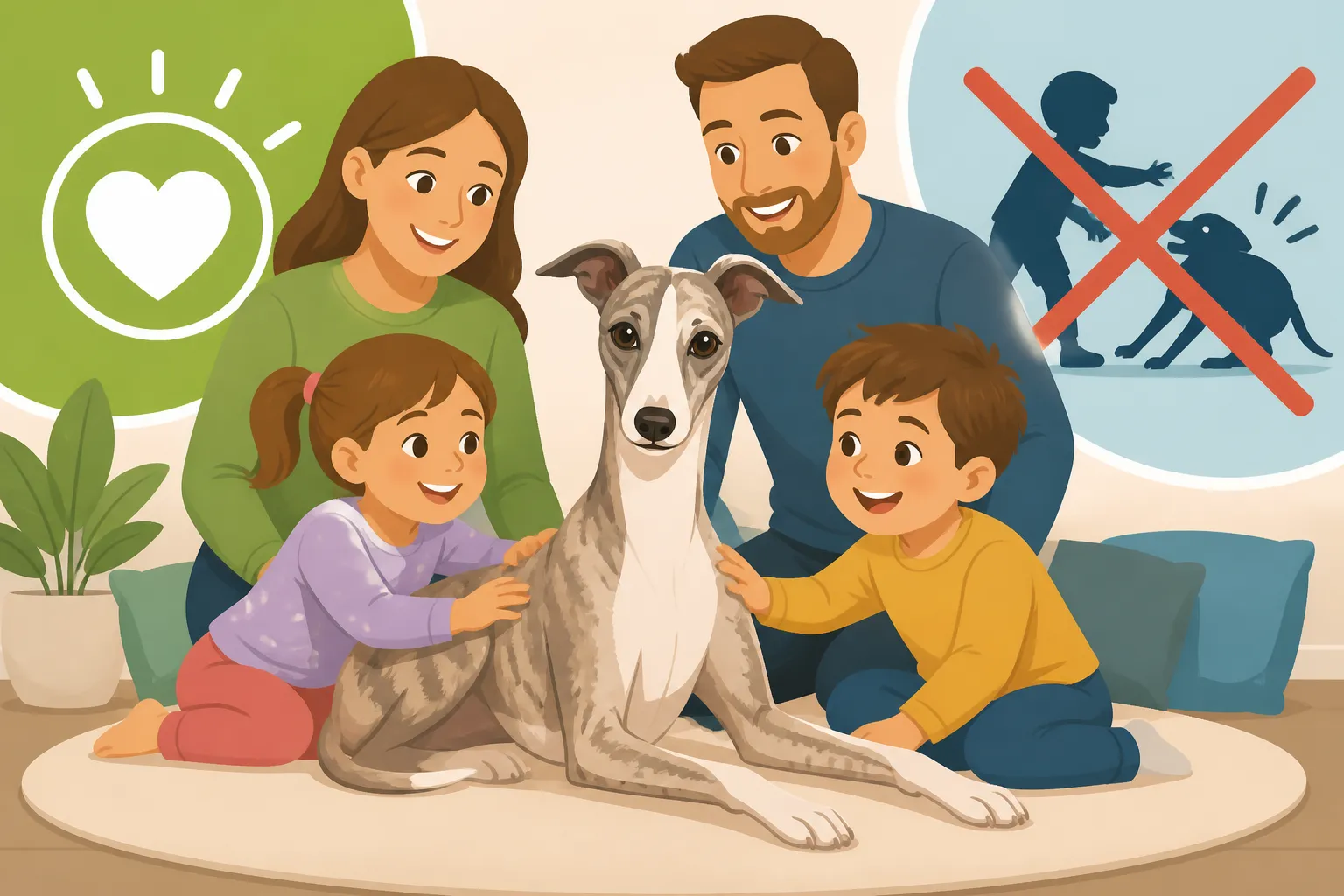
Children need specific instructions, not just reminders to “be gentle.” Show them how to approach calmly, stroke the dog briefly on the shoulder or side if the dog welcomes it, and then pause. The pause gives the Whippet a chance to move away or seek more contact. Avoid encouraging children to hug, squeeze, sit on, chase, or corner the dog.
Adults should also explain situations in which the child does not approach: when the Whippet is sleeping, eating, chewing a toy, hiding, or moving away. A child may interpret a dog turning its head or leaving as rejection and follow it. Explain that walking away is the dog’s way of asking for space, and that the child’s job is to let it go.
Make these lessons routine rather than waiting for a problem. Practice calm greetings when the dog is relaxed, and keep early interactions short. If the Whippet chooses to leave, let it leave. If the child becomes too excited, separate them before the dog has to cope with escalating noise or handling. Families considering a puppy can also prepare with Socializing a Whippet Puppy, while remembering that socialization means gradual, positive exposure—not forcing a dog into situations it finds overwhelming.
Watch body language and respond early
A Whippet does not need to growl or snap before it is uncomfortable. Early signs may include turning its head away, moving off, licking its lips, yawning when not tired, lowering its body, pinning its ears back, or becoming unusually still. Some dogs show subtle signals, and a still dog should not automatically be read as a relaxed one.
If you notice these signs, calmly create space. Call the child away, guide the dog to its safe area if it is comfortable going there, and reduce the noise or activity. Do not scold the dog for communicating discomfort. Punishing warning signals can make a dog less likely to give those signals next time, without making the underlying stress disappear.
Also pay attention to your own household’s tone. Whippets can be sensitive to raised voices and rough correction. A tense, noisy interaction may make a dog retreat or become wary, especially if it is already uncertain around children. Calm, predictable handling is a safer foundation; How a Whippet Reacts to a Raised Voice explains why a gentle approach matters with this breed.
Supervision, exercise, and everyday routines
Supervise closely rather than relying on trust
A friendly Whippet should not be left alone with a small child. Supervision means an adult is close enough to intervene immediately, not simply in the same house or distracted by a phone, cooking, or another task. If you need to step away, use a gate, closed door, or another safe separation arrangement.
This rule protects both sides. It prevents a child from accidentally hurting or frightening the dog, and it reduces the chance that a startled or uncomfortable dog will react defensively. It also gives the Whippet a reliable break from the constant movement and sound that can come with young children.
Set the environment up so safe choices are easy. Keep toys and food separate, prevent children from entering the dog’s sleeping area, and use an adult-controlled leash when moving through busy places. At home, plan ahead for high-energy moments such as visitors arriving, children running indoors, or a birthday party. A Whippet that is excited or startled may dart through a doorway or collide with a child, even if it has no intention of causing harm.
Balance a child’s play with a Whippet’s needs
Whippets need opportunities to move, sniff, explore, and sprint safely, but a child’s playtime is not a substitute for the dog’s exercise. A fenced area or a secure, controlled activity is safer than allowing the dog to run loose where it could chase wildlife, cross a road, or knock over a child. Whippet recall can be unreliable when prey catches the dog’s attention, so adults should manage off-leash opportunities carefully. See Why a Whippet Cannot Be Let Off Leash in an Open Field for more on that risk.
After exercise, give the dog time to settle in a quiet place. Some children may want to keep playing just as the dog is tired and ready to rest. Build a predictable routine: outdoor activity with an adult, a calm return to the house, water and rest, then supervised family time when the dog is relaxed. This helps children learn that dogs have needs and rhythms of their own.
If your family is very busy, consider whether you can protect that routine. A home with frequent visitors, noisy play, and little chance for the dog to retreat may be exhausting for a sensitive Whippet. Whether a Whippet Suits a Busy Household can help you think through the broader lifestyle match.
Keep outdoor and indoor contact manageable
Small children and Whippets need room to move without turning every interaction into a chase. Indoors, avoid games in which a child runs away while the dog pursues. Even playful chasing can become frightening, and a fast-moving Whippet can knock a small child off balance. Use toys designed for calm, adult-led play rather than encouraging tugging or roughhousing between child and dog.
Outside, keep the Whippet on a secure leash unless it is in a suitable enclosed space. Check fencing and gates before allowing it to run, and supervise the dog around children’s play equipment. A child swinging a toy or racing across a lawn can trigger chasing behavior. This is a prey-driven breed, so a Whippet’s response to sudden movement may be instinctive rather than a sign of disobedience or aggression.
In colder or wet weather, plan for the dog’s comfort too. Whippets have little insulation and may be reluctant to stay outside for long. If you are looking for a coat, retailers such as Chewy may carry dog clothing, but fit is important: check that it covers the body appropriately without restricting movement or rubbing the skin. A coat does not make a dog safe to leave outside unattended.
Deciding whether a Whippet is right for your family
Questions to ask before bringing one home
Be honest about the age and behavior of the children, the amount of adult supervision available, and whether the dog will have a protected resting area. Ask yourself whether adults can consistently interrupt rough play, prevent children from approaching a resting dog, and manage the Whippet outdoors. If those responsibilities would fall mainly to a young child, the setup is not ready.
When considering an individual dog, ask about its experience with children and how it responds to noise, quick movements, and handling. A dog’s past behavior is helpful information, not a guarantee. Meet the dog in a calm setting and observe whether it can relax, disengage, or move away freely. If adopting an adult Whippet, ask the rescue or previous caregiver about known fears, handling sensitivities, and any situations that have caused stress.
A puppy is not necessarily the easiest choice simply because it can grow up around the children. Puppies may mouth, jump, and nip during play, while also needing careful rest and patient training. An adult dog with a known, steady temperament can sometimes be a more predictable match, though its history still matters. For general questions about household suitability, see Whether a Whippet Suits a First Time Owner.
When the match is more likely to work
A Whippet is more likely to thrive with small children when the adults are committed to supervision, the children can learn and follow simple boundaries, and the dog has space to rest undisturbed. It also helps if the family enjoys calm companionship rather than expecting the dog to participate in every game. A Whippet can be present in family life without being treated as a toy or a built-in playmate.
The match is less promising if adults are often unavailable, the household is intensely noisy with no quiet area, or children are allowed to chase, hug, climb on, or corner the dog. It may also be sensible to wait until children are older if your family cannot reliably separate dog and child when needed. Choosing not to bring a dog home yet can be a thoughtful decision, not a failure.
No breed label can guarantee that a particular dog will enjoy small children. What matters is the combination of the individual Whippet, the child’s behavior, and the adults’ ability to manage the relationship day after day. With patient introductions, clear boundaries, and a protected place to retreat, many Whippets can share a home happily with children—but safety and respect have to be built into the routine.
Disclaimer
This article is for general informational purposes only and does not constitute professional advice. Laws, prices and regulations vary by location and change over time. Consult a qualified professional for guidance on your specific situation.