How a Whippet’s Temperament Compares With a Greyhound’s
A Whippet and a Greyhound can look like close relatives at home: both may spend hours curled up on a soft bed, then turn astonishingly fast when something moves outside. But owners often wonder whether one is calmer, more affectionate, or easier to live with. This guide compares their typical temperaments, explains why individual dogs differ, and helps you picture daily life with either breed.
Whippet and Greyhound temperament at a glance
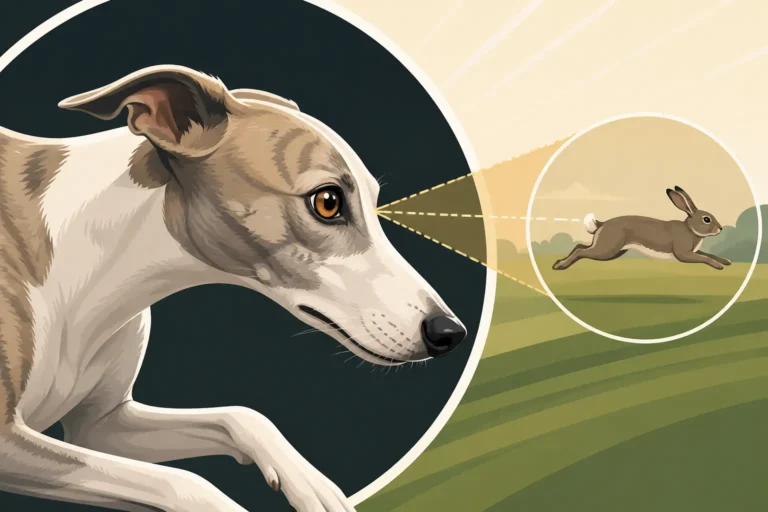
Both breeds are sighthounds: they were developed to notice movement and run after it, and many are affectionate, sensitive dogs indoors. The differences people notice most often come down to size, background, energy in short bursts, and the individual dog—not a simple rule that one breed is always gentle and the other always lively.
| Temperament trait | Whippet | Greyhound |
|---|---|---|
| Home life | Often quiet and affectionate, with regular bursts of play | Often quiet and restful, especially once settled into a routine |
| Exercise style | Enjoys brisk play and sprinting, followed by downtime | Enjoys running and walks, but many are content with a comparatively calm routine |
| Size and presence | Smaller, though still athletic and quick | Larger and physically more substantial |
| Sensitivity | Often responsive to calm, patient handling | Often responsive to calm, patient handling |
| Chase instinct | Can be strong, especially around small moving animals | Can be strong, especially around small moving animals |
| What affects behavior most | Individual temperament, socialization, health, and daily routine | Individual temperament, socialization, health, and daily routine |
Why the breeds can feel similar
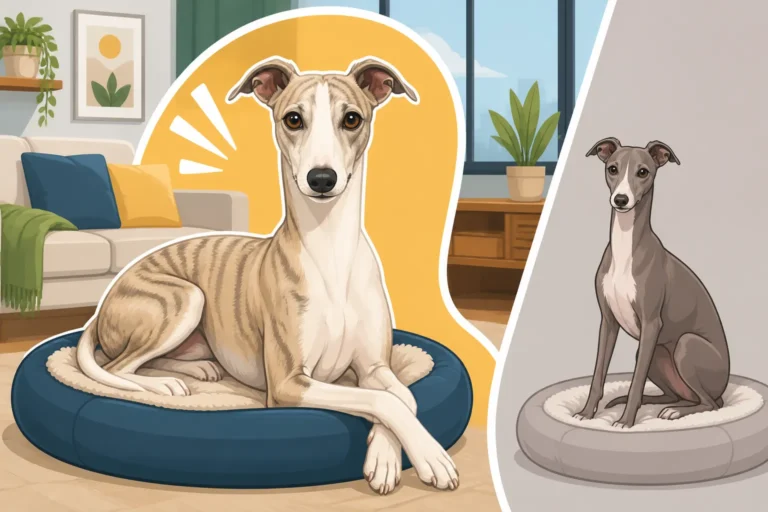
Whippets and Greyhounds share a sighthound temperament pattern that can surprise people who expect a high-energy dog all day. A dog might enjoy a fast run in a safely enclosed space and then spend the afternoon sleeping on the sofa. That contrast is normal for many individuals; a quick sprint does not necessarily mean a dog needs hours of nonstop activity.
Both breeds can be closely bonded with their people and may prefer a comfortable, predictable home to a busy environment full of noise and constant handling. Some are outgoing with visitors, while others take a little time to warm up. A quiet dog is not automatically shy, and a dog that hangs back at first is not necessarily unfriendly. Give each one room to approach at its own pace.
If you are comparing the breeds because the Greyhound seems like a larger Whippet, temperament is only part of the picture. Their shared history and physical similarities are explored in The Whippet Against the Greyhound and the Italian Greyhound and The Whippet Against a Greyhound. Those comparisons can help put the relationship between the breeds in context without treating either one as a guaranteed personality type.
Where people often notice a difference
A Whippet’s smaller frame can make its play look more animated in a living room or yard. Many Whippets enjoy a game, a dash around a fenced area, or an energetic greeting, then settle quickly when the fun is over. This can make them seem more sprightly than a Greyhound, but individual Whippets vary: some are reserved homebodies, while some Greyhounds are playful and enthusiastic.
Greyhounds are larger, and that changes the practical feel of their behavior. A friendly Greyhound may be gentle, but a large dog leaning against you or crossing a narrow hallway takes up more space than a Whippet doing the same thing. The dog’s body size is not a temperament flaw; it simply means that household layout, leash skills, and comfortable resting spots deserve extra thought.
Neither breed should be judged by a single first impression. A Greyhound who is quiet in a new home may be adjusting, and a Whippet who races around the living room may be excited rather than unusually demanding. Look for patterns over time: how the dog responds to rest, visitors, handling, walks, and everyday household sounds.
Energy, exercise, and life indoors
A Whippet or Greyhound may be a good match for someone who wants a calm companion indoors, but neither should be chosen on the assumption that a fast dog can be left to exercise itself. Both need appropriate walks, opportunities to move safely, and a home routine that supports rest. The right amount depends on the dog’s age, health, fitness, and temperament.
Sprinting is different from constant activity
Sighthounds are built for speed, but speed is not the same thing as endurance. A Whippet may have a lively burst of play and then want to curl up. Many Greyhounds also enjoy short periods of energetic movement followed by long stretches of rest. That rhythm can make either breed a comfortable indoor companion when its exercise and enrichment needs are met.
A dog who gets an exciting run is not automatically ready to spend the rest of the day without interaction. Walks, sniffing, training games, and calm time with the family all contribute to a satisfying routine. For practical ideas about matching movement to the breed, see How Much Exercise a Whippet Really Needs and How Much a Whippet Sleeps More Than Most Breeds. Exercise should be adjusted to the dog, not based only on its breed label or athletic appearance.
If the dog is young, building up activity gradually matters. Puppies and adolescents may be enthusiastic without having the maturity or conditioning for repetitive, strenuous exercise. A senior dog may still enjoy a run but need more recovery time or shorter outings. If a dog’s behavior or stamina changes suddenly, ask a veterinarian whether pain or another health issue could be involved.
What “calm indoors” actually means
A calm dog is not necessarily a dog that never gets excited, never barks, or never needs attention. It may mean that after a walk or play session, the dog can settle comfortably while the household carries on. Some Whippets and Greyhounds learn this routine readily; others need help practicing it, especially after a move or adoption.
A comfortable bed can help establish a dependable place to rest. Because both breeds are lean, many appreciate soft bedding rather than a hard floor. If you are choosing supplies online, including through Chewy, pay attention to the bed’s dimensions and washable materials rather than assuming a product sized by weight will suit a long, narrow body. A dog that repeatedly avoids its bed may prefer a different shape or location.
A home’s pace also matters. A Whippet or Greyhound in a quiet household may settle differently from one living with frequent visitors, children, or other energetic pets. Give the dog a retreat where it can rest undisturbed. If it seems overwhelmed, reducing the noise and giving it a break is often more useful than asking it to tolerate more stimulation.
Sensitivity, training, and social behavior
Both breeds often respond best to clear, patient handling. A dog that hesitates or disengages may be uncertain, distracted, tired, or uncomfortable—not deliberately stubborn. The goal is to make desirable behavior easy to understand and reward, rather than relying on intimidation or harsh corrections.
Training a sensitive sighthound
Keep training sessions brief and rewarding. For example, practice a relaxed greeting, a short recall game in a fenced space, or waiting at a doorway. End on an easy success before the dog loses interest. A Whippet may be quick to learn but still choose to ignore a cue when something more compelling catches its eye; a Greyhound may also have moments when the surroundings matter more than the person holding the leash.
Use food, toys, praise, or another reward the dog genuinely values. If a dog is startled by a loud voice or physical correction, it may become more worried instead of understanding what to do. A calm reset—creating distance from the distraction and rewarding a small step in the right direction—often gives clearer information.
The breeds’ speed and interest in moving animals make reliable off-leash recall a safety concern. Do not assume that a dog who comes when called in the kitchen will return during a chase. Use a secure, fenced area for off-leash exercise unless you have a safe setup and a well-practiced plan. Thirty Five Miles an Hour and No Brakes on a Whippet's Recall explains why recall can be difficult when a sighthound is focused on movement.
Meeting strangers, children, and other pets
Temperament around people varies widely. Some dogs greet visitors warmly; others prefer to observe before joining in. Let the dog choose whether to approach, and ask visitors not to lean over, corner, or reach suddenly toward a hesitant dog. Children should be taught to leave a resting dog alone and to interact gently, with an adult supervising.
The same care applies to other pets. A Whippet or Greyhound may live peacefully with cats or small dogs, particularly when introductions are gradual and management is thoughtful, but a calm history indoors does not erase the possibility of a chase response. Use barriers and close supervision while animals get acquainted. Do not leave a small pet alone with a newly introduced dog until you have a well-established, safe routine.
A dog’s past experience can shape its behavior as much as breed. A Greyhound adopted after a period in a kennel or racing environment may need time to learn household routines, stairs, slippery floors, or everyday appliances. A Whippet raised in a family home can still be cautious in unfamiliar places. When considering a particular dog, ask what it has experienced and observe how it responds to new people and situations.
Choosing the right breed for your household
The best choice is not necessarily the breed that sounds calmer on paper. It is the individual dog whose needs, history, and personality fit the life you can realistically offer. Think about the dog’s daily routine, the space available, the household’s noise level, and how you will safely manage its movement and chase instinct.
Questions to ask before bringing a dog home
Ask a breeder, rescue, or previous caregiver how the dog behaves when left alone, how it responds to unfamiliar people, and whether it has lived with children or other animals. Ask what kind of exercise it enjoys and how it settles afterward. Specific examples—such as “rests quietly after a walk” or “needs a calm introduction to visitors”—are more useful than a broad description like “easygoing.”
If you are considering a Greyhound, learn about that dog’s individual background rather than assuming every Greyhound has the same history. If you are considering a Whippet, ask about its usual activity level and comfort with household routines. A foster caregiver who has seen the dog in a home may be able to describe day-to-day habits that are difficult to judge during a brief meeting.
Also consider the practical differences. A Greyhound’s size affects beds, car space, and how easily the dog can turn around in a small area. A Whippet is more compact, but it still needs secure handling and comfortable places to rest. When shopping at Chewy or another retailer, check measurements carefully for coats, beds, and harnesses; a slim waist and deep chest can make ordinary size labels misleading.
Matching temperament to your home
A quieter home may suit a dog who prefers a predictable routine, while a busier home can work if the dog has a peaceful place to withdraw and family members respect its boundaries. Neither breed should be expected to tolerate constant activity simply because it is athletic. Make room for rest, regular exercise, and calm interaction.
If you work away from home, consider how the individual dog handles time alone and what support you can arrange. Some dogs settle comfortably with a gradual routine; others may struggle and need a different plan. Separation Anxiety in a Whippet discusses one concern that can affect a Whippet’s ability to be left. Similar signs in a Greyhound also deserve patient attention and, when needed, professional help.
For many households, the most useful comparison is not “Which breed is more affectionate?” but “Which dog’s needs can we meet consistently?” A Whippet and a Greyhound can both be affectionate companions, yet differ in size, background, confidence, and energy. Meeting the dog, asking detailed questions, and watching how it behaves after the initial excitement will tell you more than a breed stereotype.
Disclaimer
This article is for general informational purposes only and does not constitute professional advice. Laws, prices and regulations vary by location and change over time. Consult a qualified professional for guidance on your specific situation.