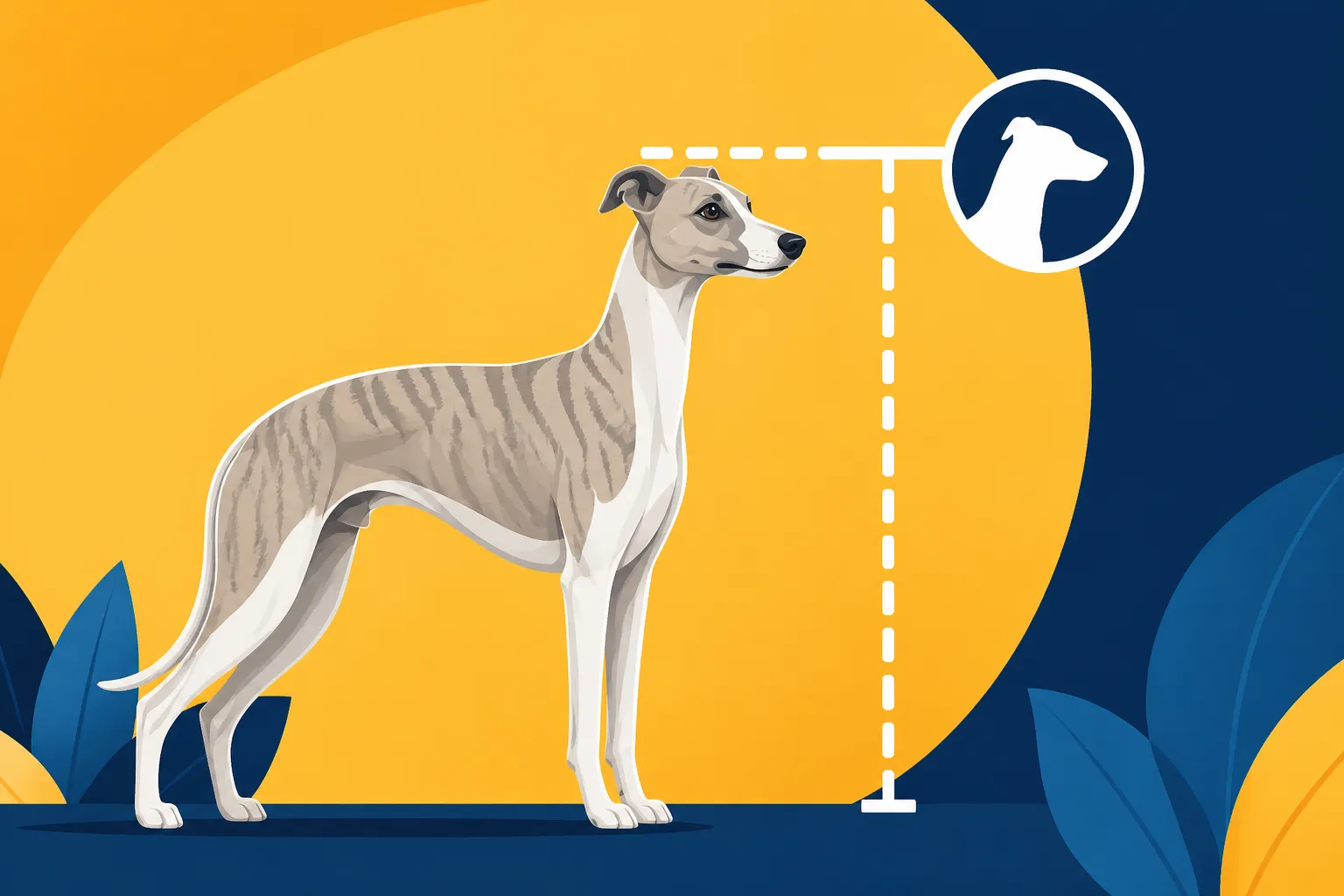
The Height Limit a Whippet Is Shown Under
A Whippet can look perfectly proportioned at home and still leave its owner wondering whether it falls inside the height range for the show ring. The answer depends on the country and registry, and a dog’s height is measured at the withers—not by eye or from the top of its head. This guide explains the standard, how measurement works, and what an out-of-range result means.
Whippet show height limits depend on the standard
There is no single worldwide height limit for every Whippet show. Breed standards are set by kennel organizations, and their wording and measurement units can differ. Before planning a conformation entry, check the standard and show rules that apply to that event.
The AKC height range in the United States
Under the American Kennel Club breed standard, the height range is 19 to 22 inches for dogs and 18 to 21 inches for bitches. The standard describes a deviation from those ranges as a serious fault. That makes height an important part of conformation assessment, but it is only one part of the picture: judges also evaluate the dog’s overall balance, structure, movement, and breed type.
The words “dog” and “bitch” in a breed standard refer to the male and female categories. The limits are not a recommendation to aim for the middle at all costs, nor do they mean that the tallest dog within range is automatically better. A Whippet at the lower end of the permitted range can still be sound and well balanced; a taller Whippet can be within range but have other qualities that affect its evaluation.
If you are comparing your dog with a published range, measure carefully before drawing conclusions. A Whippet that appears tall beside a smaller companion may still be within the standard, while a dog that looks compact can be close to the lower boundary. If you want a fuller discussion of overall stature, see How Tall a Whippet Stands.
How standards differ outside the United States
Other kennel organizations may use different measurements or wording. For example, the UK standard gives a height range of 47 to 51 centimeters for dogs and 44 to 47 centimeters for bitches. These figures are not direct conversions of the AKC ranges, so an owner should not assume that a Whippet assessed under one country’s standard will be judged by another country’s limits in exactly the same way.
A difference of a few centimeters can matter when a dog is close to the edge of a range. It is also easy to get confused when a website, breeder, or show friend quotes a height without saying which standard they mean. Ask whether the figure comes from the AKC, the UK Kennel Club, an FCI standard, or another organization, and confirm that it applies to the show you plan to enter.
For a quick comparison, use this as a starting point, then verify the relevant rules with the governing organization or show club.
| Standard | Male Whippet | Female Whippet | What to keep in mind |
|---|---|---|---|
| AKC in the United States | 19 to 22 inches | 18 to 21 inches | A deviation is described as a serious fault |
| UK Kennel Club | 47 to 51 centimeters | 44 to 47 centimeters | The ranges are stated in centimeters |
The table is not a substitute for the official breed standard or show regulations. Rules can differ by registry and event, including how a disputed measurement is handled. The broader question of whether a formal height range is part of a standard is covered in Whether the Whippet Standard Sets a Height Limit.
Height is only one part of breed type
A Whippet is not judged as a measuring-stick exercise. The standard describes a functional, balanced sighthound, and the judge considers how the dog’s parts fit together. A dog can be within the stated height range yet still be less convincing in outline or movement than another dog of appropriate size.
This is one reason owners can receive conflicting opinions. Someone may say, “That dog is too big,” based on its appearance beside a smaller Whippet, while a formal measurement places it comfortably inside the range. Conversely, a dog can look delicate and compact but measure close to the lower limit. Visual impressions are useful for conversation, but they do not replace an accurate measurement under the applicable rules.
How a Whippet’s height is measured
The official measurement point is the withers: the highest point of the shoulder blades where the neck meets the back. It is not the top of the head, the tips of the ears, or the highest point of the spine. A dog that raises its head proudly does not become taller by that measure, and a rounded or roached topline should not be used as the reference point.
Help your dog stand naturally
For a useful home measurement, place your Whippet on a firm, level surface. A non-slip floor or a stable grooming table can help, provided your dog is comfortable and safely supported. The dog should stand naturally, with weight distributed across all four feet rather than leaning, crouching, or stretching upward toward a treat.
A helper can gently keep the dog settled while you identify the top of the withers. Use a reliable measuring stick or a rigid right-angle measuring device designed for measuring height. A flexible tape held along the dog’s body can follow curves and give a misleading result. If you do not have suitable equipment, ask a breeder, experienced exhibitor, veterinarian, or show club member to demonstrate the method.
Make the experience calm and brief. Some Whippets become wiggly when someone reaches over their shoulders or adjusts their feet. Practice standing quietly and being touched around the neck and shoulders before bringing out measuring equipment. If you use small rewards, keep them modest and factor them into your dog’s normal daily food. For example, you could use a few tiny training treats purchased with your usual pet supplies from Chewy, rather than turning measurement practice into an extra meal.
Why repeated measurements may not match
A home measurement can vary from one attempt to the next because the dog’s posture changes, the floor is uneven, or the measuring tool is angled. A dog that is tense may brace its legs; a dog that is distracted may shift its weight. Even a small change in where you place the measuring device can produce a noticeably different result when the dog is near a boundary.
Take more than one careful reading, but do not keep measuring until you get the number you hoped for. If readings differ, pause and check your setup: Is the surface level? Is the dog standing squarely? Is the tool vertical? Are you measuring at the withers? A qualified person who has measured dogs for conformation can help distinguish a genuine close call from a handling or equipment error.
A formal measurement at a show is not necessarily identical to a casual measurement at home. Show procedures depend on the organization and its rules, and a measurement may be carried out only under particular circumstances. Rather than assuming every judge will measure every entry, read the show regulations and ask the club secretary or show organizer how measurement questions are handled.
Puppies and young adults can still be growing
A puppy’s height is not a final prediction of adult show size. Whippets grow quickly during early development, then continue changing in proportion and substance as they mature. A young dog that currently sits below the adult range may grow into it; one that is already near the upper boundary may still change as it develops.
Avoid trying to accelerate or limit growth through feeding. A puppy should receive appropriate nutrition and routine veterinary care, not a restricted diet intended to keep it small or excessive food intended to make it grow faster. Growth and body condition are related but not interchangeable: a lean dog can be tall, and a heavier dog is not necessarily taller at the withers.
If you are selecting a puppy for showing, discuss the parents’ size, relatives’ size, and the breeder’s experience with mature dogs from those lines. Even with that information, no breeder can guarantee the exact adult height of an individual puppy. For a deeper comparison of conformation and performance-bred dogs, see How Show Whippets Differ in Size From Racing Whippets.
What happens if a Whippet is outside the range
An out-of-range measurement does not erase a dog’s identity, affection, athletic ability, or place in the family. It may, however, affect how the dog is assessed in a conformation show under the rules that apply there. The practical consequence depends on the registry, the exact standard, and the event’s measurement procedure.
A serious fault is not the same as a different breed
Under the AKC standard, height outside the specified range is described as a serious fault. A fault is a conformation term: it indicates a feature that does not meet the ideal described by the standard. It does not mean that a registered Whippet suddenly becomes another breed, and it does not automatically say anything about the dog’s temperament, health, or suitability as a companion.
Show eligibility and judging are separate questions. An event may have its own entry requirements, and the judge evaluates each dog according to the relevant standard and rules. If your Whippet measures just outside the range, ask the show organization what that means for a specific entry rather than relying on informal advice from social media or a ringside conversation.
A small measurement difference deserves particular care. If one reading is slightly outside the range and another is inside, the discrepancy may reflect stance or measuring technique. That is a reason to confirm the measurement properly, not to repeatedly reposition the dog until the number changes.
Being undersized does not make a Whippet less purebred
Height is not a DNA test. A Whippet may be unusually small or large and still be a purebred dog; size alone does not establish parentage or pedigree. Registration records and breeding documentation are separate from whether the individual dog meets every point of the show standard.
It is also important not to assume that a shorter Whippet is necessarily healthier or that a taller one is necessarily less sound. Height by itself cannot tell you whether a dog has a medical problem. If growth seems unusual or is accompanied by concerns such as poor appetite, low energy, or difficulty moving, discuss those signs with a veterinarian rather than trying to diagnose the issue from a breed-standard chart.
Owners who want to understand the distinction between breed identity and conformation can read Whether an Undersized Whippet Is Still Purebred. For context on how different breeding goals may influence size and outline, The Split Between Racing and Show Whippets offers a useful related discussion.
Decide whether showing still makes sense for your dog
If your Whippet falls outside the standard, you do not have to stop enjoying dog activities. Conformation is only one possible outlet. Depending on your dog’s age, health, training, and interests, you might enjoy walks, scent activities, lure-based sports, or simply a comfortable life as a family companion. Some show-bred dogs participate in performance activities too; the dog’s welfare and suitability should guide the choice.
If your goal is specifically a conformation title, be realistic before investing heavily in travel, entry preparation, or handling instruction. Get an accurate measurement, check the applicable standard, and speak with a knowledgeable breeder or exhibitor who can explain the rules without promising a particular result. A Whippet that is outside the range may still be wonderful to live with, even if its prospects in that specific ring are limited.
For owners balancing show interests with athletic activities, Whether a Show Whippet Can Still Race explores how those interests can overlap. And if you are comparing a dog’s size with its overall build, What a Whippet Actually Weighs can help separate height from weight and body condition.
Preparing for a show without fixating on the number
Height is a straightforward measurement, but preparing for a show involves more than standing a dog beside a ruler. A calm, confident Whippet is easier to assess and more comfortable in the ring. Focus on sound preparation, clear information, and your dog’s experience rather than treating one number as the whole story.
Practice handling in short, positive sessions
Teach your Whippet to stand quietly, accept gentle handling around the shoulders, and remain relaxed while someone looks at its outline. Keep practice short, especially if your dog is young or easily bored. Reward calm behavior and stop before the dog becomes frustrated. A dog that learns measuring and examination are ordinary, low-pressure activities is less likely to fidget when it matters.
If you are using food rewards, choose pieces that are small enough to avoid overfeeding through repeated practice. Chewy may be one place owners look for training treats, but the label and the dog’s individual dietary needs matter more than the shop. Check ingredients if your Whippet has a known sensitivity, and account for treats in its daily ration.
Do not press a dog into a strained pose just to make the measurement easier. A natural, balanced stance is more useful than a forced stretch. If your Whippet is anxious about being handled, work gradually and consider asking a qualified trainer or experienced exhibitor to help you build comfort.
Keep records and ask the right questions
Write down the date, the measurement, the equipment used, and whether your dog stood naturally. If you are tracking a young Whippet’s growth, note changes over time rather than treating a single reading as definitive. Share the record with your breeder or veterinarian if you have a specific concern.
Before entering a show, confirm which standard applies, how the event handles measurement questions, and whether there are additional entry requirements. Ask the organizer rather than relying on a general online answer, especially if your dog is close to a limit. Keep the question simple: “Which height standard applies to this show, and what is the procedure if a dog’s measurement is disputed?”
Finally, remember what the number can and cannot tell you. It can help determine how a Whippet compares with a conformation standard. It cannot measure character, the pleasure of a walk together, or the value of the dog as a companion. A show result is one piece of information about a dog’s fit with a written ideal—not a verdict on the dog you love.
Disclaimer
This article is for general informational purposes only and does not constitute professional advice. Laws, prices and regulations vary by location and change over time. Consult a qualified professional for guidance on your specific situation.