Where a Whippet’s Arch Should Begin
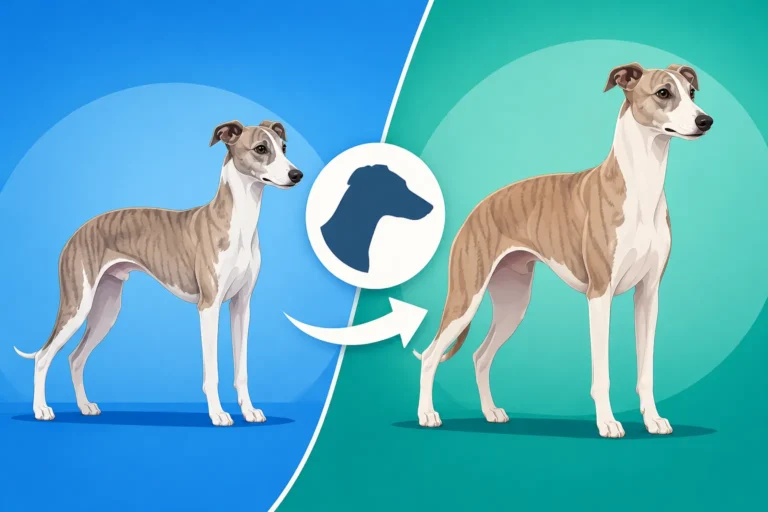
A Whippet’s topline can look confusing in a photo: the back may seem nearly flat, sharply arched, or simply different depending on how the dog is standing. The key is to look for a gentle rise over the loin, beginning around the end of the rib cage—not a hump across the back. This guide explains where that arch belongs and how to assess it without mistaking posture or muscle for structure.
Where the Whippet’s Arch Should Begin
Look at the transition from ribs to loin
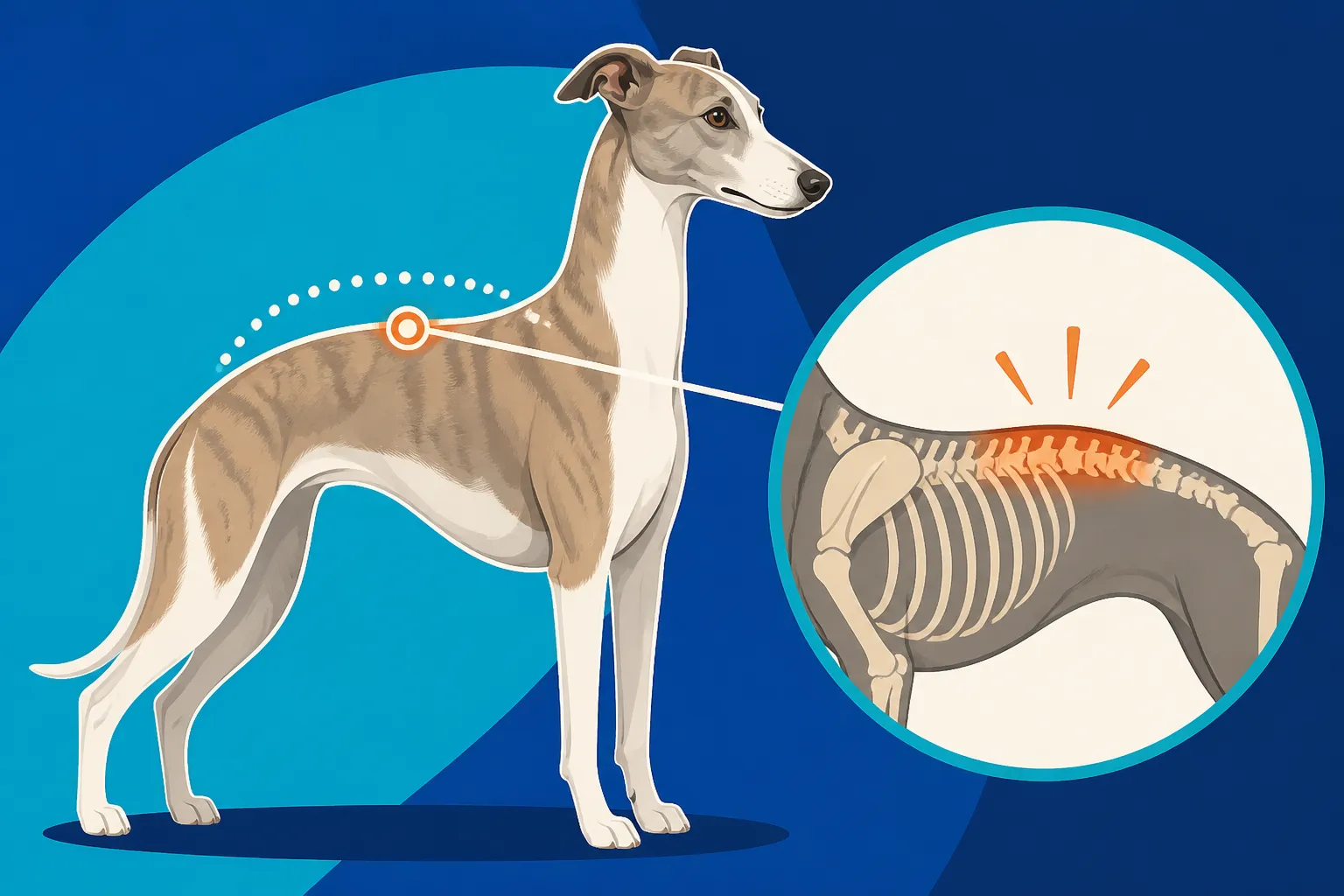
A Whippet’s arch belongs over the loin, the short section of the back between the end of the rib cage and the pelvis. Viewed from the side, the topline should rise gradually from the back into this area, reach its highest point over the loin, and then flow down toward the croup. The curve should look smooth and balanced rather than like a sudden bump.
In practical terms, look for the rise to become visible around the point where the rib cage ends and the waist begins. It should not start up at the shoulders, and it should not look like a hump placed in the middle of the dog’s back. The Whippet’s shape is a series of connected lines: neck and shoulders, back, loin, croup, and tail. The arch is one part of that outline, not a stand-alone feature.
Breed standards and judging traditions may describe the topline in slightly different language. Some emphasize a slight arch; others describe a definite rise over the loin. Either way, the intended shape is a controlled, graceful curve over the lumbar area. For a broader explanation of how this feature fits into the breed’s outline, see Why the Whippet Standard Cares So Much About the Topline.
Find the high point without demanding a dramatic curve
The high point should sit over the loin, not at the shoulder blades and not far back over the hips. A Whippet’s arch is often more subtle than people expect, especially when the dog is relaxed, young, or not carrying much muscle over the loin. A photograph taken from above or at an angle can make the curve look steeper or flatter than it really is.
Try tracing the topline with your eyes rather than focusing only on the highest point. Does the back rise gradually into the loin? Does it then descend smoothly toward the croup? A balanced outline usually reads as a flowing curve. If your eye catches on an abrupt “step” or a high, rounded bump, consider whether the dog is standing awkwardly or whether the camera angle is distorting the line before deciding that the structure is unusual.
The arch also needs to be considered alongside the rest of the dog. The Whippet is built for speed, with a deep chest, a pronounced tuck-up, and strong hindquarters. A beautiful curve in isolation does not make a balanced topline if the rest of the outline is poorly proportioned. For a closer look at the arch’s role in the whole dog, read What a Whippet's Arch Actually Does.
How to Assess the Arch on a Standing Whippet
Set up a fair side view
For a useful look, observe the dog standing naturally on a level, firm surface. A side-on view is usually more informative than a view from above, and the camera should be held around the dog’s mid-body height rather than pointed sharply down. Take more than one photo if you can; a single snapshot may catch a step, stretch, or tail movement that changes the apparent outline.
The dog should not be pulled into position by the collar or leash. Tension can make the neck, shoulders, and back look different, while a dog leaning forward or bracing its hind legs may alter the line over the loin. Let the Whippet settle with its weight comfortably distributed. If it is fidgeting, panting, or turning toward a noise, wait for a calmer moment rather than trying to interpret a distorted stance.
A non-slip surface helps the dog stand without sliding. If you need one, you might find a suitable mat through a pet retailer such as Chewy, but the important thing is that it lies flat and does not shift underfoot. A soft, cushioned dog bed is less useful for judging the outline because it can change the dog’s balance. A familiar mat can be comfortable for standing; a plush Chewy bed is better thought of as a resting place than an assessment surface.
Check posture, coat, and muscle before judging shape
A Whippet may look more arched when it is alert and standing with its head raised, or flatter when it is relaxed and slightly slouched. Coat length and color can also change how clearly the topline shows. Dark markings, shadows, and a tight-fitting coat may create visual lines that are not part of the skeleton. When comparing dogs, try to compare them in similar stances and lighting.
Muscle matters too. A fit adult may have more definition over the loin and hindquarters than a growing puppy or a dog returning to exercise after a quiet period. That does not mean every difference in the topline is caused by conditioning, but it is a reason not to judge a dog from one image alone. Age, posture, body condition, and recent activity all affect what you see.
If you are considering a puppy or evaluating a dog for breeding or the show ring, ask an experienced Whippet breeder or conformation judge to assess the dog in person. Photos can help start a conversation, but they cannot show how the topline looks through movement or how the structure fits the dog as a whole. If you take reference photos at home, a nonslip mat—whether bought from Chewy or another retailer—can help create a more consistent standing position without forcing the dog into a pose.
| What you see | What it may indicate | What to check next |
|---|---|---|
| A smooth rise over the loin | A typical arched topline | Look at the whole outline and the dog’s stance |
| A sharp bump in the middle of the back | Possible posture, camera-angle, or structural difference | Observe the dog standing naturally from the side |
| A nearly level topline in one photo | Relaxed posture, angle, or a genuinely flatter outline | Compare several calm, side-on views |
| A very steep-looking curve | The dog may be bracing, stretching, or photographed at an angle | Check weight distribution and take another view |
| A curve that changes after exercise | Muscle tone or posture may affect the appearance | Consider age, conditioning, and the dog’s normal movement |
Distinguishing a Correct Arch From Other Back Shapes
A Whippet arch is not the same as a roach
The terms “arch” and “roach” are sometimes used casually as if they mean the same thing, but they can describe different impressions. A Whippet should have a rise over the loin; that does not mean the back should look sharply humped. A pronounced, abrupt curve extending across the back may be described as roached, but the word can be used inconsistently in everyday conversation.
The distinction is easier to understand when you consider location and smoothness. A breed-appropriate arch is concentrated over the loin and flows into the croup. A more obvious hump may look higher, rounder, or longer than that expected curve. The dog’s posture can complicate the view, so avoid labeling a back shape based only on a snapshot or a casual remark.
For more on the difference in appearance and terminology, see Whether a Whippet's Back Should Be Roached. It is also helpful to understand how the topline can relate to movement: How a Whippet's Roach Affects Its Speed discusses that question in more detail.
A flatter back is not automatically a fault
A dog may look flat-backed in a photograph because it is standing in a relaxed posture, because the camera is angled, or because its coat and lighting hide the curve. A young or lightly muscled Whippet may also show a less obvious rise than a mature, well-conditioned dog. One view is not enough to decide whether the topline is genuinely flat.
If the back appears level in repeated side-on views, it is reasonable to ask a knowledgeable person for an assessment. That still does not mean the dog has a health problem. Conformation describes how a dog’s structure compares with a breed ideal; it is not, by itself, a diagnosis. For the breed-standard question, see Whether a Flat Backed Whippet Is Faulted.
A deep tuck-up can also make the loin appear more arched than it is. The waist rising sharply behind the chest is a separate feature from the topline rising over the loin. Looking at those lines together helps prevent a common mistake: treating the underside of the body as proof of the shape of the back. Whether a Whippet's Tuck Up Can Be Too Deep explains that related feature.
Why the Arch Matters and When to Ask for Help
The topline is part of a working outline
The arch is not decorative. It is one element of the Whippet’s characteristic outline, alongside a deep chest, flexible body, strong loin, and powerful hindquarters. Those features work together in a running dog. The topline needs to be understood as part of that overall design, not as a curve that should be exaggerated for visual effect.
That is why “more arch” does not automatically mean “better.” A dramatic hump may attract attention in a still image, but the breed’s desired shape is about balance and a smooth transition through the back and loin. The outline should make sense both when the dog is standing and when it moves. For a useful comparison of sighthound body types, see The Whippet Against the Greyhound and the Italian Greyhound.
It is also worth separating appearance from body condition. A Whippet is naturally lean, and visible ribs or a tucked waist do not, by themselves, tell you whether the topline is correct. If you are unsure whether your dog is too thin or simply built like a Whippet, compare the dog’s whole body condition and ask your veterinarian rather than trying to judge weight from the back’s curve alone. What a Whippet Actually Weighs offers more context on the breed’s build.
Know when a change deserves a veterinary conversation
A topline that has always looked a particular way is different from a new change in shape. If your dog suddenly appears hunched, guards its back, moves stiffly, avoids jumping, or seems painful when handled, contact your veterinarian. Those signs are reasons to look for a health explanation, not to debate whether the arch matches a show standard.
Likewise, an unusual outline in a photograph should not be treated as evidence of a spinal condition. Camera angle, posture, muscle, and body condition can all affect appearance. If you are concerned, take a clear side-on picture for reference, note when you first noticed the change, and describe any differences in movement or comfort to your veterinary team.
For an ordinary conformation question, a breeder or experienced Whippet judge can help you understand where the loin begins and how the topline flows into the croup. For pain or a sudden physical change, start with a veterinarian. Keeping those questions separate makes it easier to get the right kind of answer without worrying over every curve in a casual photo.
Disclaimer
This article is for general informational purposes only and does not constitute professional advice. Laws, prices and regulations vary by location and change over time. Consult a qualified professional for guidance on your specific situation.