Whether the Whippet Is Genetically Close to the Greyhound
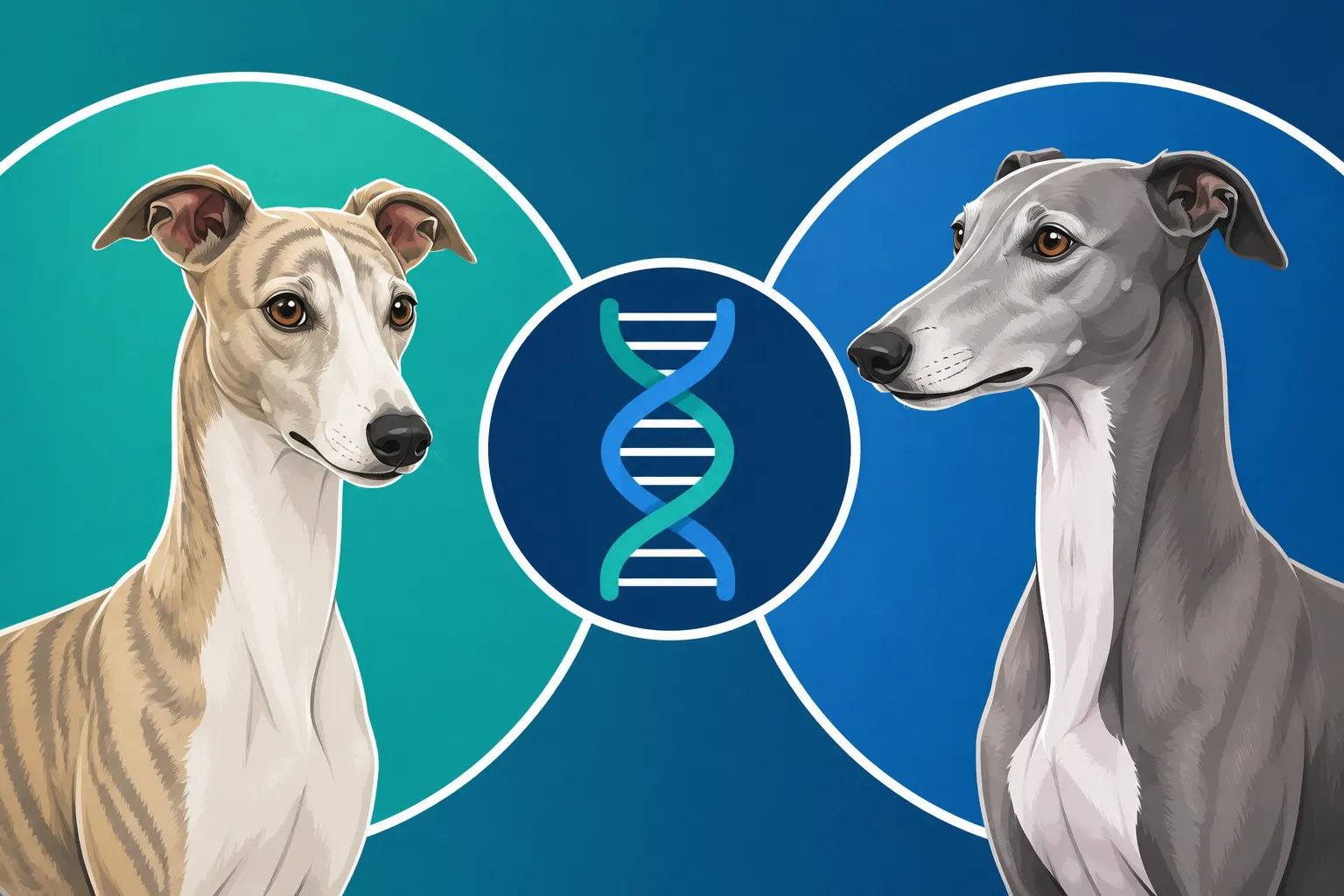
A Whippet can look like a smaller Greyhound, and the two breeds share a close sighthound ancestry. But that resemblance does not mean a Whippet is simply a miniature Greyhound or that the breeds are genetically interchangeable. This guide explains what their relationship means, where they differ, and how to interpret breed-DNA results without overreading them.
How closely related are Whippets and Greyhounds
They share sighthound ancestry
Whippets and Greyhounds are both sighthounds: dogs developed to notice moving prey, pursue it at speed, and use vision more than scent when hunting. Their long legs, deep chests, flexible backs, and lean outlines reflect some of the same functional demands. Those shared traits are a visible clue to related ancestry, though appearance alone cannot tell you precisely how closely two breeds are related.
The Whippet is generally understood to have developed from Greyhound-like dogs, with its own history as a smaller, practical working dog. It was not created simply by taking modern Greyhounds and shrinking them. The breed developed as a distinct population, shaped by the needs and preferences of the people who kept and bred it. For more on its beginnings, see Where the Whippet Was Developed.
Greyhounds and Whippets also share a broader relationship with other sighthound breeds. Similar body shapes can arise when dogs are selected for similar jobs, so resemblance does not prove that one breed is just a smaller version of another. The Whippet’s history and identity are better understood through its own development, including Which Breeds Went Into the Whippet and The Whippet Against the Greyhound.
Close kin does not mean the same breed
A useful way to picture the relationship is to think of the breeds as close relatives rather than copies. They may share ancestors and many physical characteristics, but each has its own established breed population, history, and typical traits. “Genetically close” describes a relationship; it does not erase the differences built up through generations of separate breeding.
That distinction matters in practical settings. A Whippet is not automatically a Greyhound because it is tall, unusually fast, or resembles a racing dog. Likewise, a Greyhound-shaped mixed-breed dog is not necessarily a Whippet. Breed identity reflects ancestry across generations, not a single feature such as height or body outline.
The comparison can be helpful, but it has limits:
| Feature | Whippet | Greyhound |
|---|---|---|
| Breed relationship | A distinct sighthound breed with shared ancestry with Greyhounds | A distinct sighthound breed and close relative of the Whippet |
| Typical build | Smaller and lighter overall | Generally larger and more substantial |
| Shared traits | Lean body, deep chest, speed, and strong visual interest in movement | Lean body, deep chest, speed, and strong visual interest in movement |
| What appearance can tell you | It may suggest sighthound type, but cannot confirm ancestry | It may suggest Greyhound type, but cannot confirm ancestry |
| What a DNA test can tell you | Estimates breed ancestry from the dog’s DNA and the test’s reference data | Estimates breed ancestry from the dog’s DNA and the test’s reference data |
These are general comparisons, not rules for identifying an individual dog. Within each breed, dogs vary in size, shape, and athletic style. A Whippet from racing lines may look different from a show-bred Whippet, and individual Greyhounds can vary too. The broader history of those differences is explored in The Split Between Racing and Show Whippets.
Why Whippets and Greyhounds look alike
Shared function shaped similar bodies
Both breeds were selected for speed and the ability to chase by sight. A deep chest provides room for the heart and lungs, while long limbs and a flexible body help create an efficient running stride. Those features do not belong exclusively to either breed. They are part of a body plan that has proved useful for fast pursuit.
This is why people sometimes mistake a large Whippet for a small Greyhound, or assume that any sleek, long-legged dog must be one of the two. The silhouette provides a clue about function and type, but it is not a genetic test. Other sighthounds can share some of the same proportions, and mixed-breed dogs may inherit a similar outline.
It also explains why visual comparison can get confusing when dogs are young or underdeveloped. A lanky adolescent Whippet may look especially leggy; a Greyhound with a compact build may seem less imposing than expected. Breed is assessed from a whole collection of traits and ancestry, not from one snapshot. For a closer look at the Whippet’s structure, see Why the Whippet Standard Cares So Much About the Topline.
Breed history and breeding goals created differences
Although the two breeds have related roots, they were shaped in different contexts. Whippets became known as smaller, fast dogs that could be kept and raced by working people, while Greyhounds developed as a larger sighthound type. Those historical roles influenced which sizes and proportions people favored over time.
Breeding goals can also vary within a breed. Some Whippet lines are associated with showing, others with racing or performance activities, and many are bred as companions. These categories are not absolute, and a dog’s line does not determine every aspect of its temperament or ability. Still, different selection priorities can affect the look of individual dogs, making direct comparisons tricky.
That variation is one reason a simple “Whippet equals small Greyhound” explanation falls short. It overlooks the Whippet’s separate history and the ways a breed’s population can develop its own characteristic combination of size, movement, and temperament. The comparison between the two is covered further in How Much Smaller a Whippet Is Than a Greyhound.
What genetic closeness means in a DNA test
Consumer results are estimates, not a family tree
A consumer dog DNA test compares a dog’s genetic markers with reference samples used by that company. The result is an estimate of which breed populations the dog’s DNA most resembles. It can be useful for exploring a mixed-breed dog’s ancestry, but it is not the same as a complete historical record of every ancestor.
Closely related breeds can be harder to distinguish than unrelated ones because they may share more genetic variation. A test may identify a strong sighthound signal without resolving whether a particular ancestor was a Whippet, Greyhound, or another related breed. The outcome depends on the company’s reference panel and the way its analysis separates similar populations.
If you are looking at a consumer test through a retailer such as Chewy, treat the listing as a way to find a test—not as proof that the result will answer every ancestry question. Before ordering, read what the test says it can identify, how it handles mixed ancestry, and whether it offers details about its breed reference data. Chewy may be part of your shopping research, but the test provider’s explanation is what matters for interpreting the result.
How to read a result that names both breeds
A result that reports both Whippet and Greyhound ancestry does not automatically mean the dog is a cross between the two. It could reflect genuine ancestry, uncertainty in distinguishing closely related breeds, or a combination of both. The test’s percentages are estimates, and small reported portions deserve particular caution.
If your dog has known parents or a documented pedigree, that information is usually more useful for confirming recent ancestry than a consumer test alone. If the dog is a rescue with unknown history, the test may offer interesting clues, but it should be considered alongside physical traits and any information available from the rescue or prior owner.
When comparing options on Chewy or elsewhere, look carefully at the test’s purpose and limitations rather than choosing by the most confident-sounding claims. A result can be informative without being definitive. For a broader discussion of the breed’s genetic relationship to its larger relative, see How Closely the Whippet Descends From the Greyhound and Whether the Whippet Is Just a Small Greyhound.
What the relationship means for Whippet owners
Similar ancestry does not make care identical
Whippets and Greyhounds share many broad sighthound tendencies, but an owner should not assume that every care decision transfers unchanged from one breed to the other. Size, individual health, age, activity, and body condition all affect a dog’s needs. A Whippet’s appetite, exercise routine, comfort in cold weather, and response to handling should be assessed as that individual’s needs—not guessed from a Greyhound comparison.
The same applies to behavior. Both breeds may have a strong interest in moving animals, so secure management matters, but individual dogs differ in prey drive, recall, confidence, and sociability. A dog that looks relaxed on the sofa may still accelerate quickly after a squirrel or rabbit. Understanding the Whippet’s own behavior is more useful than relying on generalizations about all sighthounds.
For a broader overview of the breed’s home life and needs, read The Household a Whippet Was Built For. That context helps explain why Whippets can be athletic outdoors and devoted loungers indoors, without suggesting that every dog will fit the same pattern.
Use the comparison as a starting point, not a diagnosis
If someone tells you that your Whippet “must be part Greyhound,” it is reasonable to ask what they mean. They might be commenting on size, shape, or running style, rather than making a claim about documented ancestry. A visual impression can start a conversation, but it cannot establish a dog’s pedigree.
If you are choosing a puppy, look for clear information about the parents, breeding goals, and health testing rather than relying on labels such as “mini Greyhound.” A responsible breeder should be able to explain what breed the puppies are and provide relevant documentation. If you are adopting an adult dog, focus on the dog in front of you: its health, behavior, history, and needs.
Ultimately, Whippets and Greyhounds are closely related sighthounds with meaningful similarities and separate breed identities. Their shared appearance reflects shared ancestry and function, while their different histories and breeding populations explain why they are not interchangeable. DNA testing can add clues, especially for dogs with unknown backgrounds, but it should be interpreted as an estimate rather than a final verdict.
Disclaimer
This article is for general informational purposes only and does not constitute professional advice. Laws, prices and regulations vary by location and change over time. Consult a qualified professional for guidance on your specific situation.