How Much Smaller a Whippet Is Than a Greyhound
A Greyhound can look almost twice as substantial as a Whippet, but the difference is more than a number on the scale. Height, body length, chest depth, and build all affect how each dog fits into a home, car, or walking routine. This guide compares their typical sizes and explains what those differences mean in everyday life.
Whippet and Greyhound size at a glance
Typical height and weight
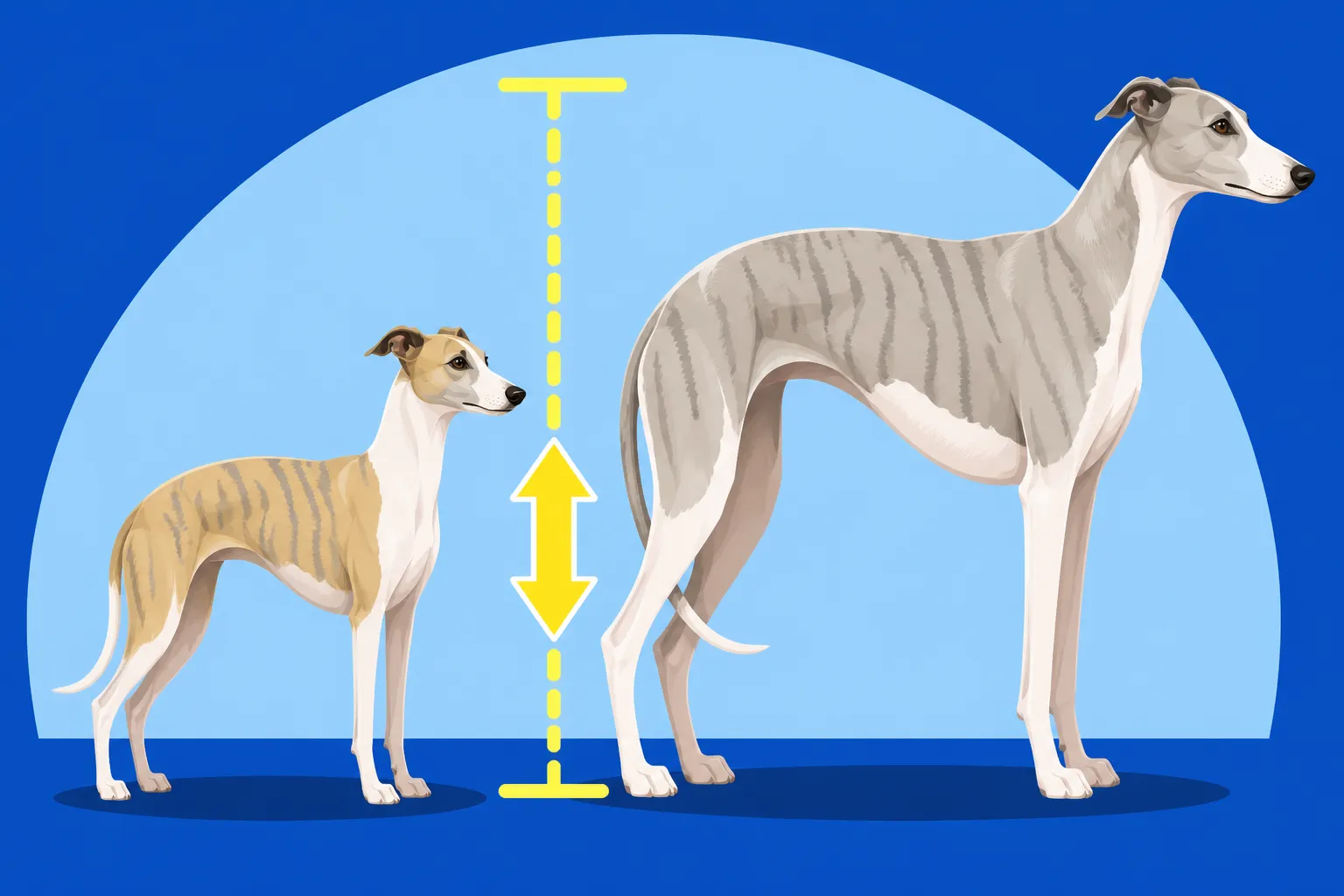
Whippets are noticeably shorter and lighter than Greyhounds, though the gap varies between individual dogs. A Whippet is generally around 18 to 22 inches tall at the shoulder. Greyhounds are often about 27 to 30 inches tall. That commonly puts a Greyhound roughly half a foot to a foot taller, depending on the dogs being compared.
Weight differences are just as apparent. Many adult Whippets weigh somewhere around 25 to 40 pounds, while adult Greyhounds often weigh roughly 60 to 70 pounds. These are broad ranges, not a pass-or-fail test. A dog’s sex, age, frame, condition, and breeding all influence its size, and a healthy Whippet may fall outside the middle of the usual range.
| Feature | Whippet | Greyhound |
|---|---|---|
| Typical shoulder height | About 18–22 inches | About 27–30 inches |
| Common adult weight range | About 25–40 pounds | About 60–70 pounds |
| General build | Medium-sized, fine-boned and athletic | Large, long-legged and athletic |
| Household footprint | Easier to lift and fit into smaller spaces | Needs more room for its longer frame |
| Common impression | Lean and compact | Tall and substantially larger |
The ranges above are practical generalizations. Breed standards describe an ideal rather than guaranteeing that every dog will fit a particular measurement. For breed background and a closer look at how the two dogs compare, see The Whippet Against the Greyhound.
Why the scale does not tell the whole story
A Greyhound is not simply a Whippet with a few extra pounds. Its longer legs, larger frame, and greater overall body length change how it moves through a room and how much space it occupies when stretched out. A Greyhound that looks slim can still be a large dog: its lean outline may make its size less obvious until it stands beside a person, steps into a vehicle, or takes over a sofa.
Whippets are also lean, but their smaller frame is easier to manage physically. Many owners can lift an adult Whippet into a car or carry one briefly if an injury or emergency makes walking impractical. A Greyhound’s greater size and weight can make that kind of handling considerably more difficult, especially for one person.
Neither breed should be judged by a single number alone. A dog’s condition matters more than whether its weight matches a rough average. Whippets, in particular, may look startlingly narrow to people who are used to heavier-bodied dogs. If you’re unsure whether a Whippet’s outline is healthy, What a Whippet Actually Weighs and How Thin a Whippet Should Look offer helpful context.
How their size feels in everyday life
Furniture, beds, and living space
A Whippet’s smaller size can make daily logistics easier in a compact home. It is usually simpler to find a comfortable bed, provide a padded resting place in more than one room, or fit a crate into a bedroom. That does not mean Whippets need no space: they often stretch out dramatically and appreciate a soft, warm place to rest. Their long bodies can occupy more bed than their standing height might suggest.
Greyhounds have an even longer resting footprint. A Greyhound may curl up neatly, but when fully stretched out, it can use much of a sofa or a substantial section of a floor. In a small apartment, the key question is not whether the dog can physically live there; it is whether there is room for a large bed, safe pathways, and enough space for the dog to settle without being stepped over all day.
Both breeds can be surprisingly relaxed indoors. Their athletic appearance does not mean they need to pace constantly through the house. Still, a soft, generously sized resting spot is useful for either dog. For Whippets, who have little natural padding over bony points, The Pressure Sores a Whippet Gets From Sleeping on the Floor explains why a cushioned bed is more than a decorative extra.
Lifting, handling, and getting around
The size difference becomes very practical when a dog needs help. A Whippet is often manageable for an adult to lift into a vehicle, onto an examination table, or away from a hazard, although lifting should be done carefully and with the dog’s comfort in mind. A Greyhound may require more strength, a second person, or a ramp, particularly if it is older, recovering from an injury, or frightened.
That difference can affect travel planning. A Whippet is more likely to fit comfortably in a smaller vehicle, but the right setup still depends on the dog’s length, restraint system, and crate dimensions. A Greyhound’s height and length may make a compact car feel cramped, especially if luggage or another passenger is sharing the space. Measure the dog and the usable vehicle area rather than guessing from breed labels.
Handling equipment also needs to match the individual dog. A collar, harness, or coat chosen only by weight may fit poorly because sighthounds have deep chests and narrow waists. If you use an online retailer such as Chewy to compare products, check the manufacturer’s sizing chart and measure the dog’s chest and neck first. A Whippet and a Greyhound can both need a sighthound-shaped fit, even though they need different overall sizes.
Choosing between the breeds based on size
What the size difference means for a home
A Whippet is often the more manageable choice for someone who wants a medium-sized sighthound and has limited storage or vehicle space. Its smaller frame can make everyday handling easier, and it may be simpler to accommodate a crate or bed in a modest home. But “smaller” does not mean tiny or delicate in every situation. Whippets are athletic dogs, and a secure, thoughtfully arranged home still matters.
A Greyhound may suit a household that is comfortable with a large dog and has enough room for its long frame. Think about doorways, stairs, the vehicle, and the dog’s resting area, not only floor space. If a Greyhound is adopted as an adult, its size is usually already apparent, but its comfort with stairs, car travel, and household routines will still depend on the individual dog.
Temperament and daily needs should carry at least as much weight as height and pounds. A Whippet is not automatically the better apartment dog just because it is smaller, and a Greyhound is not automatically unsuitable for a smaller home. The dog’s routine, training, confidence, and access to safe exercise all matter. For a broader look at matching a dog to your household, read Whippet or Greyhound for an Apartment and Whether a Whippet Suits a First Time Owner.
Equipment and costs tied to body size
A larger dog generally needs larger equipment: a roomier bed, a suitably sized crate, and walking gear that fits its body. The difference may also affect food portions, though an individual dog’s energy needs and body condition matter more than breed name alone. Whippets are smaller, but they still need appropriately fitted equipment rather than scaled-down versions of whatever happens to be available.
Avoid buying a bed, harness, or crate based only on a breed’s usual range. Puppies grow, adult dogs vary, and product sizing differs. Measure your dog while it is standing naturally, then compare those measurements with the product’s own guidance. Chewy can be one place to browse a range of sizes, but the listing’s measurements are more useful than a label such as “medium” or “large.” A Whippet may need a surprisingly long bed, while a Greyhound may need a bed with enough length for a full-body stretch.
Size can influence expenses, but it does not determine the total cost of ownership. Medical care, insurance, food type, dental needs, and unexpected injuries all contribute. For a sense of the broader financial picture, see Why a Whippet Is Cheap to Feed and Expensive to Insure. When shopping for everyday supplies, Chewy’s size filters can help narrow options, but it is worth checking dimensions and return conditions before ordering something bulky.
Measuring an individual dog accurately
How to compare height, length, and weight
To compare two dogs fairly, measure them in similar conditions. Shoulder height is measured from the floor to the highest point of the shoulder, with the dog standing naturally. A dog that is fidgeting, crouching, or leaning can give you a misleading result, so it helps to have another person keep the dog relaxed while you measure.
For length, measure from the front of the chest to the base of the tail rather than including the tail itself. This can help you judge whether a bed or vehicle area is long enough. Weight is useful, but it should be interpreted alongside body condition: a fit dog’s ribs may be visible or easy to feel, especially in a lean sighthound, without the dog being underweight. If the dog’s weight changes unexpectedly or you are worried about its condition, ask a veterinarian to assess it.
A comparison between breeds is most useful when you are planning a real purchase or household change. For example, if you are deciding whether a crate will fit beside a bed, measure the actual crate footprint and the available floor area. If you are choosing a car restraint, check that the dog can sit and lie down comfortably while secured. Breed averages are a starting point, not a substitute for measuring the dog in front of you.
What to consider before deciding
Ask yourself how often you will need to lift or transport the dog, whether your vehicle can accommodate its full length, and where a bed or crate will go. If you have mobility limitations or live alone, the difference between a 30-pound dog and a 65-pound dog may matter more during an emergency than it does on an ordinary walk.
Also consider how the dog’s size fits with children, other pets, and household routines. A Greyhound’s height can put its head and shoulders closer to counters or tables, while a Whippet may be easier to move around in a crowded room. These are practical considerations, not guarantees about behavior. Training, supervision, and the individual dog’s temperament remain important.
The best choice is not necessarily the smaller breed. It is the dog whose size, needs, and personality fit your actual life. A Whippet is substantially smaller than a Greyhound, but both are long-legged sighthounds built for speed and both need thoughtful care. If you’re exploring the Whippet’s athletic side as well as its size, How Fast a Whippet Actually Runs and Why a Whippet Cannot Be Let Off Leash in an Open Field explain why a smaller body does not make a sighthound’s instincts or exercise needs disappear.
Disclaimer
This article is for general informational purposes only and does not constitute professional advice. Laws, prices and regulations vary by location and change over time. Consult a qualified professional for guidance on your specific situation.