How the Show Ring Refined the Whippet
A modern show Whippet can look so polished that it is easy to assume the breed was shaped mainly for the ring. Its history is more complicated: Whippets were valued for speed and practical hunting long before conformation shows became influential. This guide explains how judges, written standards, and breeding choices refined the Whippet’s appearance—and what that refinement did, and did not, change.
Before the show ring, the Whippet was a working sighthound
Speed and usefulness came first
The Whippet developed as a small, fast sighthound, valued by working people for its ability to chase and catch small game. In parts of northern England, especially in communities associated with mining and textile work, people also raced Whippets for sport. These dogs were not bred to look exactly alike in the way a modern show population might be expected to. They needed to be quick, athletic, and useful.
That practical history helps explain why the breed’s outline matters. A Whippet’s deep chest, flexible back, long legs, and strong hindquarters are not decorative flourishes. Together, they support a galloping stride and the burst of speed the breed was developed to produce. The show ring later gave breeders a more formal way to describe and compare those features, but it did not invent the underlying athletic dog.
The shift from informal racing and working use to organized competition happened gradually. Some owners kept breeding for performance, while others became increasingly interested in presenting a consistent type. For a broader look at racing’s development, see How Whippet Racing Became Organized.
Breed recognition encouraged consistency
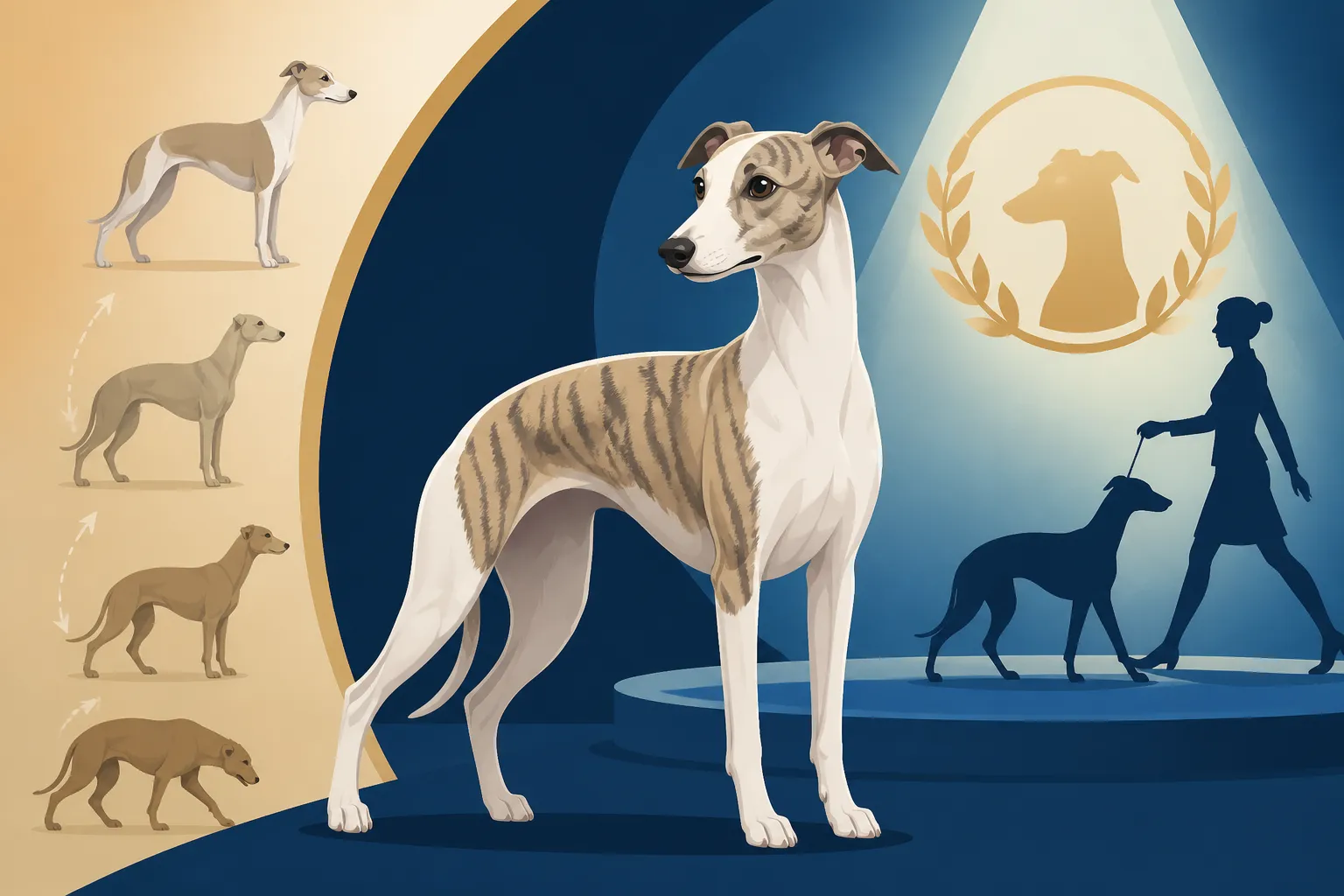
As dog shows and kennel organizations became more established, written breed descriptions gave judges a shared reference point. The Whippet’s standard set out the general silhouette and qualities considered desirable. Breeders could use that description to guide mating decisions, and judges could use it to assess whether dogs represented the breed type.
Recognition by kennel clubs helped make the breed more visible and made pedigree records and organized showing more important. The story of official recognition is covered in The Year the Kennel Club Recognized the Whippet and The Year the AKC Recognized the Whippet. Recognition did not instantly produce one uniform kind of Whippet, though. Breeding traditions, local preferences, and the goals of individual owners continued to shape the dogs.
The important change was that appearance could now be assessed against a shared ideal, rather than only against a dog’s racing results or usefulness. A Whippet might still be admired for speed, but a show judge was also considering balance, movement, proportion, and whether the dog looked like a Whippet according to the standard.
What the show ring refined
A recognizable outline, not a new breed
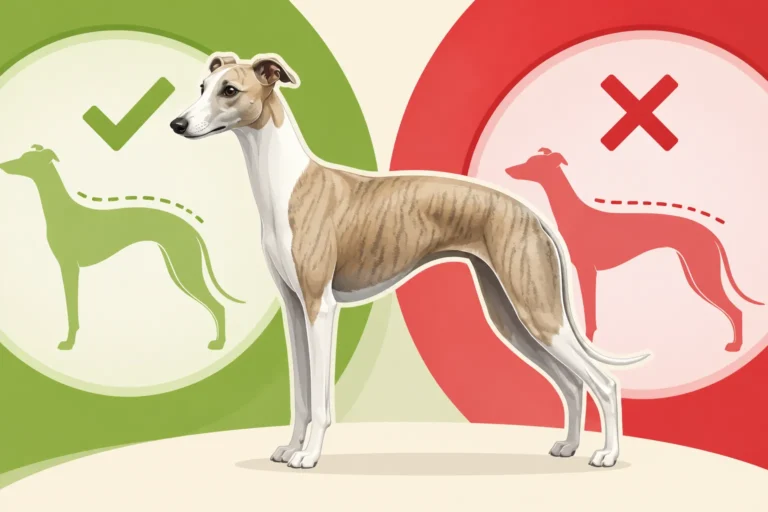
The show ring encouraged breeders to pay close attention to the Whippet’s overall outline: a graceful, muscular dog with a deep chest, a distinct waist, a tucked-up abdomen, and a gently arched loin. The goal was not simply to make dogs slimmer or more elegant. It was to produce a balanced athlete whose structure made sense as a whole.
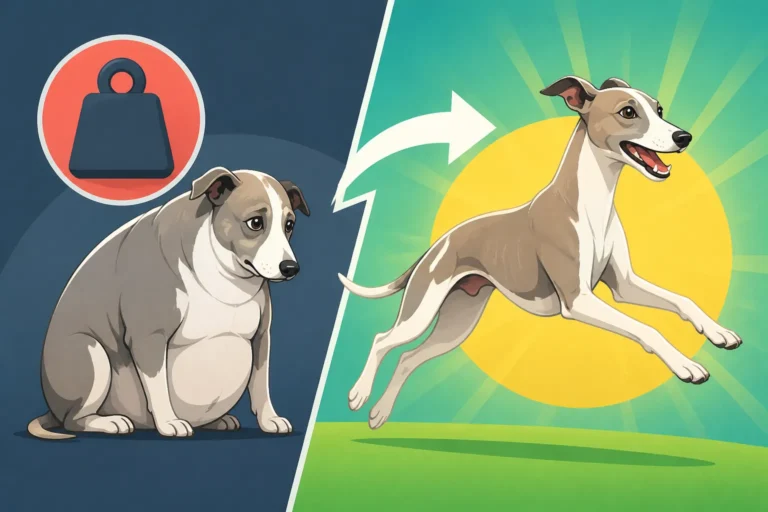
That distinction matters when people see a Whippet and worry that it looks too thin. A fit Whippet may have visible ribs and a noticeable waist, but the breed should still appear muscular and healthy. The standard’s emphasis on a smooth, athletic outline is different from rewarding emaciation. Individual condition varies, and a dog’s health is better judged through its body condition, energy, and veterinary assessment than by trying to match a show photograph.
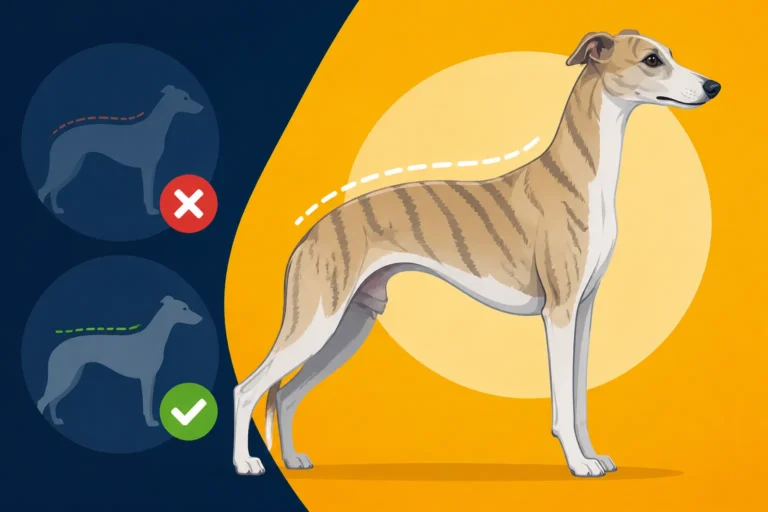
The arch of the back is another feature that can be misunderstood. It is part of the breed’s characteristic shape, but it should be considered alongside the rest of the body and the dog’s movement. The details are explored in What the Whippet Standard Says About the Arch. A striking topline on a standing dog means little if the dog cannot move comfortably and efficiently.
Movement and balance became central judging points
In the ring, a Whippet is assessed both standing and moving. Judges look for a dog that appears balanced in proportion and moves freely, with an efficient stride rather than exaggerated action. That is one way the show ring connected appearance back to function: the ideal Whippet should not only resemble an athlete while standing still, but also move like one.
This can make judging seem subjective to newcomers. One dog may have a lovely outline on the table or in a stacked pose, while another looks more compelling as it trots around the ring. Judges consider the whole dog, not a single feature in isolation. A beautiful head cannot compensate for poor movement, just as a dramatic topline does not automatically make a dog a sound representative of the breed.
The standard is a guide, not a promise that every dog will look identical or that the winning dog is objectively best in every respect. Different judges may weigh qualities somewhat differently within the standard. The most useful question for an owner is whether the dog is healthy, comfortable, and able to move naturally—not whether it matches one particular show winner.
| Feature considered in the show ring | What judges are assessing | Why it matters beyond appearance |
|---|---|---|
| Overall outline | Proportion, balance, and characteristic Whippet shape | Helps distinguish breed type without reducing the dog to one feature |
| Topline | A graceful, appropriate arch and loin shape | Part of the breed’s athletic structure |
| Movement | Free, efficient, coordinated movement | Offers clues about balance and functional soundness |
| Muscle and condition | Athletic development without excess weight or gauntness | Supports health and mobility |
| Temperament and presentation | Composure and handling in the ring | Shows how the dog responds to a controlled public setting |
How show breeding differed from performance breeding
Different priorities can create different-looking Whippets
Once showing and racing became separate pursuits for many owners, breeding choices could emphasize different goals. A show breeder might prioritize conformity to the written standard, movement, temperament, and a consistent family type. A racing breeder might give more weight to speed, racing instinct, and results on the track. These aims can overlap, but they are not identical.
That does not mean show Whippets are merely ornamental or that racing Whippets lack breed type. Both can be athletic, sound dogs. The difference is more about what a breeder is selecting for most strongly over generations. The distinctions are discussed in The Split Between Racing and Show Whippets and How Show Whippets Differ in Size From Racing Whippets.
There is also plenty of variation within each group. A show-bred dog may enjoy lure coursing or racing, and a dog from performance lines may have an outline that fits the standard well. A pedigree can offer clues about a dog’s background, but it cannot predict every individual’s speed, drive, structure, or suitability for competition.
The ring did not erase the breed’s athletic roots
A responsible interpretation of the standard keeps function in view. Whippets should be capable of moving freely and comfortably; their elegance is not meant to come at the cost of soundness. Owners considering whether a show-bred dog can take part in sport can explore Whether a Show Whippet Can Still Race. The answer depends on the individual dog, its conditioning, its health, and the rules of the particular event.
This is why the ring’s influence is best described as refinement rather than replacement. It helped make certain features more consistent and gave breeders a common language for evaluating them. It did not remove the Whippet’s history as a fast, athletic dog, nor does a ribbon prove that a dog is faster or healthier than one that never enters a show.
For pet owners, this history can also take some pressure off. Your Whippet does not need to be show quality to be a wonderful companion. A dog may have a feature that would be considered less desirable in the ring and still be healthy, affectionate, and happy to enjoy walks, play, or a safely managed run.
What the show ring means to owners today
Conformation is one kind of evaluation
A conformation show evaluates how closely a dog matches a written breed standard. It is not a complete health screening, a temperament guarantee, or a direct measure of athletic performance. A show title tells you that judges considered the dog a strong representative of the standard in competition; it does not answer every question a future owner might have about health, behavior, or suitability for a particular home.
If you are choosing a puppy, ask about the parents’ health, temperament, and daily lives as well as their show results. A breeder should be able to explain why a particular pairing was made and what qualities they hope to preserve. You can also ask whether the parents have participated in sport or other activities that demonstrate their comfort moving and working.
For a puppy already at home, show-ring history can be an interesting part of the family story, but it is not a checklist you have to reproduce. Keep nails comfortable, maintain a healthy body condition, and let your dog develop gradually. If you are preparing for a local show, ask an experienced handler or breeder to demonstrate basic ring presentation rather than trying to force a stance that feels uncomfortable to the dog.
Grooming and preparation are usually modest
Whippets have short coats, so show preparation is generally about cleanliness, nail care, and presenting the dog calmly rather than elaborate grooming. A gentle brush and a soft cloth may be enough for routine coat care, while bathing is useful when the dog is genuinely dirty. Avoid harsh scrubbing: thin skin can be irritated, and the goal is a clean, comfortable dog, not a glossy finish at any cost.
If you are assembling basic grooming supplies, Chewy can be one place to compare options such as soft brushes and nail-care tools. Focus on tools that suit your dog and that you can use without a struggle. If nail trims are stressful, a veterinarian or experienced groomer can help you build a gradual, low-pressure routine instead of turning each trim into a wrestling match.
For show preparation, practice brief handling sessions at home: let the dog stand naturally, touch its feet and ears gently, and reward relaxed cooperation. Chewy may also be useful for comparing ordinary care supplies, but the most important “equipment” is patience and a dog that feels safe. If you are new to showing, ask the club hosting the event what to expect and whether a beginner can attend as a spectator before entering.
Disclaimer
This article is for general informational purposes only and does not constitute professional advice. Laws, prices and regulations vary by location and change over time. Consult a qualified professional for guidance on your specific situation.