Whether an Undersized Whippet Is Still Purebred
A Whippet that stands noticeably shorter than expected can make an owner wonder whether the dog is purebred, still growing, or dealing with a health problem. Height alone cannot answer that question. This guide explains how breed standards, age, pedigree records, body condition, and veterinary checks fit together so you can assess a small Whippet without jumping to conclusions.
Can an undersized Whippet still be purebred
Height is not the same as pedigree
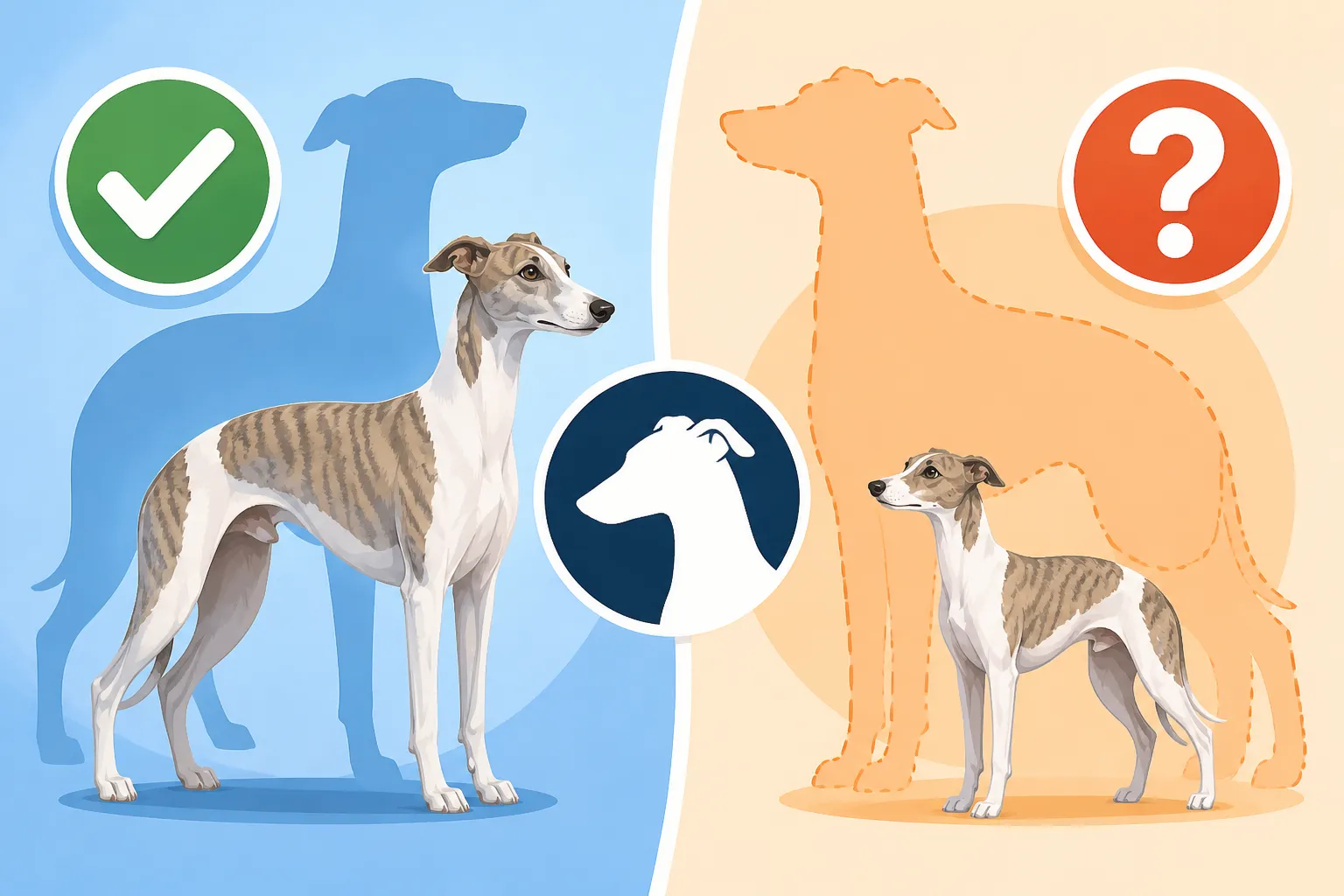
Yes. A Whippet can be purebred and fall below the height range in a breed standard. A standard describes the desired characteristics of a breed; it is not a genetic test, and an individual dog’s size does not prove or disprove ancestry. A Whippet with a shorter-than-expected frame may simply have inherited a smaller build from its parents.
The breed standard used also matters. Standards can differ between kennel clubs and countries, and a dog may be judged against a different height range depending on where it is registered or shown. For example, the American Kennel Club’s Whippet standard gives separate height ranges for males and females. Before comparing your dog with a number you found online, check which registry and standard that number refers to.
A dog can also be purebred without being a perfect example of the standard. Purebred does not mean show-quality, and it does not promise that every puppy in a litter will reach the same height. If you are comparing your dog with others, What a Whippet Actually Weighs is useful background, but weight and height are different measurements and should not be treated as interchangeable.
What registration and DNA testing can tell you
The best starting point for confirming a Whippet’s recorded ancestry is usually the breeder’s documentation: registration papers, pedigree information, and records identifying the puppy’s parents. If you did not get these documents, ask the breeder or rescue organization what information is available. A shelter or rescue may know little about a dog’s original breeding, and that uncertainty is not proof that the dog is mixed.
A consumer DNA test may estimate breed ancestry, but it does not replace a verified pedigree or necessarily establish that a dog meets a particular registry’s requirements for purebred registration. Results can be harder to interpret among related breeds, and a result should be understood as one piece of information rather than a verdict based on height.
If registration matters to you, contact the registry named in the dog’s paperwork and ask what its rules require. If your concern is mainly whether your dog is healthy, a veterinarian’s examination will be more useful than trying to infer health from a breed label or a DNA estimate.
Why some Whippets are smaller than expected
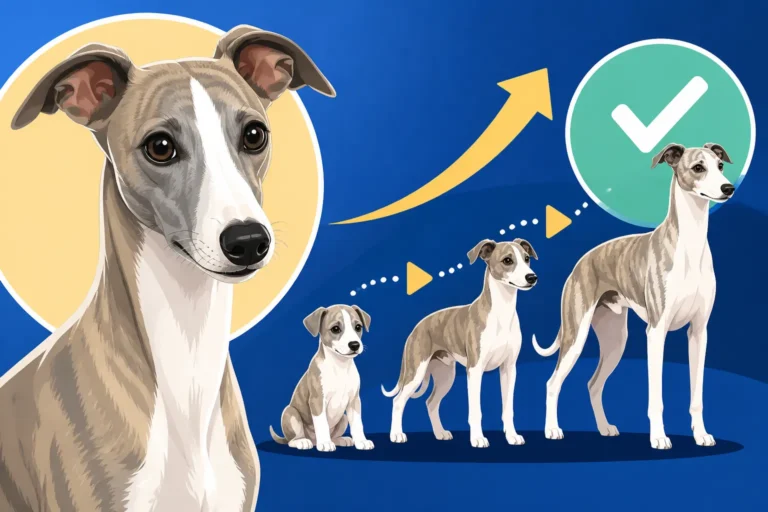
Your Whippet may not be finished growing
Age is one of the easiest explanations to overlook. A young Whippet may look unusually small simply because it has not reached adult height. Growth is not perfectly uniform: a puppy can appear leggy for a while, then change in proportion as the chest and body mature. Owners may also mistake a lean adolescent’s narrow appearance for a sign that the dog is undersized.
A Whippet’s adult height and its adult weight do not necessarily settle at the same time. Even after a dog has reached close to its adult height, it may continue to gain muscle and fill out with maturity. That does not mean every small adult will eventually become large; it means age and body development should be considered before judging a puppy or young dog. See The Age a Whippet Stops Growing and Whether a Whippet Fills Out After Two for more on the difference between growing taller and maturing in body condition.
If you have a puppy, compare its progress over time rather than relying on a single measurement. Your veterinarian can assess whether growth is following a healthy pattern for that individual dog. A puppy that is consistently gaining weight, eating normally, and developing well may simply be small, while a puppy whose growth has stalled or who seems unwell needs a closer look.
Genetics, sex, and individual variation
Whippets vary in size, just as people do. A puppy from smaller parents may grow into a smaller adult, and littermates can differ even when they share the same parents and household. Males and females may also differ in average size, so comparisons between a small female and a larger male can create a misleading impression.
A breeder’s emphasis may shape the overall look of a line, but no single description—such as “racing bred” or “show bred”—guarantees a particular height. It is more useful to ask about the parents’ actual adult measurements, the health of the line, and how the breeder raises and tracks puppies. For help thinking through puppy growth, Whether a Whippet Puppy Should Grow Slowly explains why steady development is preferable to trying to force rapid growth.
Be cautious of claims that a tiny Whippet is rare, special, or valuable solely because of its size. A smaller dog is not automatically healthier, and a larger dog is not automatically a better example of the breed. Size should be considered alongside soundness, temperament, overall health, and reliable records.
How to assess your Whippet’s size and health
Measure the dog consistently
If you want to know whether your Whippet is actually shorter than a breed standard, measure height at the withers—the highest point of the shoulder blades—not at the head. A dog standing on a sloped floor, leaning, crouching, or stretching its neck can produce a misleading measurement. A relaxed, square stance on a level surface makes the result more useful.
For a reasonably consistent home measurement:
- Stand your dog on a firm, level surface.
- Ask someone to help keep the dog standing naturally, without stretching or pressing down.
- Find the top of the shoulder blades, where the neck meets the back.
- Measure vertically from the floor to that point, using a suitable measuring tool.
- Repeat the measurement on another occasion if the dog is young or was moving around.
A home measurement is only an estimate. If the exact height matters for a show, registry question, or formal assessment, ask a knowledgeable breeder, show official, or veterinarian to measure the dog properly. Keep the measurement date and the dog’s age with the record; a height without context is easy to misread.
Look at body condition, not just the outline
Whippets are naturally lean, and their ribs, waist, and tucked-up abdomen can make them look smaller or thinner than other breeds. The outline alone does not tell you whether a dog is underweight. You should consider how easily the ribs can be felt, whether the dog has lost muscle, and whether its weight is stable for its frame.
A sudden change is more concerning than a lifelong small build. Contact your veterinarian if your dog is losing weight, has a poor appetite, seems unusually tired, has persistent digestive symptoms, or is not growing as expected. Puppies in particular should be checked if they stop gaining, fall behind in development, or show other signs of illness.
Do not try to make a small Whippet grow by overfeeding or adding supplements without veterinary guidance. Excess calories can create weight gain without changing the dog’s adult height, and rapid or inappropriate growth is not a sensible goal. Your vet can assess body condition and advise on a suitable feeding plan. What Body Condition Score a Whippet Should Be offers more context for judging a lean Whippet’s shape.
| What you notice | What it may mean | A sensible next step |
|---|---|---|
| A young dog is shorter than adult Whippets | The dog may still be growing | Track age, height, weight, and development with your veterinarian |
| A healthy adult has always been small | Individual or inherited size variation may explain it | Review pedigree or parent information if available |
| The dog is losing weight or muscle | Illness, dental problems, diet issues, or another concern may be involved | Arrange a veterinary examination |
| The dog is below a registry’s standard | It may be outside the preferred size range, but that does not establish ancestry | Check the relevant standard and registration records |
| The dog’s background is unknown | Purebred status cannot be confirmed from appearance alone | Ask the rescue for records and consider appropriate testing with professional guidance |
What to do if your Whippet is below the breed standard
Start with records and a veterinary check
Gather what you know before drawing a conclusion: age, sex, current weight, previous weights, height measurements, pedigree or registration papers, and any information about the parents. If the dog came from a breeder, ask for the parents’ measurements and the puppy’s growth history. If the dog was adopted, ask the rescue whether it has intake records, veterinary notes, or information from the previous owner.
A veterinarian can help distinguish a naturally small but healthy dog from one whose size may be connected to poor growth or illness. The exam may include questions about appetite, diet, stool, activity, and development. What is appropriate to check depends on the dog’s history and symptoms, so a routine examination is a better starting point than assuming that every short Whippet needs extensive testing.
If you are choosing a puppy, ask about the health and history of both parents, not only their appearance. Responsible breeders should be willing to discuss health screening and provide clear documentation. The Health Tests Both Whippet Parents Should Have can help you prepare questions, while Whether an Untested Whippet Litter Is Worth Buying covers why missing health information deserves careful consideration.
Understand what “undersized” means for breeding or showing
A Whippet that measures below the preferred range may not be eligible for some conformation classes or may be considered outside the standard for that registry. The specific consequences depend on the organization’s rules. Check the relevant rulebook or speak with the registry rather than relying on a social media post or a general statement about “the standard.”
Being under the standard does not automatically make a dog unhealthy or unsuitable as a companion. Nor does it automatically mean that the dog should be bred. Breeding decisions involve more than height: health, temperament, structure, genetic risks, and the overall welfare of the dogs all matter. If breeding is being considered, talk with an experienced, responsible breeder and a veterinarian familiar with Whippets.
If you are buying a puppy, treat unusually small size as a reason to ask more questions, not as proof of a bargain or a special type. Ask for accurate age, parent details, veterinary records, and registration information. For broader context on how different Whippet lines can look, read The Split Between Racing and Show Whippets. A difference in line or appearance should not be used to explain away missing records or health concerns.
An undersized Whippet can absolutely be purebred. The dog’s height may reflect age, inherited variation, sex, or a health or growth issue, while pedigree and registration records provide a more relevant starting point for ancestry. Measure carefully, consider the dog’s overall condition, and involve your veterinarian if growth, weight, or health gives you concern.
Disclaimer
This article is for general informational purposes only and does not constitute professional advice. Laws, prices and regulations vary by location and change over time. Consult a qualified professional for guidance on your specific situation.