How Much a Male Whippet Weighs
A healthy adult male Whippet often weighs about 25 to 40 pounds, but that range is only a starting point—not a pass-or-fail test. Height, muscle, age, activity, and individual build all affect the number on the scale. This guide explains what male Whippets commonly weigh, how to judge body condition at home, and when a weight change deserves a closer look.
Typical adult male Whippet weight
A useful range, not a rigid target
Many adult male Whippets weigh somewhere around 25 to 40 pounds, or roughly 11 to 18 kilograms. A smaller-framed male may be healthy near the lower end, while a taller, more substantial dog may weigh more and still be in good condition. The number alone cannot tell you whether a particular Whippet is too thin, just right, or carrying extra fat.
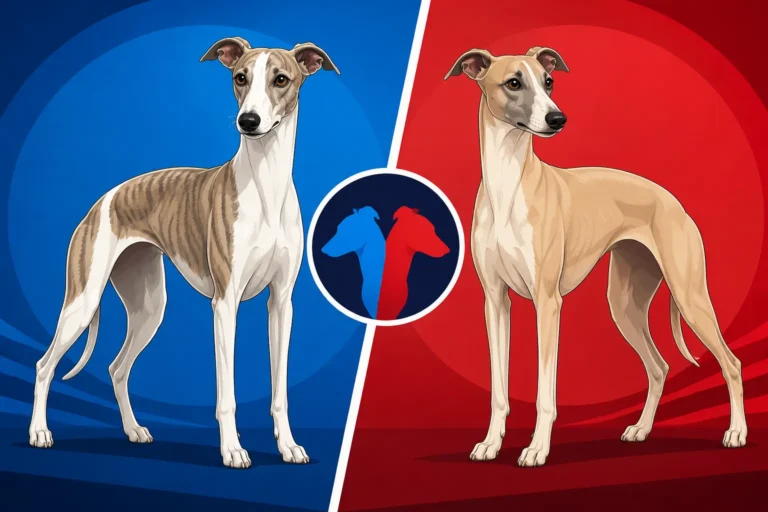
Whippets are built for speed: they have a deep chest, a narrow waist, long limbs, and visible muscle. That shape can make a healthy dog look surprisingly lean beside breeds with broader bodies or thicker coats. It is common for people unfamiliar with the breed to assume a fit Whippet is underfed, even when the dog is energetic, eating normally, and maintaining a steady weight. For a broader look at build and size across the breed, see What a Whippet Actually Weighs.
A male’s height also matters. Males are generally taller than females, but two dogs of similar height can still differ in frame and muscle. Height standards help describe the breed; they do not provide a precise weight target for every individual. How Tall a Whippet Stands offers useful context if you are comparing your dog’s height with typical breed proportions.
Why two healthy males can weigh differently
A Whippet’s body is not just a smaller or larger version of another Whippet’s. Some have a lighter frame, while others have more bone or muscle. A dog that regularly sprints, races, or participates in lure coursing may carry more visible athletic muscle than a companion whose exercise consists mainly of walks and play. That difference can affect weight without indicating a health problem.
Age and life stage matter, too. Puppies are growing and should be assessed over time rather than judged against adult weights. A young male may look lanky during a growth spurt, then gradually gain muscle as he matures. Older dogs may lose muscle or become less active, while some gain fat if their portions and exercise routine stay the same after their needs change.
Neutering can also affect appetite and energy needs for some dogs. It does not automatically make a Whippet overweight, but it may be a good reason to keep an eye on portions and body condition. If your dog’s appetite or weight changes after neutering, Weight Gain in a Neutered Whippet can help you think through what to monitor.
| What you’re assessing | What to keep in mind |
|---|---|
| Scale weight | A common adult male range is about 25 to 40 pounds, but individual healthy weights vary |
| Ribs | They may be visible or easy to feel, but should not look sharply prominent |
| Waist | A noticeable waist behind the ribs is normal for the breed |
| Abdomen | The underside usually rises toward the hindquarters rather than hanging straight down |
| Trend over time | A stable weight is often more useful than one isolated reading |
| Changes in condition | Sudden weight loss or gain deserves attention, especially with other symptoms |
How to tell whether your male Whippet is at a healthy weight
Look at shape as well as the scale
Check your Whippet from above and from the side. From above, you should generally see a waist behind the rib cage. From the side, the abdomen should tuck up toward the rear rather than form a level line from chest to hips. These contours are part of the sighthound build, so they can look more pronounced than the outline of many other dogs.
Then use your hands. Run your fingers gently along the ribs and over the hips. You should be able to feel the ribs without pressing hard, but they should not feel like sharp ridges under very little padding. The hip bones and spine may be noticeable on a lean Whippet, yet they should not appear dramatically protruding. For a more structured at-home check, see Feeling a Whippet's Ribs and Hip Bones and What Body Condition Score a Whippet Should Be.
It helps to check the same way each time. A quick look after a bath or while your dog is standing naturally can be more informative than trying to judge through a coat or while he is curled up on the sofa. If you are unsure, take clear notes or photos from above and from the side and ask your veterinarian to assess them alongside a hands-on examination.
A lean Whippet is not necessarily an underweight Whippet
Whippets are naturally fine-boned and short-coated, so their outlines are easy to see. A hint of rib definition is not automatically a warning sign. In contrast, a dog with a rounded waist, a less visible abdominal tuck, and ribs that are difficult to feel may be carrying more weight than is ideal, even if the scale falls within a typical range.
A useful comparison is your own dog over time rather than a photograph of a different Whippet. Images online may show racing athletes, show dogs, puppies, or dogs photographed at an angle. A racing Whippet may be especially conditioned, while a companion Whippet can be perfectly healthy with a different amount of muscle. Whether a Racing Whippet Is Leaner Than a Show One explains why those builds may not look identical.
If you are worried that your dog looks too thin, compare his current shape with his usual shape and look for a trend. A Whippet who has always been lean, eats well, and maintains a stable weight is different from one who is steadily losing weight or becoming less muscular. For more on the distinction, see How Thin a Whippet Should Look and When a Whippet Is Genuinely Too Thin.
Tracking weight and adjusting feeding sensibly
Weigh consistently instead of guessing
If you can, weigh your Whippet on the same scale under similar conditions. A veterinary clinic can weigh him during a routine visit, and some owners use a suitable home scale. For a small change, consistency matters: weighing at different times of day or on different scales can make comparisons less useful.
Keep a simple record of the date, weight, and any relevant change, such as a new exercise routine, illness, medication, or change in food. A gradual trend is easier to spot in a log than in memory. If your dog is difficult to weigh at home, avoid turning it into a stressful wrestling match; ask the veterinary team to help make weighing part of a calm visit.
Use food portions as a starting point, then observe
Feeding guidance on a food label can help you choose an initial portion, but it is not a custom prescription for every dog. A Whippet’s needs can vary with age, activity, metabolism, and the calorie content of the food. Measure meals rather than estimating by eye, and include treats, chews, training rewards, and table scraps when considering the whole day’s intake.
If you use Chewy or another retailer for your dog’s food, check the feeding directions on the specific product packaging when you change formulas. Different foods can have different calorie densities, so the same-looking scoop may not provide the same amount of energy. Keep a note of the food and approximate daily portion so you can discuss a clear picture with your veterinarian if your dog’s weight shifts.
Avoid making a dramatic cut or adding large extra meals based only on a single weigh-in. If your Whippet needs to lose or gain weight, gradual adjustments and follow-up checks are generally more sensible than sudden changes. How Much a Whippet Should Eat has more detail on feeding portions, while How Easily a Whippet Gains Weight explores why small routine changes can add up.
When a weight change needs veterinary attention
Pay attention to the pattern and accompanying signs
A few ounces of variation can happen, especially when measurements are taken under different conditions. A consistent change over several checks is more meaningful. Contact your veterinarian if your male Whippet is losing weight without an obvious reason, gaining steadily despite unchanged habits, or losing muscle along his back and hindquarters.
Weight concerns matter more when they arrive with other changes. Reduced appetite, increased thirst, vomiting, diarrhea, unusual tiredness, difficulty exercising, or a change in bathroom habits are all useful details to mention. Rather than waiting until your dog looks dramatically different, share the timeline and any changes in food, routine, or medication with the clinic.
Do not rely only on whether your dog still seems eager to run. Some dogs remain lively even when something is changing, while others naturally have quieter days. A body-condition check and a veterinary exam can help distinguish normal variation from a problem that needs investigation.
What to bring to a weight check
Before an appointment, write down your dog’s recent weights if you have them, what and how much he eats, his usual treats, and any changes in appetite or activity. If you order food through Chewy, you can use the product label or your order history to identify the exact food and formula you have been feeding. That practical detail can help when discussing portions, particularly if the food changed recently.
Ask the veterinarian to assess body condition, muscle condition, and overall health—not just whether the weight falls inside a general range. The vet can tell you whether your dog’s individual target should be lower or higher than a broad breed estimate and whether a gradual feeding adjustment makes sense. If the appointment confirms that his current weight and condition are healthy, you will have a baseline for future checks.
If you use Chewy for regular food deliveries, keeping the food name and feeding amount consistent in your notes can make it easier to notice when a change in routine coincides with a change in weight. The goal is not to chase a particular number; it is to understand what is normal for your dog and respond when his pattern changes.
Disclaimer
This article is for general informational purposes only and does not constitute professional advice. Laws, prices and regulations vary by location and change over time. Consult a qualified professional for guidance on your specific situation.