Why a Blue Whippet Is a Dilute
A blue Whippet can look gray, charcoal, or almost silvery, which often leads people to wonder whether the dog is a different breed or has an unusual health condition. The answer is simpler: blue is a coat color created by a genetic dilution of black pigment. This guide explains what “dilute” means, how the color is inherited, and what owners should—and should not—assume about a blue Whippet’s health.
What dilute means in a blue Whippet
Blue is diluted black pigment
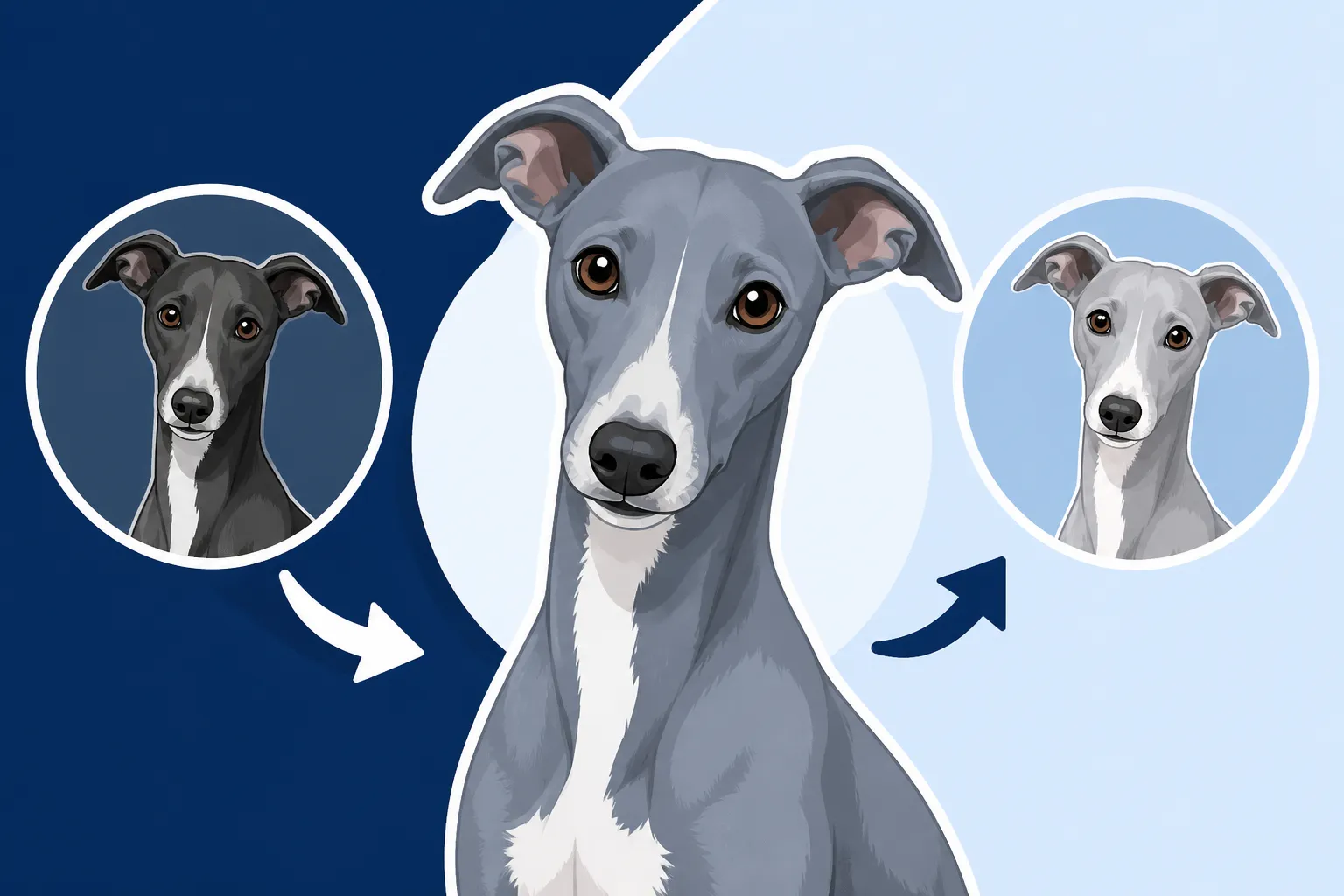
In dog-coat terminology, “blue” usually describes a softened, slate-gray version of black. It is not the same as a bright blue, and it does not mean the dog has blue skin. The color comes from pigment in the hair shaft: when black pigment is diluted, it looks lighter and cooler in tone.
The underlying pigment is still black pigment, often called eumelanin. The dilution changes how that pigment is distributed along the hair, so the coat appears gray-blue rather than solid black. Depending on the individual dog and its coat pattern, the result may look like charcoal, gunmetal, or a pale steel gray.
That is why “blue Whippet” describes a color, not a separate type of Whippet. Blue dogs have the same breed identity as Whippets in other colors. If you’re comparing the range of coat patterns and shades, The Colors a Whippet Comes In offers useful context.
The genetic change affects pigment distribution
A commonly discussed cause of coat dilution in dogs involves the MLPH gene, often referred to in coat-color testing as the dilution, or D, locus. In simplified terms, a dog generally needs two copies of the dilution variant—one inherited from each parent—to show a diluted coat. A dog with one copy may carry the variant without looking blue.
This inheritance pattern helps explain why two dogs can have ordinary-looking coats and still produce a blue puppy if both carry the relevant variant. It also explains why a blue Whippet can pass the variant to its puppies even though the puppy’s eventual color depends on what it inherits from the other parent.
Coat color is influenced by more than one gene, so a simple label cannot tell you every detail of a dog’s genetics. Patterns such as brindle and white markings add another layer to what you see. For a blue Whippet, “dilute” describes the effect on black pigment; it doesn’t by itself describe the dog’s full pattern or ancestry.
Blue does not mean mixed breed
A blue coat does not make a Whippet less purebred. Coat color alone is not a reliable way to determine a dog’s breed, and a blue Whippet may be registered or bred as a Whippet when its pedigree and other requirements support that. The best way to assess breed background is through credible pedigree and breeder records, not a color-based guess. See Whether a Blue Whippet Is Purebred for more on that distinction.
Whippet color rules and preferences can also vary by registry and context. A color may be acceptable in one setting even if it is less familiar to the public. If someone tells you that a blue Whippet “cannot be purebred” simply because of its coat, that claim is not supported by color alone.
| What you see | What it generally means | What it does not prove |
|---|---|---|
| Slate, charcoal, or gray-blue coat | Black pigment appears diluted | That the dog is a different breed |
| Blue brindle pattern | Dilution appears alongside a brindle pattern | That the dog has a health condition |
| A blue puppy from two non-blue parents | Both parents may carry a dilution variant | That either parent is unhealthy |
| A blue nose or lighter eye color | Pigmentation may vary with coat genetics | That the dog has a vision problem |
How blue coloring is inherited
A puppy gets one copy from each parent
A puppy inherits a copy of each gene from each parent. For the commonly described recessive dilution pattern, a puppy generally needs two dilution copies to show the blue coat. If it inherits only one, it may be a carrier without visibly diluted coloring. If it inherits none, it will not show that particular dilution effect.
This is a simplified explanation, not a prediction for every possible coat outcome. Other color and pattern genes influence what appears on the dog, and a visual inspection cannot reliably identify every carrier. If a breeder needs to understand whether a dog carries a particular variant, a genetic test may be more informative than coat color alone.
When both parents are carriers, each puppy’s inheritance is a separate event. A litter can include puppies with different coat colors and different genetic combinations, even though the puppies share the same parents. The fact that one puppy is blue does not mean every puppy in the litter will be blue—or that the parents must be blue themselves.
A blue nose and blue eyes are separate observations
People sometimes use “blue” loosely to describe a Whippet’s coat, nose, or eyes, but these features are not interchangeable. A blue coat means the coat’s black pigment is diluted. Nose color is another visible pigmentation feature, while eye color is influenced by its own genetic and developmental factors.
Some blue Whippets have a nose that looks gray or slate rather than black. That can be consistent with the dog’s pigmentation, but a nose color by itself cannot confirm a coat-color genotype. For more on the distinction, see Whether a Whippet Can Have a Blue Nose.
Eye color should also be assessed separately. A lighter-looking eye does not automatically mean the dog has impaired vision, and a blue coat does not automatically mean the dog will have blue eyes. If an eye appears cloudy, painful, unusually red, or different from the other eye, that is a reason to seek veterinary advice rather than assume it is simply a coat-color feature. Whether a Whippet Can Have Blue Eyes explores the question in more detail.
A DNA test can answer a different question than appearance
A coat-color test may tell you whether a dog has a variant associated with dilution, but it does not replace a general health assessment or prove a complete pedigree. Likewise, a blue appearance is not a substitute for genetic testing when a breeder needs to know whether a dog carries a particular variant.
If you are considering a puppy, ask the breeder what health and genetic information they have, what the results actually test for, and how those results relate to the planned breeding. Be wary of treating a color label as a guarantee of health, temperament, or quality. Those traits cannot be established from coat color alone.
Does a blue Whippet have health problems?
Dilution is a color description, not a diagnosis
A blue coat by itself is not a disease. Many owners encounter a striking blue Whippet and worry that the color signals a hidden medical problem, but the visible shade alone cannot tell you whether a dog is healthy or unwell. A veterinarian assesses the individual dog, including its skin, coat, general condition, and medical history.
There is a condition called color dilution alopecia that is discussed in connection with dilute coats in some dogs. It can involve hair thinning or loss and skin changes, but having a dilute coat does not mean a dog will develop it. The relationship between coat color and skin problems should be approached carefully rather than treated as an automatic consequence of being blue. For a Whippet-specific discussion, see Whether Color Dilution Alopecia Affects Whippets.
A blue dog with a healthy, comfortable coat does not need treatment simply because its coat is dilute. On the other hand, patchy hair loss, persistent itchiness, scaling, redness, sores, or recurring skin infections deserve attention regardless of color. A veterinary exam can help distinguish a skin condition from normal coat variation or another cause of hair loss.
Watch the dog, not just the shade
A few practical observations can help you notice changes. Check whether the coat remains evenly covered, whether the skin looks comfortable, and whether the dog is scratching or licking more than usual. A change that develops over time matters more than the simple fact that the coat is blue.
If you are concerned about coat thinning, take clear notes about when it started, where it appears, and whether there are other signs such as itching or irritation. Photos taken in similar lighting can help you describe changes at an appointment. A veterinarian can decide whether testing or treatment is appropriate; avoid assuming that a specific shampoo or supplement will solve the problem.
For basic coat care, use gentle products intended for dogs and follow your veterinarian’s advice if the skin is irritated. If a vet recommends a particular kind of dog-safe shampoo, Chewy can be one place to compare product labels with those at a local pet shop. The important part is choosing based on the dog’s needs, not because a product claims to change or “correct” the coat color.
A blue coat does not establish skin sensitivity
Some owners worry that blue pigment automatically makes a Whippet’s skin fragile or unusually sensitive. Coat color alone is not enough to make that conclusion. Individual skin problems can occur for many reasons, including irritation, parasites, infection, allergies, or injury, and a dog’s coat shade cannot identify the cause.
Whippets have a short coat, so it can be easier to notice small scrapes, irritation, or changes in the skin. That is a breed-care consideration, not proof that blue Whippets have a particular disorder. If you want to understand the broader question of color and skin, Whether a Blue Whippet Has Skin Problems discusses the issue without treating color as a diagnosis.
If sun exposure is a concern—especially for a dog with lightly pigmented areas—ask your veterinarian what precautions suit that individual dog. Don’t apply human sunscreen unless a veterinary professional confirms that the specific product is safe for your pet. For protective clothing or other dog-care supplies recommended by your vet, Chewy and other pet retailers may help you compare options, but comfort and fit matter more than color.
Understanding and caring for a blue Whippet
Describe the coat accurately
Blue coats can vary noticeably. One Whippet may look dark charcoal, while another appears lighter and more silvery. Lighting, season, coat condition, and the presence of white markings or brindle patterning can all affect how the color looks in a photograph or in person.
A blue brindle Whippet, for example, has a pattern that can make its coat look quite different from that of a solid blue dog. White areas may also contrast strongly with the diluted dark pigment. These variations are normal reasons that two dogs described as blue may not look identical.
When discussing a dog with a breeder, veterinarian, or rescue, describe what you see rather than relying on a color label alone. Note whether the coat is solid or patterned, where the markings appear, and whether the color is changing. If you are unsure whether a coat pattern is recognized or simply want to understand the terminology, Whether Whippet Markings Are Faulted may help.
Keep grooming simple and gentle
A blue Whippet does not need a special routine to preserve its color. Regularly check the skin and coat, keep the dog comfortable, and use grooming products that suit its skin. Harsh products or frequent bathing can irritate some dogs, so it’s sensible to avoid trying several treatments at once when a skin concern appears.
A soft brush or grooming mitt can help remove loose hair, while a quick hands-on check can reveal burrs, small cuts, or tender areas. If you’re choosing a dog shampoo because your veterinarian recommends one, Chewy may be useful for comparing ingredients and directions, but follow the vet’s guidance rather than selecting a product based on a color-related marketing claim.
Do not try to darken, lighten, or chemically alter the coat. Color-enhancing products are not a substitute for care, and a coat’s natural shade is not a problem to fix. If the coat is changing in an unexpected way or the skin looks unhealthy, ask a veterinary professional before adding a new product.
Ask better questions when choosing a puppy
If you are looking at a blue Whippet puppy, ask the breeder about the parents’ health, temperament, and relevant test results—not just whether the puppy is rare or unusually colored. A responsible discussion should make room for questions about the litter’s background and the breeder’s plans for the dogs.
Be cautious of claims that blue coloring guarantees a special temperament, superior health, or exceptional performance. A coat color does not establish those qualities. Nor should a buyer feel pressured to pay extra simply because a color is presented as scarce or exclusive. The puppy’s health, early care, socialization, and fit with your household matter far more than the shade of its coat.
The same approach applies to adult dogs. A blue Whippet adopted from a rescue or rehomed by a previous owner should be evaluated as an individual. Ask about known medical concerns and observe the dog’s comfort and behavior, but don’t assume that a blue coat itself tells you what care the dog will need. A veterinarian can help you make a sensible plan based on the dog in front of you.
Disclaimer
This article is for general informational purposes only and does not constitute professional advice. Laws, prices and regulations vary by location and change over time. Consult a qualified professional for guidance on your specific situation.