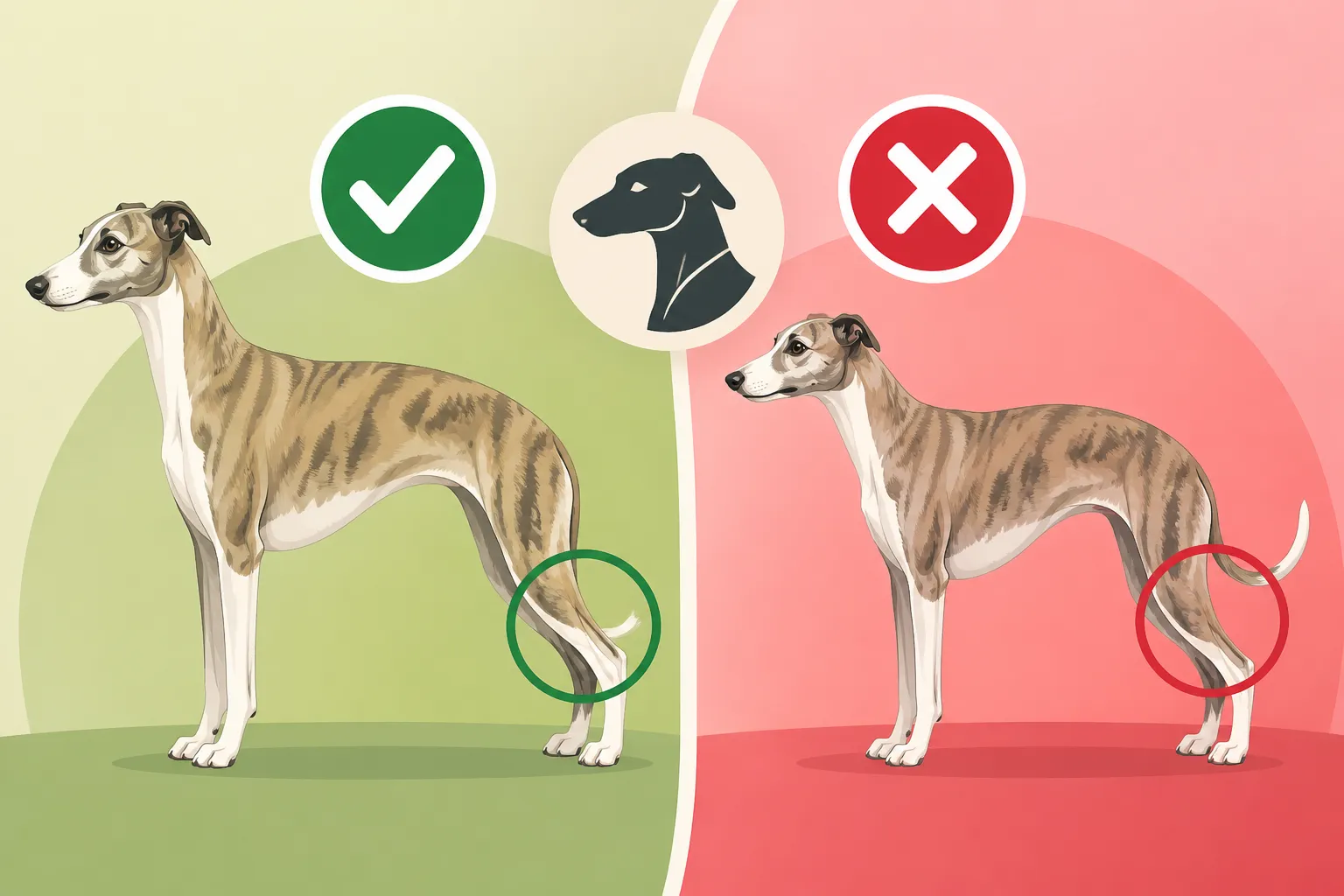
Whether a Whippet’s Tail Should Reach the Hock
A Whippet’s tail can look surprisingly long against its slim body, and its position changes with mood and movement. That makes it easy to wonder whether the tail should reach the hock, or whether a lower or higher carriage means something is wrong. This guide explains the breed’s expected tail length, how to assess it fairly, and when a change deserves a vet’s attention.
What “reaching the hock” means on a Whippet
Finding the hock on the hind leg
The hock is the joint partway down a dog’s back leg, between the lower leg and the foot. It is easy to mistake it for the knee: the knee is higher up, closer to the body, while the hock is the prominent joint lower down. When a Whippet stands naturally, you can usually identify the hock by following the rear leg toward the ground.
When people say a Whippet’s tail should reach the hock, they are describing the tail’s length in relation to the standing dog. They do not mean the tail must touch the hock at every moment. A dog may hold its tail in a curve, tuck it between the legs, or lift it while moving, so its tip will not always line up with that landmark.
The tail should also be considered in proportion to the dog. Whippets vary in height and body shape, and a naturally long or short-looking tail can be influenced by the dog’s stance, coat, and the angle from which you view it. If you are comparing your dog with a photograph, check whether the Whippet in the photo is standing squarely and holding its tail in a relaxed position.
For a closer look at how a Whippet’s overall proportions fit together, see What a Whippet Actually Weighs and Why the Whippet Standard Cares So Much About the Topline. The tail is one part of the outline, not a feature to judge in isolation.
The breed description and everyday variation
Breed descriptions generally call for a long, tapering tail that reaches at least to the hock. When relaxed, it is typically carried low, with a gentle upward curve toward the tip. That describes a general breed characteristic; it does not mean every Whippet’s tail will look identical in length, shape, or carriage.
A healthy Whippet may hold its tail differently depending on what is happening. A dog resting at home may let it hang loosely. One greeting a familiar person may lift it, while a nervous dog may tuck it close to the body. During a run, the tail can move as part of the dog’s balance and turning. These changes are not, by themselves, evidence that the tail is too short or that the dog is uncomfortable.
Standards are used to describe the breed, especially in conformation settings. They are not a health diagnosis or a guarantee that every pet Whippet will match a written ideal exactly. If you are learning how the breed is described, Whether a Whippet Is Just a Small Greyhound provides useful context on the traits Whippets share with other sighthounds and the features that distinguish them.
How to assess tail length and carriage at home
Observe the tail in a relaxed standing position
Start by watching your Whippet stand naturally on a level surface. Avoid lifting the tail, stretching it, or trying to position the dog like a show-ring photograph. Notice where the tip falls when your dog is calm and the tail is hanging in its ordinary relaxed position. If possible, look from the side and from behind, since perspective can make a tail appear shorter or longer.
A useful comparison is the tail tip against the hock, not against the floor. The floor distance changes with the dog’s stance: a Whippet standing with one rear foot tucked forward may look different from the same dog standing squarely. A curved tail can also make the tip appear higher, even though the tail itself is long enough.
For a simple record, take a side-view photo while your dog is standing comfortably. Keep the camera around the dog’s body height and include the rear legs and tail in the frame. A photo taken over several days can help you see what is normal for your dog, especially if your first impression came from a single moment when the tail was tucked or lifted.
| What you notice | What it may mean | What to do |
|---|---|---|
| Tail tip reaches around the hock when relaxed | Consistent with the common breed description | Note the dog’s normal carriage and enjoy your Whippet |
| Tail looks short only when tucked or curled | Tail position may be changing with mood | Observe again when the dog is calm |
| Tail seems short in photos but not in person | Camera angle or stance may be misleading | Take a level side-view photo with the dog standing naturally |
| Tail suddenly hangs differently or seems painful | Possible injury or discomfort | Contact your veterinarian for guidance |
| Tail has always looked shorter than expected | Could be individual variation or a structural difference | Ask your vet or a knowledgeable breed professional if you want an assessment |
Don’t mistake tail position for tail length
A tail that is tucked tightly may look much shorter than it is. Whippets are often sensitive to unfamiliar handling, noise, or new environments, so a dog that holds its tail low or close may simply be uncertain. Give the dog time to settle rather than coaxing, pulling, or repeatedly touching the tail to check its length.
A high-carried tail can create the opposite impression. The tail may appear shorter because it is curved upward, but the visible distance from the body to the tip is not the same as its full length. Look at the relaxed position when possible, and remember that a Whippet’s tail carriage can shift from one moment to another.
It also helps to consider the rest of the dog’s shape. The Whippet’s arched loin, deep chest, and tucked-up abdomen create a distinctive outline. A tail viewed against that silhouette can seem unusually long or short depending on the dog’s posture. For more on the back shape, see Whether a Whippet’s Back Should Be Roached and Whether a Flat Backed Whippet Is Faulted.
If you are assessing a puppy, allow for the fact that puppies can be wiggly and rarely stand in a neat, neutral pose for long. A single snapshot may capture a tail tucked during a new experience or lifted in excitement. Repeated relaxed observations are more useful than trying to make a decision from one photograph.
When tail length matters and when it does not
Breed description is not the same as a health concern
For most owners, the important question is not whether the tail matches a written ideal to the last detail. It is whether the dog is comfortable and can move its tail normally. A tail that has always looked a little shorter or longer than expected, without pain or a change in movement, is usually a different matter from a tail that suddenly becomes limp, painful, swollen, or difficult for the dog to move.
If you are considering a Whippet for showing or breeding, a knowledgeable breed mentor or qualified judge can help explain how the dog’s overall conformation is evaluated. The tail is considered in relation to the whole dog, including balance and carriage. Comparing your pet with a standard can be interesting, but it is not a reason to repeatedly handle or stretch the tail.
For a family pet, personality, comfort, and soundness matter much more in daily life than whether the tail tip lands exactly at a particular point. A Whippet with an unconventional outline can still be a delightful companion. Why a Whippet Is Tougher Than It Looks offers more perspective on the difference between the breed’s delicate appearance and the realities of living with an active dog.
If your concern is about a puppy’s appearance, ask the breeder what they have observed and whether the puppy’s tail has always looked that way. A responsible breeder should be willing to discuss the dog’s development without making promises based on one feature alone. If there is a concern about movement, pain, or an unusual structure, a veterinarian is the right person to assess it.
Signs that call for a veterinary check
A change in tail carriage can be more meaningful than the tail’s length. Contact your veterinarian if your Whippet suddenly holds the tail limp, cries or flinches when the area is touched, avoids sitting, or seems uncomfortable when turning or toileting. Also seek advice if you notice swelling, bleeding, a wound, or a change in the tail after a collision, fall, or rough play.
Try not to test the tail by bending it or moving it through its range. A dog in pain may react defensively, and repeated handling can make discomfort worse. Instead, observe from a comfortable distance, take a short video if the change happens while walking, and share what you saw with the clinic. If the tail change comes with weakness, difficulty walking, or other sudden symptoms, describe those too.
Tail injuries can be easy to underestimate because a small-looking wound may bleed or become irritated. If there is an open wound or ongoing bleeding, call a veterinary clinic for instructions rather than trying to close it at home. A pet-supply retailer such as Chewy may carry basic first-aid items, but supplies are not a substitute for an examination when an injury is painful, deep, or not improving. Your veterinarian can tell you what, if anything, is appropriate to use.
If a vet recommends protecting a healing area, ask how to prevent licking or further knocks without putting pressure on the tail. Chewy carries recovery and wound-care products, but the right choice depends on the wound’s location and your dog’s behavior. A collar that fits one Whippet may not suit another, so confirm fit and use with the clinic before relying on it.
Keep the area clean only as directed, and don’t apply human creams, adhesives, or medication unless your veterinarian says to. If you need to compare basic supplies while following the clinic’s plan, Chewy is one retailer where owners can look for them; check the item details and ask your vet whether it is suitable for your dog’s specific injury.
Caring for a Whippet’s tail through everyday life
Protect the tail without overhandling it
A Whippet’s slender frame can make the tail look exposed, but most healthy dogs do not need routine wrapping or special treatment. The simplest protection is a safe home environment: avoid shutting the tail in doors, give the dog enough room to turn around in a crate, and make sure children know not to grab or pull it. A comfortable bed can also give a resting dog a soft place to settle.
Watch how your Whippet moves through tight spaces, especially if the dog is excited or tends to wag against furniture. If the tail repeatedly knocks into a hard edge, consider changing the layout rather than trying to keep the tail held still. A dog should be able to wag and move naturally without being restrained for the sake of appearance.
When grooming or checking your dog, use a calm, light touch and stop if the dog tenses or turns away. Some Whippets are perfectly comfortable with handling; others need a gradual approach. Short, positive handling sessions help your dog learn that a gentle tail-area check does not have to be stressful.
Keep the whole outline in perspective
The Whippet’s tail is part of a body built for speed, balance, and quick changes of direction. Its length and carriage can be striking, but they should be considered alongside the dog’s movement, comfort, and general condition. If you are curious about other features that can look unusual to a first-time owner, The Colors a Whippet Comes In explains how much natural variation is part of the breed.
A tail that reaches the hock in a relaxed stance matches the usual description, but small differences do not automatically mean a problem. Judge what you see in a calm, natural position, and resist the temptation to compare every angle with a perfect-looking photograph. Dogs are not statues; their posture changes with mood, setting, and movement.
If you are choosing a puppy, ask questions about health, temperament, and the parents’ overall build rather than focusing narrowly on tail length. If you already share your home with a Whippet, your dog’s normal behavior is the best baseline. A sudden change, pain, or injury deserves attention; a tail that simply looks a little different from the ideal usually calls for perspective, not panic. For broader guidance on matching the breed to a household, see Whether a Whippet Suits a First Time Owner.
Disclaimer
This article is for general informational purposes only and does not constitute professional advice. Laws, prices and regulations vary by location and change over time. Consult a qualified professional for guidance on your specific situation.