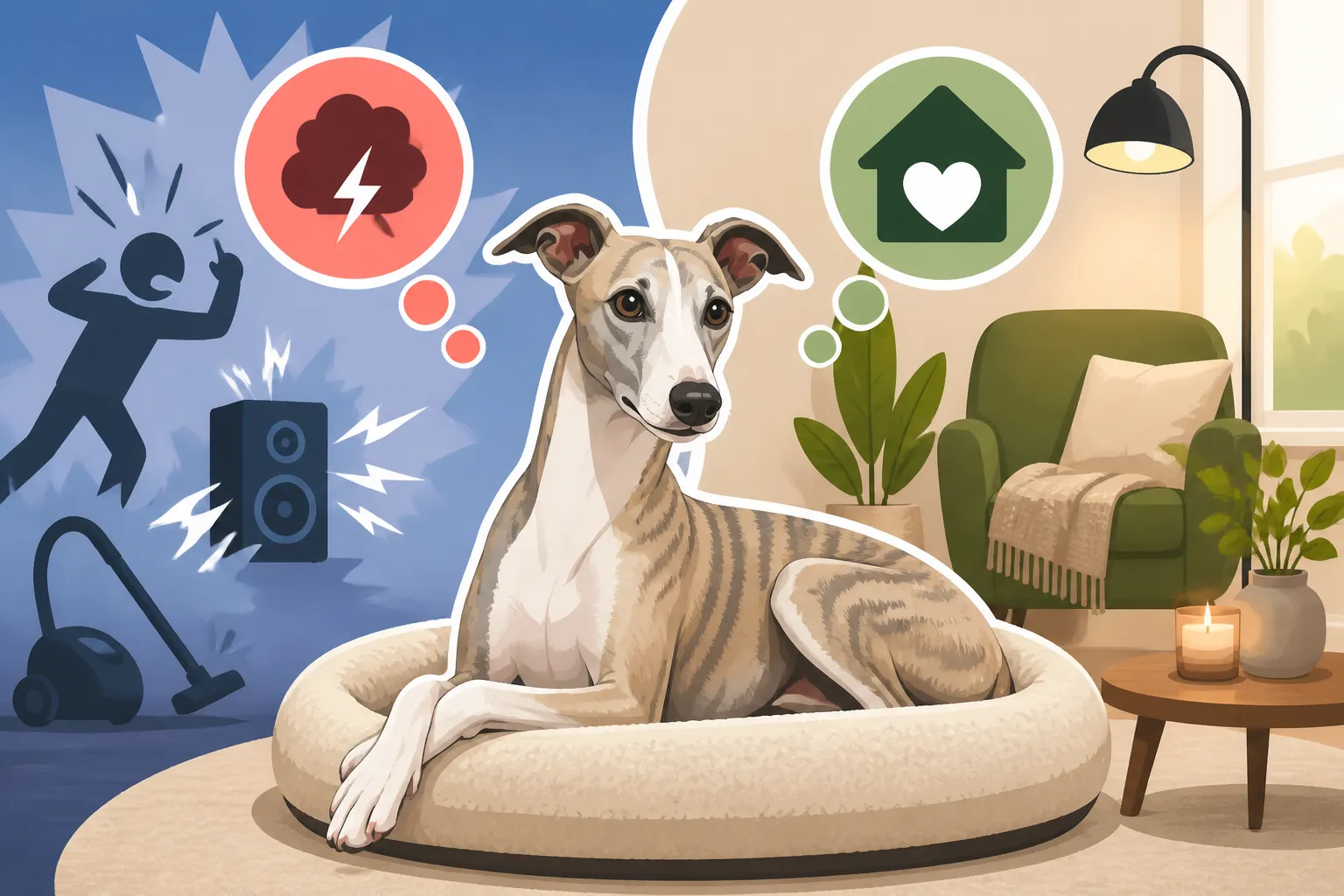
Whether a Whippet Suits a Quiet Home
A Whippet can fit beautifully into a calm household, but “quiet home” does not automatically mean “low-maintenance dog.” A Whippet may snooze for hours indoors, then need a safe chance to sprint, patient introductions to visitors, and company when left alone. This guide explains what quiet living with a Whippet is really like and how to tell whether your home suits one.
What a Whippet Is Like at Home
Calm indoors does not mean inactive
Many adult Whippets are wonderfully restful at home. After a walk, a sniffing game, or a chance to run in a securely fenced area, yours may curl up on a sofa and seem content to nap through a quiet afternoon. That appealing contrast is real: these dogs can be fast and athletic outdoors while being surprisingly relaxed indoors.
But it is a pattern, not a guarantee that every Whippet will calmly occupy itself all day. A young dog may have more energy, curiosity, and mischievousness than an older one. Even an adult who is usually peaceful can become restless if exercise, interaction, and opportunities to use their mind are missing. “Quiet home” should describe your household’s atmosphere, not an expectation that the dog will never need attention or activity.
A reliable routine helps. For example, a Whippet who gets a leisurely morning walk, a safe opportunity to stretch out at a sprint when appropriate, and a comfortable place to rest is more likely to settle than one expected to sleep all day without a break. For a fuller look at the breed’s indoor-outdoor contrast, see The Whippet Is a Forty Mile an Hour Couch Potato. And for practical guidance on daily activity, How Much Exercise a Whippet Really Needs explores what exercise should look like beyond a quick trip around the block.
Comfort is part of a peaceful household
Whippets have short coats and little body fat compared with many breeds, so they often seek warm, soft places to rest. In a quiet home, that may mean a favorite bed near the family, a blanket, or a comfortable spot on the sofa. A hard, bare floor may not be an inviting place to spend long stretches, particularly for a lean dog who likes to lie down for hours.
This is worth considering if your version of a quiet home involves keeping dogs out of bedrooms and off furniture. That arrangement can work, but the Whippet still needs a comfortable resting place in the rooms where the family spends time. If the dog is expected to settle in a chilly hallway or on a thin crate mat while everyone else relaxes elsewhere, the home may feel less peaceful for the dog than it does for its people.
Quiet also means predictable. A Whippet may appreciate a household where resting areas are not constantly disturbed and where everyone understands that a sleeping dog should be left alone. This matters especially in homes with children or frequent visitors: a peaceful retreat gives the dog a place to decompress rather than forcing them to remain in the middle of activity.
Noise, Visitors, and Household Activity
Are Whippets quiet dogs?
Whippets are not generally known as constant barkers, but “not a big barker” is different from “silent.” A dog may bark at a doorbell, an unfamiliar sound, a passing animal, or a burst of excitement. Some whine when they are anticipating a walk or asking for company. Others are naturally more vocal than you might expect. Temperament, early experiences, and the dog’s individual habits all matter.
If you work from home, live in an apartment, or share walls with neighbors, think about the noises your dog may hear and how you will help them settle. A Whippet who reacts to every sound in a shared hallway may need gradual practice with those noises and a resting spot away from the front door. A dog who barks when left alone may need a different plan altogether; simply hoping they will “get used to it” can make the problem harder to manage. For more detail, see How Much a Whippet Barks and Separation Anxiety in a Whippet.
A quiet home can help a sensitive dog feel comfortable, but quiet by itself does not prevent barking or anxiety. It is more useful to ask what happens when the home stops being quiet. Can your Whippet cope with a delivery, a visitor, or an ordinary hour alone? If you have thin walls or close neighbors, plan for those real-life situations before you bring a dog home.
A calm household still needs a visitor plan
Some Whippets are reserved around unfamiliar people. A quiet home with a small circle of familiar visitors may suit such a dog better than a household that regularly hosts lively gatherings. Still, reserve should not be mistaken for a wish to avoid all people or for a problem that will disappear if the dog is kept isolated.
Let a new dog approach visitors at their own pace. Ask guests not to crowd, lean over, or reach toward the dog’s face. A bed or quiet room can give the Whippet an option to retreat, while a gate or lead can help you manage greetings safely. For a puppy, gentle, positive exposure to different people and ordinary household sounds can build confidence without overwhelming them. For an adult, take time to learn what they already find comfortable.
The key question is whether your household can respect the dog’s signals. If you expect every visitor to be greeted enthusiastically, or if people will continually enter the dog’s resting space, a Whippet who prefers a slow introduction may be a frustrating match. More guidance on this temperament is available in Why a Whippet Is Shy With Strangers.
| Quiet-home factor | Often a good fit when | May need extra planning when |
|---|---|---|
| Daily routine | The household can provide regular walks, interaction, and rest | The dog is expected to entertain itself for most of the day |
| Noise | Occasional barking or whining can be managed patiently | Neighbors are extremely noise-sensitive or hallway sounds trigger barking |
| Visitors | Guests can give the dog space and follow your guidance | The home has frequent, unpredictable gatherings |
| Resting space | The dog has a warm, comfortable place to relax | The dog is expected to settle on a cold or hard floor |
| Time alone | Absences are introduced gradually and fit the dog’s needs | The dog will be alone for long stretches without support |
Exercise, Enrichment, and Time Alone
A quiet home still needs room for activity
Whippets do not need to be in motion every minute, but they need more than a quiet room and a soft bed. A walk offers more than physical movement: sniffing, exploring, and noticing the world provide mental stimulation too. Some Whippets enjoy running or dog sports, while others are happiest with walks and occasional safe opportunities to stretch their legs. The right routine depends on age, health, fitness, and temperament.
Because Whippets are sighthounds, a sudden chase can overpower a recall in an open area. A quiet home with a nearby unfenced park is not necessarily a safe place to let one run loose. Use secure fencing or suitable lead arrangements, and assess each space rather than assuming a calm dog will stay close. The article Whether a Whippet Needs a Fenced Area to Run explains why safe access matters.
Enrichment can be simple. Scatter a portion of food for the dog to sniff out, offer a suitable chew, practice short training games, or rotate a few toys instead of leaving everything out all the time. If you shop online for food puzzles or other enrichment supplies, Chewy can be one place to compare the types available; choose items that suit your dog’s size, chewing style, and supervision needs. Enrichment should complement walks and companionship, not serve as a substitute for them.
Being home is not the same as being available
A household can be quiet yet leave a dog alone for much of the day. That distinction matters. Some Whippets cope well with a predictable period of solitude after gradual training; others struggle when separated from their people. A dog’s previous experiences, age, and individual temperament influence how they handle being alone.
If you work outside the home, think through the whole day rather than just the hours you are away. Can someone provide a break? Is there a safe resting area? How will you build up alone time gradually instead of leaving the dog for a long stretch on the first day? A puppy generally needs more frequent supervision and toilet opportunities than an adult, while a newly adopted dog may need time to learn that departures are temporary.
A camera may help you see whether your dog is settling, pacing, barking, or trying to escape, but observation is only useful if you respond to what you find. If the dog is distressed, consider adjusting the schedule and seeking qualified, reward-based behavior support. A second dog is not a guaranteed fix; some dogs still feel anxious when their preferred person leaves. For the broader household question, read Whether a Whippet Suits an Apartment and The Job a Whippet Actually Needs.
How to Decide Whether Your Home Is a Match
Look at your real routine, not your ideal one
It is easy to picture a Whippet snoozing beside you while you read or work. That may happen, but choose based on an ordinary weekday, including bad weather, errands, visitors, and the occasional disrupted schedule. Can you offer consistent walks even when it is raining? Will you provide a warm place to rest? Can you arrange safe exercise without relying on an open field and perfect recall?
Also consider how much togetherness you want. Whippets are often affectionate companion dogs, and many enjoy being close to their people. If you want a dog who is content to be largely ignored in another room, a Whippet may not match that expectation. If you enjoy having a companion nearby and can balance that closeness with gentle independence training, the fit may be much better.
Before choosing a puppy, ask the breeder about the parents’ temperaments and how the puppies respond to ordinary household activity. If adopting an adult, ask what is known about the dog’s behavior around visitors, children, other pets, and time alone. A rescue organization or foster home may be able to describe how the dog actually behaves in a domestic setting. For households with other dogs, Whether a Whippet Is Safe With Small Dogs is a useful related consideration, especially if your home includes a much smaller companion.
Signs the match may be difficult
A Whippet may be a challenging fit if you need a dog who can be left alone for long periods without preparation, must remain silent under every circumstance, or can safely run off leash wherever you happen to walk. Likewise, a home that cannot provide comfortable resting places or routine outdoor activity may not meet the breed’s needs, even if it is peaceful.
That does not mean a quiet household has to be perfectly silent, spacious, or full of dog-sport enthusiasts. A modest home can work well when the dog gets regular attention, safe exercise, and a predictable routine. An active household can also suit a Whippet if it offers a calm retreat and does not expect the dog to participate in every commotion.
If you are uncertain, talk with an experienced Whippet breeder, rescue group, or veterinarian before making a decision. Share the unvarnished details: your work hours, your neighborhood, your plans for exercise, and how often people visit. A good match is not simply a quiet house. It is a household willing to understand the dog’s need for both calm and activity.
Disclaimer
This article is for general informational purposes only and does not constitute professional advice. Laws, prices and regulations vary by location and change over time. Consult a qualified professional for guidance on your specific situation.