Whether the Whippet Gene Pool Is Healthy
A Whippet can look healthy, move beautifully, and still carry an inherited condition—or come from a breeding population with limited genetic variety. That makes “Is the Whippet gene pool healthy?” a more complicated question than a simple yes or no. This guide explains what genetic health means, which risks to ask about, and how to assess a breeder’s health-testing practices.
What a healthy Whippet gene pool means
Genetic diversity is not the same as individual health
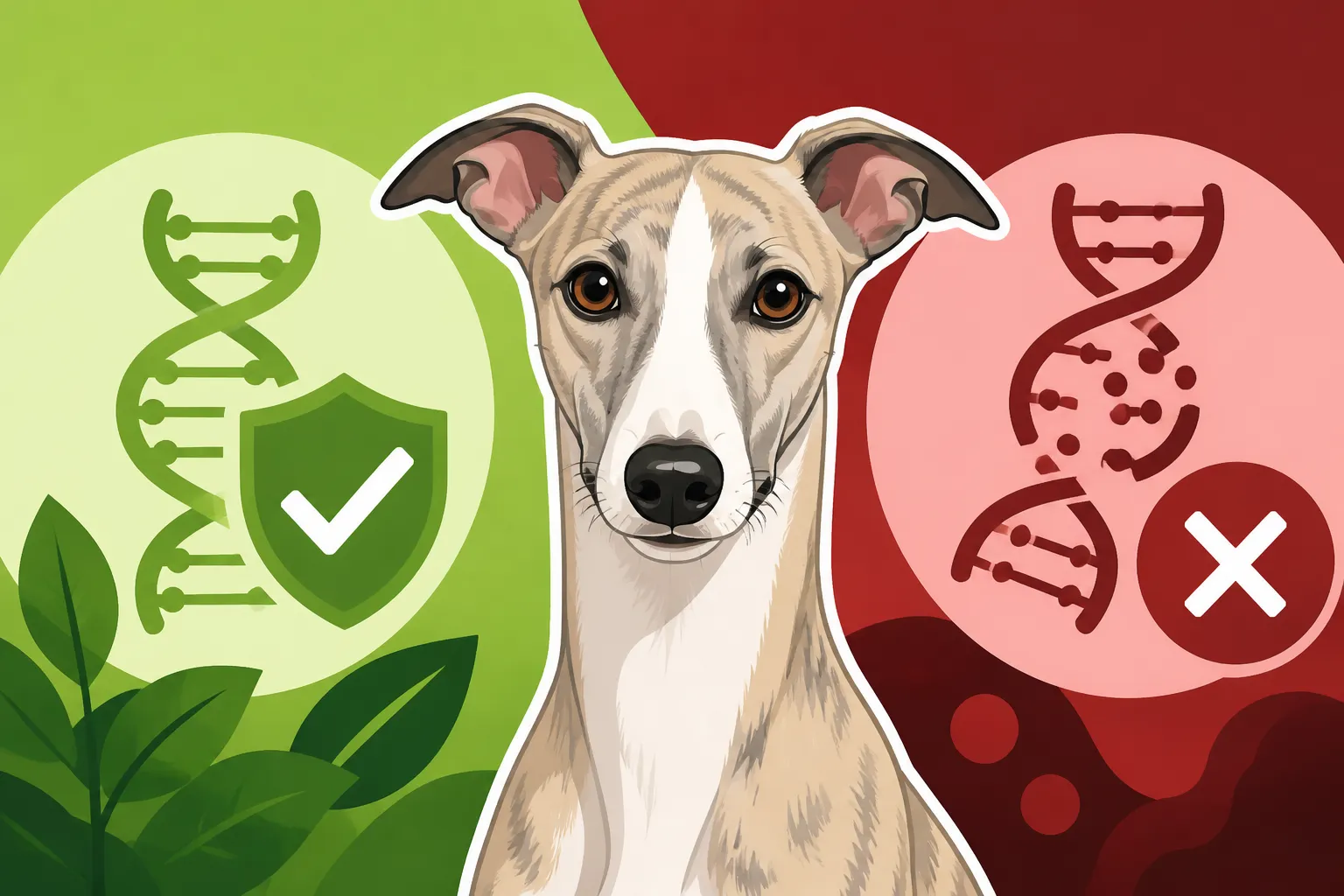
A gene pool is the collection of genetic variation in a population. In practical terms, a diverse gene pool gives breeders more options when choosing compatible dogs and may reduce the chance that two breeding animals share the same harmful inherited variant. But it does not guarantee that every dog will be healthy, nor does a health problem in one Whippet prove that the entire breed is genetically unhealthy.
It also helps to separate two ideas that are often blended together: genetic diversity and the frequency of particular diseases. A breed could have reasonable overall diversity and still carry a specific inherited condition. Conversely, a dog may inherit no known disease-causing variant while coming from a population where diversity is a concern.
For an individual puppy buyer, a healthy-looking puppy is not enough to answer the question. Many inherited conditions do not show obvious signs in young dogs, and a normal veterinary examination cannot identify every genetic risk. A careful assessment considers the parents’ health, relevant screening, family history, and the breeder’s choices over several generations.
Why no single test can certify the whole breed
There is no single DNA test, certificate, or laboratory result that can establish that the Whippet gene pool as a whole is healthy. A DNA test checks for particular variants included in that test. It does not measure every gene, predict every illness, or tell you whether two dogs are a good match across their entire genomes.
Pedigree-based measures, including inbreeding estimates, can help breeders evaluate relatedness. However, results depend on the quality and depth of pedigree information, and a number should not be treated as a complete verdict. A low estimate does not guarantee a healthy litter; a higher estimate does not mean every puppy will be sick. Responsible interpretation includes the dogs’ actual health and the goals of the breeding.
It is also worth asking what someone means when they describe a “healthy gene pool.” They may be talking about low rates of a particular condition, genetic diversity, long-lived dogs, or a breeding program that uses health screening. Those are related but distinct questions. For a broader look at breeding priorities, see The Health Tests Both Whippet Parents Should Have and Whether a Whippet Should Be Screened Before Breeding.
Inherited health questions to consider in Whippets
Specific conditions matter more than vague claims
A breeder or seller may say that their dogs are “genetically clear,” but that phrase needs context. Clear of which condition, based on what test, and for which dogs? A result for one known variant does not make a dog clear of every inherited disease. Ask for the name of the condition and the relevant results for both parents, rather than relying on a general assurance.
Whippets are associated with some inherited health concerns that deserve informed discussion, including phosphofructokinase deficiency and the myostatin mutation often discussed in connection with unusually heavy muscling. The presence of a condition or variant in the breed does not by itself show how common it is across all Whippets. Nor does one test result tell the whole story of population health.
For example, the myostatin variant can be tested for, but a test result should be understood in relation to the dog’s genotype and breeding plan. A carrier is not automatically an unhealthy dog, and the decision to breed should not be based on appearance or a single result alone. Learn more in The DNA Test That Finds the Whippet Myostatin Mutation and What Phosphofructokinase Deficiency Does to a Whippet.
Health screening can include more than DNA
Some health concerns are evaluated through veterinary examinations or clinical tests rather than a simple DNA panel. Eye examinations and cardiac assessments, for example, address different questions from a genetic test. A veterinarian may also interpret findings in the context of the Whippet’s age, symptoms, family history, and physical condition.
A useful screening plan is therefore condition-specific. Ask what screening is recommended for the parents, how recently it was done, who performed it, and whether the records are available. If a breeder says a test is unnecessary, ask for the reasoning. A thoughtful breeder should be able to explain the decision without dismissing reasonable questions.
For Whippets, interpretation matters as much as the result. Some laboratory values and physical findings can differ from what people expect in other breeds, so a result should be assessed with appropriate breed context. That does not mean every unusual result is harmless; it means that conclusions should be made by a veterinarian familiar with the relevant considerations. Related reading includes Whether a Whippet Needs Sighthound Reference Ranges and Whether a Whippet's Heart Should Be Checked Yearly After Eight.
| Question | What to ask | Why it helps |
|---|---|---|
| Which inherited conditions are considered in this breeding? | Ask for the specific condition names and the reason each is relevant. | Replaces broad promises with information you can evaluate. |
| What tests were done on both parents? | Request the test type, date, and written results. | Shows whether both parents were assessed for the risks being discussed. |
| Are there health issues in close relatives? | Ask about parents, siblings, and earlier generations where information is available. | Family patterns can add context beyond a single test. |
| How are results interpreted? | Ask whether a veterinarian or qualified specialist reviewed them. | Helps distinguish a meaningful finding from a result taken out of context. |
| How does the breeder choose pairings? | Ask how health, temperament, structure, and relatedness are balanced. | Reveals whether the program considers more than one trait. |
How breeding choices affect genetic health
Responsible breeding balances several goals
Maintaining a healthy population is not as simple as removing every dog with any risk from breeding. If a dog is a carrier of a recessive condition, excluding that dog automatically may shrink the available gene pool without being necessary to prevent affected puppies. In some situations, a carefully planned pairing with a dog that does not carry the same variant can reduce the risk to offspring while retaining valuable genetic diversity.
That does not mean every carrier should be bred. Breeding decisions depend on the condition, the reliability of the test, the dog’s overall health and temperament, and the availability of suitable mates. The important point is that test results need to guide a considered plan rather than trigger an automatic, one-size-fits-all response.
Breeders also select for traits that are not captured by a DNA panel: sound movement, stable temperament, long-term health, and suitability for the dog’s intended life. Selection for a narrow physical ideal or a single performance trait, without attention to other characteristics, can create trade-offs. A careful breeder should be able to describe what they are trying to preserve and what they are trying to avoid.
A pedigree is useful, but it is not a crystal ball
A pedigree can help identify close relationships and repeated ancestors, but it cannot show every health outcome. Its usefulness depends on how complete and accurate the records are. A long pedigree is not necessarily a diverse pedigree, and a familiar champion appearing repeatedly does not tell you by itself whether a mating is wise.
Ask whether the breeder tracks health and longevity in related dogs, not just titles or show results. It is reasonable to ask what happened to previous puppies and whether the breeder stays in contact with owners. No breeding program can promise that a litter will never develop a health problem, but openness about outcomes is a positive sign.
A breeder may use pedigree analysis, genetic testing, veterinary screening, and knowledge of the wider population together. These tools answer different questions. A breeder who can explain their limitations—and who does not promise perfect health—often gives you a more realistic basis for making a decision.
How to evaluate a Whippet breeder’s health claims
Ask clear questions and request records
You do not need to be a genetics expert to have a useful conversation. Begin by asking what health concerns the breeder considers most relevant to their dogs and what screening has been completed for each parent. If the answer is simply “they’re healthy,” follow up by asking how that was determined.
Request documentation rather than relying on a verbal summary. Check that records identify the dog, the test or examination, and the result. If you are unsure what a result means, ask your veterinarian to help interpret it. Be especially cautious if someone uses one DNA result to claim that a dog is free from all hereditary problems.
It can also help to ask about relatives and prior litters. A breeder may not know every detail about every dog in a large extended family, but they should be willing to discuss what they do know. Ask whether puppies from earlier litters have developed recurring health issues, and how the breeder handles new information as it becomes available.
Look at the overall pattern, not one reassuring answer
A thoughtful health conversation should include uncertainties. No test catches everything, and health can be influenced by genetics, environment, care, and chance. A breeder who acknowledges those limits is not necessarily less responsible than one who uses confident language; in fact, careful explanations are more useful than blanket guarantees.
Use the breeder’s answers alongside other signs of a well-run program: transparent records, interest in the homes their puppies will enter, appropriate veterinary care, and a willingness to discuss why a particular pairing was chosen. If you are comparing litters, do not assume that more tests automatically mean a better breeding program. The tests should be relevant, accurately interpreted, and part of a broader approach to health.
Finally, keep the question in perspective. The Whippet gene pool cannot be reduced to a single score, and no responsible person can promise a risk-free dog. The most useful assessment is whether a breeder understands the breed’s known concerns, tests and screens appropriately, makes considered pairings, and speaks honestly about what the results do—and do not—show.
Disclaimer
This article is for general informational purposes only and does not constitute professional advice. Laws, prices and regulations vary by location and change over time. Consult a qualified professional for guidance on your specific situation.