Whether a Whippet’s Feet Should Be Hare Shaped
A Whippet’s feet can look surprisingly long and narrow, which often leads owners to wonder whether they are “hare-shaped” or somehow wrong. The short answer is that Whippet feet are generally oval, with arched toes and firm pads; the exact outline varies. This guide explains what that shape means, how it supports movement, and when a change deserves attention.
What hare-shaped feet mean on a Whippet
The shape is oval, not literally a hare’s foot
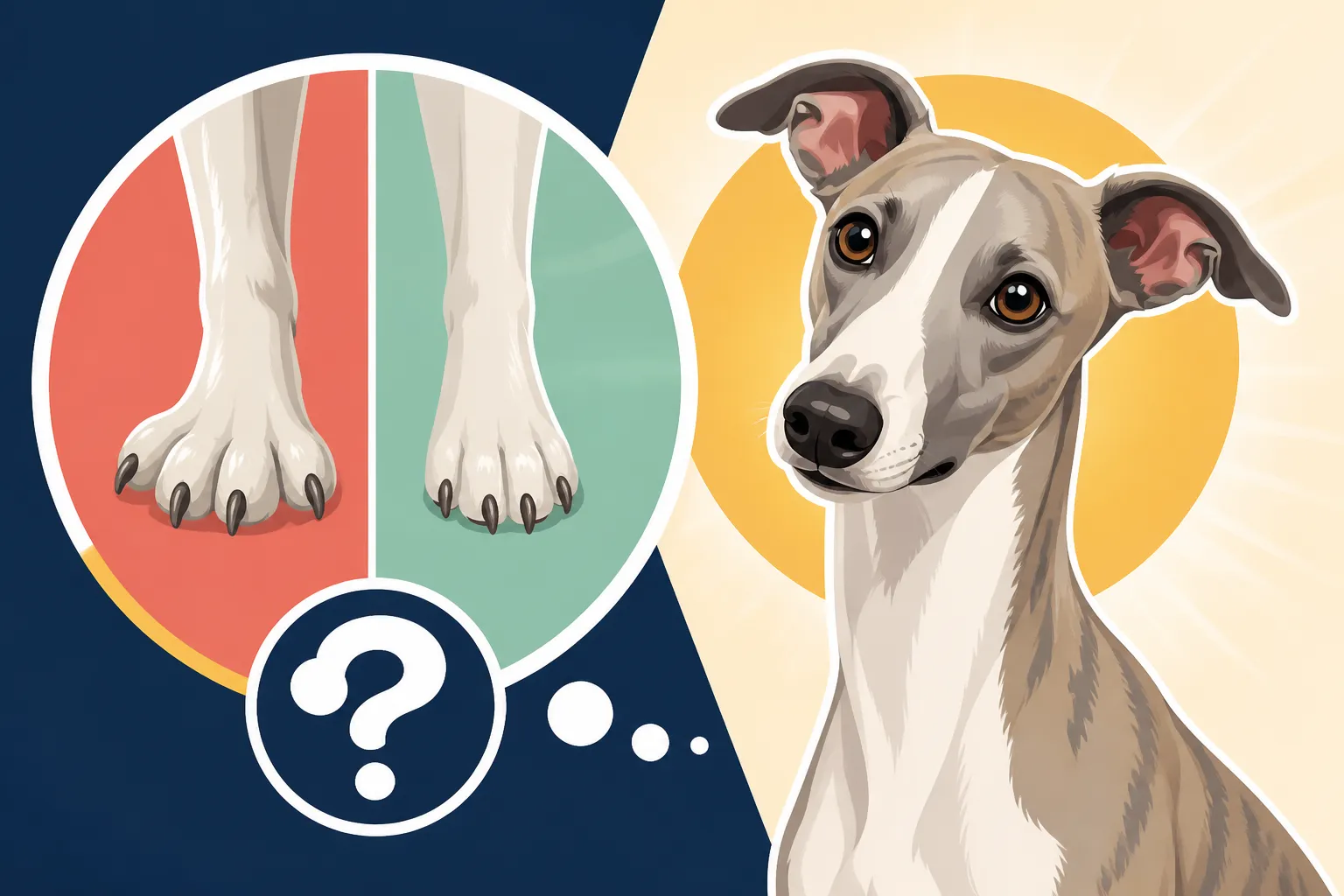
“Hare-shaped” is a casual description people sometimes use for a foot that looks more elongated than round. It does not mean a Whippet should have long, flat, widely spread toes. A well-shaped Whippet foot is typically oval and fairly compact, with toes that are close together and visibly arched. The pads should look firm and substantial for the dog’s size.
That outline can be easier to see when the dog is standing square on a level surface. From above, the foot may look longer than a round, cat-like paw, but it should not appear loose or splayed. From the side, the toes should have some lift rather than resting flat against the ground. A Whippet with fine limbs and a narrow frame can make its feet look especially delicate, but delicate-looking is not the same as weak or poorly formed.
Breed descriptions often emphasize oval feet, well-separated toes, arched knuckles, and strong pads. “Hare-shaped” is not always the exact wording used in breed standards, so it is more useful to judge the overall shape and condition than to insist on a label. Just as a Whippet’s outline has particular proportions, its feet are one piece of a larger structure built for movement. For more on how breed traits fit together, see Why the Whippet Standard Cares So Much About the Topline.
Why Whippet feet look different from round paws
Whippets are sighthounds, built to accelerate and cover ground efficiently. Their feet need to contact the surface, provide grip, and help support quick changes in direction. A neat oval paw with arched toes can distribute pressure while still allowing the dog to push off during a sprint. It is not a specialized “racing shoe,” and no single foot shape guarantees speed, soundness, or good performance.
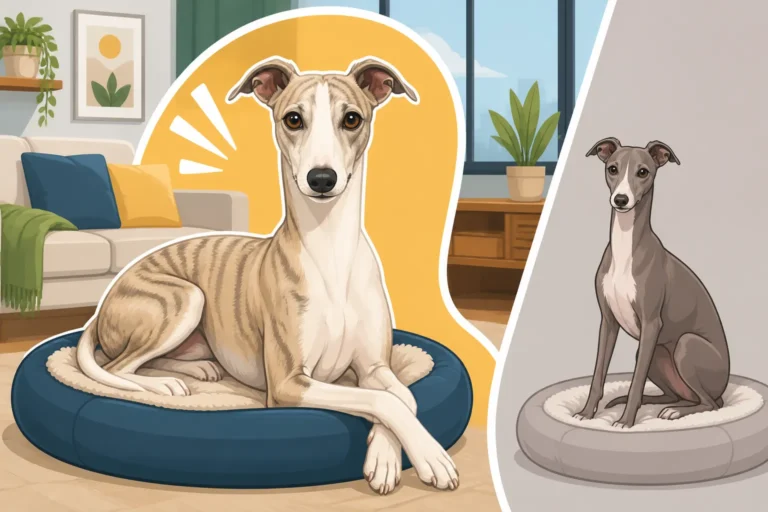
The contrast with a rounder paw is often most noticeable in photos. A Whippet standing on a soft bed may spread its toes slightly for balance, while the same dog standing on firm ground may show a more compact outline. Long nails can also change what the foot appears to look like, making the toes seem flatter or more open. So can thick hair between the pads, a paw held at an angle, or a camera view taken from too close.
If you are comparing your dog with another Whippet, remember that feet vary between individuals. Age, size, inherited structure, nail length, and the surface underfoot all affect what you see. A picture online is a particularly poor measuring tool: the dog may be posed, the feet may be turned, and the camera may exaggerate their length. The question is less “Does this paw match a perfect outline?” and more “Is the foot comfortable, functional, and free of concerning changes?”
How Whippet feet support running and everyday movement
Arched toes and firm pads have practical jobs
Arched toes help form a supportive, compact foot. The pads provide cushioning and traction, while the nails contribute to grip when they are kept at a suitable length. During an ordinary walk, these features may not seem important. During a sudden sprint, a tight turn, or a fast stop, the feet have to cope with forces that are easy to underestimate.
That does not mean every Whippet needs to run at full speed to be healthy, or that a particular paw shape makes it safe to sprint anywhere. A Whippet can be injured by slippery ground, holes, sharp debris, poor conditioning, or an abrupt turn just as any athletic dog can. The combination of speed and a strong chase response is one reason a safe, enclosed running area matters. Whether a Whippet Should Run on Wet Grass and Whether a Whippet Should Run on Hard Ground are useful reading if you are deciding where to exercise your dog.
For everyday care, look at the whole foot rather than focusing only on whether the toes look arched enough. Check that the dog places the paw comfortably, bears weight evenly, and walks without favoring one side. Compare the right and left feet. A longstanding, symmetrical difference may simply be part of your dog’s individual build; a sudden change in one foot is more likely to need a closer look.
A Whippet’s foot shape does not predict every injury
Whippet owners sometimes notice a toe that looks prominent, a nail that wears unevenly, or a paw that seems to turn slightly outward. Those details are not automatically signs of a problem. But appearance alone cannot rule out soreness either. Dogs may initially hide discomfort, especially when they are excited to go out, and a change may be clearer after exercise or after resting.
Keep an eye out for limping, repeated licking, reluctance to walk, tenderness when the paw is touched, swelling, broken nails, or a sudden change in how the toes sit. A thorn, small cut, cracked pad, or sore nail bed can make an otherwise normal foot look oddly positioned. If your Whippet is lame, seems painful, or has a wound that is deep, dirty, or bleeding heavily, contact a veterinarian rather than trying to diagnose the cause from the paw’s outline.
Toe problems are worth taking seriously because a small injury can interfere with normal movement and can worsen if the dog keeps running on it. Whether a Whippet's Toe Injuries Are Common covers the kinds of issues owners may encounter. If you are unsure whether an injury is minor, especially after a high-speed run, a veterinary examination can help distinguish a simple surface problem from an injury involving deeper tissue.
How to assess your Whippet’s feet at home
Do a calm, consistent paw check
A quick check after a walk or run can help you catch small problems early. Choose a calm moment, use good light, and handle one paw at a time. Look between the toes and around the pads for grit, seeds, small cuts, redness, or swelling. Check the nails for cracks and for signs that one has caught or torn. If your dog pulls away or reacts sharply, stop rather than forcing the examination; pain or worry can make handling harder.
It helps to know what your dog’s feet usually look like. Take note of whether the paws are roughly similar in shape, how the nails sit, and whether the pads are smooth or naturally textured. That baseline makes a new change easier to spot. For example, a Whippet whose toes have always looked slightly long is different from a dog whose toes suddenly spread or whose paw becomes swollen after a run.
Keep the check brief and pleasant. Praise and small treats can make paw handling easier over time, especially for a puppy or a dog that is not used to having its feet touched. If you need supplies for routine grooming, compare tools carefully for size and suitability; retailers such as Chewy carry different styles of nail clippers and paw-care products. A product does not replace veterinary advice when the paw is painful, bleeding, or changing rapidly.
Nail length can affect the look and feel of the foot
Overgrown nails can push against the ground, alter how the toes sit, and make a paw appear less compact. They may also catch on flooring or outdoor surfaces. Nail length varies with the individual dog, the surfaces it walks on, and how quickly its nails grow, so there is no single schedule that suits every Whippet. Check them regularly and trim gradually if you are comfortable doing so.
If your dog has dark nails, it may be difficult to see the quick, the living tissue inside the nail. Taking off small amounts at a time is safer than making a large cut. If your Whippet is anxious, has had a painful nail-trimming experience, or strongly resists having its feet handled, ask a groomer or veterinary team for help. The goal is not to force the paw into a particular appearance but to keep the nails comfortable and the dog relaxed.
Avoid using paw balm, boots, or other products simply because the feet look narrow. Those items may be useful in specific situations, such as rough or hot surfaces, but they are not a correction for normal foot shape. If you shop for paw-care items at Chewy or another retailer, check that the product is intended for dogs and follow its label. Ask your veterinarian before applying a product to an injured, inflamed, or persistently irritated paw.
| What you notice | What it may mean | A sensible next step |
|---|---|---|
| Oval feet with arched toes and firm pads | A common, functional Whippet foot shape | Keep nails trimmed appropriately and check the paws routinely |
| Toes look longer in a photo or on soft ground | Angle, posture, or surface may change the appearance | Recheck the feet standing naturally on a level surface |
| One nail is much longer or worn differently | Uneven wear, altered gait, or a nail issue may be involved | Inspect the nail and monitor how your dog walks |
| Sudden swelling, tenderness, or limping | Possible injury, irritation, or another painful problem | Limit running and contact a veterinarian |
| Toes gradually look flatter or more spread | Could reflect individual variation, growth, or a change in comfort | Compare with the other foot and arrange an exam if gait changes |
When foot shape or movement deserves veterinary attention
Sudden changes matter more than small differences in outline
A Whippet’s feet do not need to match one another perfectly in every detail. Small differences in toe length, nail wear, or the apparent angle of a paw can be harmless, particularly when the dog walks comfortably and the difference has been present for a long time. What deserves more attention is a change: a foot that suddenly looks swollen, a toe that becomes painful, or a dog that starts favoring one leg.
After a run, check whether your Whippet is putting weight on all four feet and moving as usual. Do not assume that a limp will disappear just because the dog seems eager to chase again. Resting the dog and contacting your veterinarian is a safer choice when there is persistent lameness, visible injury, marked pain, or a nail that has torn close to its base. In some cases, a vet may recommend an examination even when the outside of the paw looks nearly normal.
If the concern involves more than a toe or paw, tell the veterinarian what happened and when you first noticed the change. Mention the surface your dog was running on, whether there was a fall or sudden turn, and whether the limp improved with rest. That information can be more useful than trying to describe the foot as “hare-shaped” or “not hare-shaped.” For broader context on the breed’s athletic build and resilience, see Why a Whippet Is Tougher Than It Looks.
Puppy feet and adult feet should be judged in context
Puppies are still growing, and their proportions can look a little awkward as their legs and bodies change. A puppy’s paws may seem large or ungainly at one stage and more balanced later. Avoid judging developing feet against a photograph of a mature show dog, and do not encourage repeated high-speed running just to see how the puppy moves. Growth, coordination, and conditioning all matter when planning activity.
Adult Whippets also change with age, activity, and health. A dog that has spent years running may have different nail wear and pad texture from a mostly indoor companion. Changes in gait can also come from a sore toe, a muscle strain, or another issue elsewhere in the limb, not necessarily from the shape of the paw itself. A veterinarian can assess the dog’s movement and determine whether further investigation is needed. Whether a Whippet's Long Bones Break More Easily provides additional perspective on taking limb injuries seriously in this athletic breed.
For a routine check, focus on comfort and function: does your dog walk freely, stand evenly, and tolerate gentle paw handling? Are the pads intact and the nails manageable? If yes, an oval, slightly elongated outline is usually nothing to “fix.” Chewy and other pet retailers can be convenient places to compare ordinary grooming supplies, but the right tool is the one you can use safely and calmly. If you are uncertain about a paw’s appearance or your dog is moving differently, an in-person veterinary assessment is the best way to get an answer tailored to that dog.
Disclaimer
This article is for general informational purposes only and does not constitute professional advice. Laws, prices and regulations vary by location and change over time. Consult a qualified professional for guidance on your specific situation.