How a Whippet Hunts by Sight
A Whippet can look relaxed on the sofa one moment and launch after a squirrel the next. That switch is not stubbornness: it reflects how a sighthound notices movement, focuses on it and gives chase. This guide explains how Whippets hunt by sight, what that instinct looks like at home and outdoors, and how to manage it safely without expecting training to erase it.
How sight shapes a Whippet’s hunting style
Whippets are built to notice movement
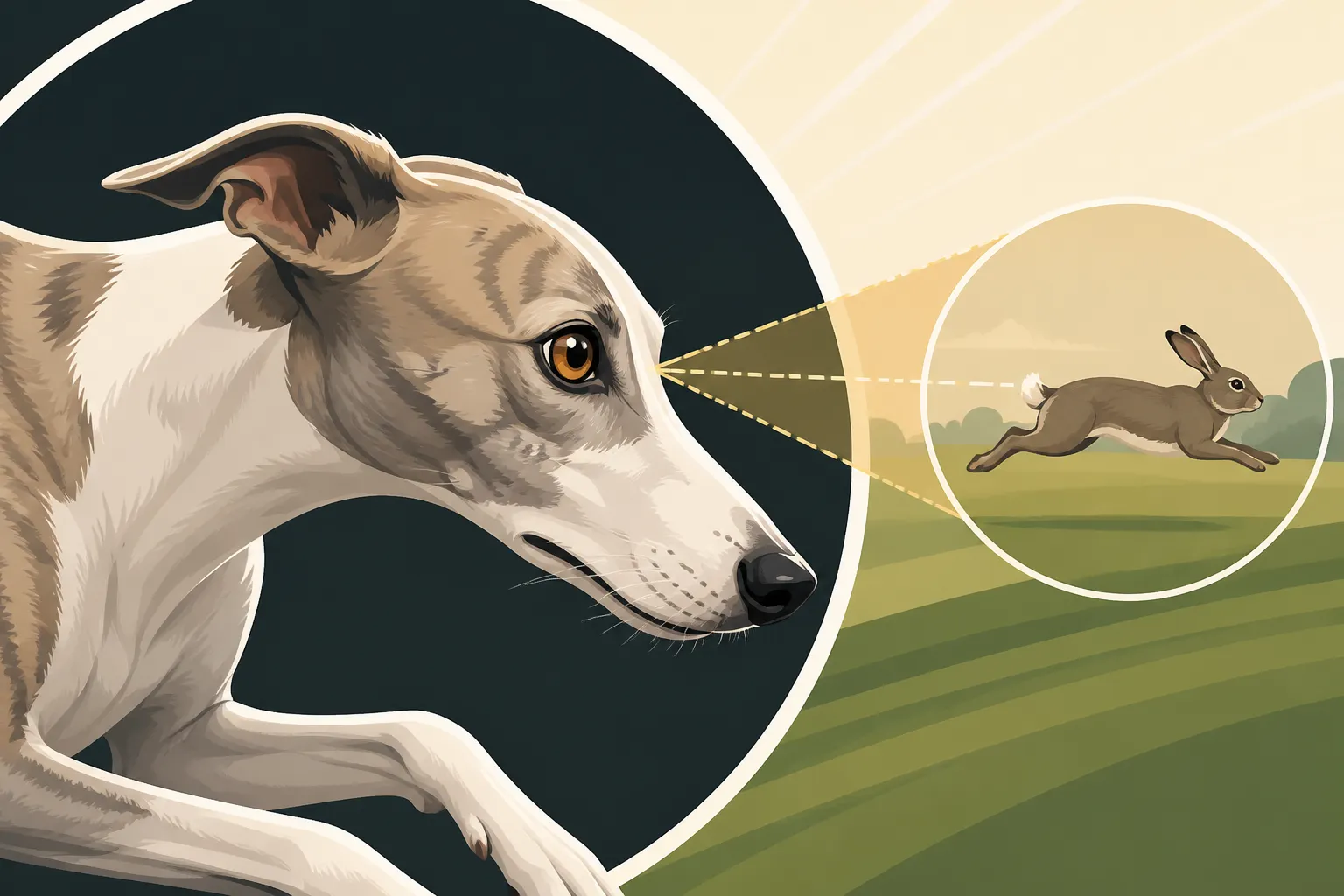
Whippets are sighthounds: dogs whose traditional hunting style relies heavily on vision to spot and pursue moving animals. Their long legs, flexible bodies and explosive acceleration help them cover ground quickly once something catches their attention. They do not need to follow a scent trail before they react. A rabbit darting across a field, a cat slipping through a hedge or even a plastic bag tumbling in the wind can be enough to start the sequence.
That does not mean a Whippet sees everything more clearly than a person does. It means its senses and behavior are well suited to detecting movement and responding quickly. A still animal may go unnoticed until it moves; then the contrast can be startling. Owners often describe a dog that seemed not to hear them suddenly becoming intensely focused on a bird or rabbit in the distance.
The breed’s history helps make sense of this response. Whippets were developed as fast hunting and racing dogs, and their speed and pursuit style are central to what makes them sighthounds. For more background, Why the Whippet Is a True Sighthound and Where the Whippet Actually Comes From explain the breed’s place in the wider history of sight-hunting dogs.
The chase can unfold in a few seconds
A typical sight-driven reaction may begin with orientation: the Whippet notices movement and turns its head or body toward it. Then comes visual fixation. The dog may go quiet, lean forward, stiffen slightly or stop responding to familiar cues. If the moving target continues, the Whippet may launch into a chase.
The stages are not always obvious or neatly separated. A dog may look relaxed, notice a rabbit near a hedgerow, and be sprinting before its person has finished saying its name. This quick transition can make the chase feel unpredictable, especially for a first-time Whippet owner. In reality, the trigger may have been visible to the dog before the person noticed it.
Chasing is not the same as disobedience in the ordinary sense. Once a Whippet is intensely focused on a moving target, familiar cues may compete poorly with the immediate pull of the chase. That is why Why a Whippet's Chase Instinct Overrides Its Recall is useful context: a recall can be well practiced and still not be dependable around prey.
Sight is important, but it is not the only sense
Hunting by sight does not mean a Whippet ignores smell or sound. Dogs use several senses at once, and a Whippet may investigate a scent after it has spotted an animal, or notice a rustle before seeing what caused it. The key difference is that visual motion can trigger a rapid pursuit response without the dog first needing to track a scent trail.
This can explain why the same Whippet behaves differently in different settings. On a quiet pavement, it may walk politely past parked cars and garden walls. On an open path with birds lifting from the grass, it may become much more alert. In a wooded area, scents and sounds may draw its attention too, but a sudden movement in a clearing can still prompt an immediate sprint.
A Whippet’s response also varies by individual. Age, experience, training, environment and temperament all play a part. One dog may pursue every squirrel it sees; another may show little interest in some animals but react strongly to rabbits. It is safer to plan around the possibility of chasing than to assume an individual dog will never do it.
What a sight-driven chase looks like in everyday life
Common triggers are not limited to wild prey
Rabbits and squirrels are familiar triggers, but anything moving quickly can attract a Whippet’s attention. Cats, birds, rodents and small dogs may prompt a chase, particularly if they run suddenly. A cyclist, jogger or fluttering object can also draw a dog’s focus, even when the Whippet has no intention of catching it.
A dog’s response may be more intense in open spaces, where it can see movement from a distance and has room to accelerate. At a park in the suburbs of Chicago, for example, a Whippet might notice a squirrel crossing a lawn well before its person does. In a more enclosed garden, the same dog may have fewer opportunities to spot distant movement, but a cat slipping between fences can still trigger pursuit.
Not every look becomes a chase. Some Whippets watch a moving animal and then turn away; others need only a brief glimpse to spring forward. Pay attention to your dog’s early signs: a sudden pause, fixed gaze, forward weight shift, closed mouth or ears angled toward the target. Those signs are a better cue to act than waiting until the dog is already running.
Why a fast dog can be hard to stop
Whippets accelerate quickly and can cover ground before a person has time to catch up. Even a dog that usually stays close may run after prey with little warning. That speed is part of the breed’s athletic ability, but it also makes an open gate or a dropped leash more consequential. How Fast a Whippet Actually Runs offers a fuller picture of why a short burst can create a real safety challenge.
Roads are an especially serious risk. A Whippet chasing a rabbit across a verge may not pause to check for traffic, and calling from the other side of the road may not interrupt the pursuit. A strong recall is valuable, but it is not a physical barrier. For the same reason, a leash or secure fencing is not an overreaction; it is a practical way to prevent a moment of instinct from becoming an emergency. Why a Loose Whippet Runs Into Traffic explores that risk in more detail.
There is also a risk of injury during a chase. A Whippet running at speed may twist, slip or collide with an obstacle while following a target rather than watching the ground. Wet grass, uneven terrain, holes and debris can all make a sprint less safe. Choosing a suitable enclosed area and checking the ground before letting a dog run can reduce avoidable hazards.
Hunting instinct does not mean a Whippet is aggressive
A chase response is not, by itself, evidence that a Whippet is aggressive or poorly socialized. It is a pursuit behavior directed toward movement. A dog may be affectionate with the family cat indoors and still be tempted to chase an unfamiliar cat outdoors, where the setting and movement are different.
That distinction matters for households with other animals. A Whippet’s behavior around a familiar pet depends on the individual dog, its history and how carefully the animals are introduced and supervised. A calm history together is encouraging, but it does not justify leaving a small animal and a dog unsupervised if there is any uncertainty. Whether a Whippet Is Safe With a Rabbit in the House covers the special care needed when a potential prey animal lives in the home.
If a Whippet fixates on or chases another dog, it is worth considering the situation rather than assuming the motive. The dog may be reacting to movement, excitement, fear or a mix of factors. Give both animals space, prevent an uncontrolled chase and consult a qualified, reward-based trainer if the behavior is frequent or difficult to manage.
Keeping a Whippet safe around moving animals
Use secure spaces and equipment
The most dependable way to allow a Whippet to run freely is to choose a securely enclosed space. Fencing should be high and well maintained, with no gaps at gates or underneath panels. Check the whole perimeter before unclipping the leash: a dog focused on an animal may use an opening that seemed too small to matter during an ordinary walk.
In unfenced areas, keep the dog on a suitable leash. A well-fitted harness or collar and a sturdy lead can help you maintain control, but fit matters: Whippets’ narrow heads and necks can make ordinary flat collars easier to slip out of. Some owners shop at Chewy when looking for walking equipment; whichever retailer you use, check the fit carefully and supervise the dog while it gets used to new gear. A poor fit can create a problem precisely when you need the equipment to work.
A long line may offer room to explore in an appropriate setting, but it is not a substitute for a fenced field when there are animals nearby. Lines can snag, and a running dog reaching the end at speed can be injured or pull the handler off balance. Use a long line only where it can be managed safely, keep it away from traffic and other dogs, and avoid wrapping it around your hand.
| Situation | Safer approach | Why it helps |
|---|---|---|
| Open field with visible rabbits or squirrels | Keep the Whippet leashed or choose a secure enclosure | A sudden chase can begin before a recall is effective |
| Fenced exercise area | Check gates, gaps and ground before unclipping | Prevents escape and reduces the chance of a slip or collision |
| Neighborhood walk near roads | Use secure, well-fitted walking equipment | Adds a physical safety measure if the dog spots prey |
| Wildlife-heavy trail | Create distance from triggers and maintain leash control | Reduces close encounters and limits opportunities to chase |
| Training around moving distractions | Work at a distance where the dog can still respond | Makes it easier to reward attention before fixation takes over |
Train attention and recall without promising perfection
Recall training is still worthwhile. Practice in quiet, low-distraction places first, reward your Whippet generously for turning toward you, and gradually add distractions at a distance your dog can handle. If the dog cannot respond around a moving target, make the situation easier by increasing distance rather than repeating the cue while the dog remains locked on.
An emergency recall can be taught as a special cue paired with an unusually valuable reward. Use it sparingly in practice so it stays meaningful, and rehearse it in safe settings before you rely on it outdoors. Training can strengthen the chance that a Whippet will turn back, but responsible handling means accepting that no cue is guaranteed to interrupt a full chase.
Rewarding calm observation can also help. When your dog notices a bird or squirrel but remains able to look away, mark that choice and reward it. You are not trying to punish the dog for seeing wildlife; you are teaching that checking in with you can be worthwhile. If the Whippet is already over threshold—unable to disengage, take food or respond—move farther away rather than trying to force a lesson in the moment.
For additional enrichment, some owners use sniffing games, food puzzles and structured activities at home. If you are comparing supplies, Chewy is one place people look for treat pouches or puzzle feeders, but the important part is choosing an activity suited to the individual dog and supervising its use. These activities can occupy a Whippet’s mind; they do not remove its interest in chasing live movement.
Give the instinct a safer outlet
A Whippet does not need to chase wildlife to have a satisfying life. Secure exercise, sniffing opportunities, play and reward-based training can all provide useful outlets. Some owners also explore organized activities designed around the breed’s athleticism. How Lure Coursing Channels a Whippet's Drive explains how a controlled pursuit activity differs from an uncontrolled chase in a field.
Before trying a sport, ask the organizer about safety rules, age and fitness requirements, equipment and how dogs are introduced to the activity. A Whippet should be physically ready for the demands, and the surface and conditions should be appropriate. If your dog is recovering from an injury or has a health concern, discuss exercise plans with a veterinarian first.
At home, short games that encourage searching, chasing a toy or responding to cues can add variety without involving wildlife. Keep play controlled and consider the surface, space and dog’s physical condition. Buying toys or enrichment items through Chewy may be convenient for some households, but check that any toy is appropriate for your dog and replace damaged items rather than leaving them available to chew.
Understanding your individual Whippet
Observe the dog in different settings
A useful first step is to notice what specifically gets your Whippet’s attention. Does the dog react most strongly to rabbits, birds, cats, or fast-moving objects? Does it fixate at a particular distance? Are there certain routes or times of day when wildlife is more visible? Keeping brief notes can reveal patterns and help you choose safer walking locations.
Also notice the difference between interest and loss of control. A Whippet that sees a bird, glances at its person and takes a reward is in a very different state from one that is rigid, leaning forward and unable to disengage. That distinction can guide training: reward the first dog’s check-in, while creating more distance for the second.
If the response changes suddenly, or your Whippet seems unusually distressed, disoriented or difficult to handle, seek veterinary advice. Behavior is shaped by context, but changes in health or comfort can also affect how a dog responds. For persistent chasing that creates risk, a qualified trainer or veterinary behavior professional can help you build a plan tailored to your dog and surroundings.
Set expectations that respect the breed
Living with a Whippet often means balancing affection and athleticism. The dog curled up under a blanket at home is the same dog that may launch after movement outside. Neither side cancels out the other. Understanding the sight-based chase helps you plan walks, choose safe exercise spaces and avoid interpreting a fast reaction as a deliberate refusal to cooperate.
The goal is not to eliminate every instinctive response. It is to reduce preventable risk, teach useful skills and give the dog appropriate opportunities to move and explore. Use secure handling near roads and wildlife, reward attention when your Whippet can offer it, and avoid testing recall in situations where failure could be dangerous.
A realistic plan protects both the dog and the animals it might chase. Once you understand what your Whippet is noticing—and how quickly that attention can turn into pursuit—you can make safer choices before the chase begins.
Disclaimer
This article is for general informational purposes only and does not constitute professional advice. Laws, prices and regulations vary by location and change over time. Consult a qualified professional for guidance on your specific situation.