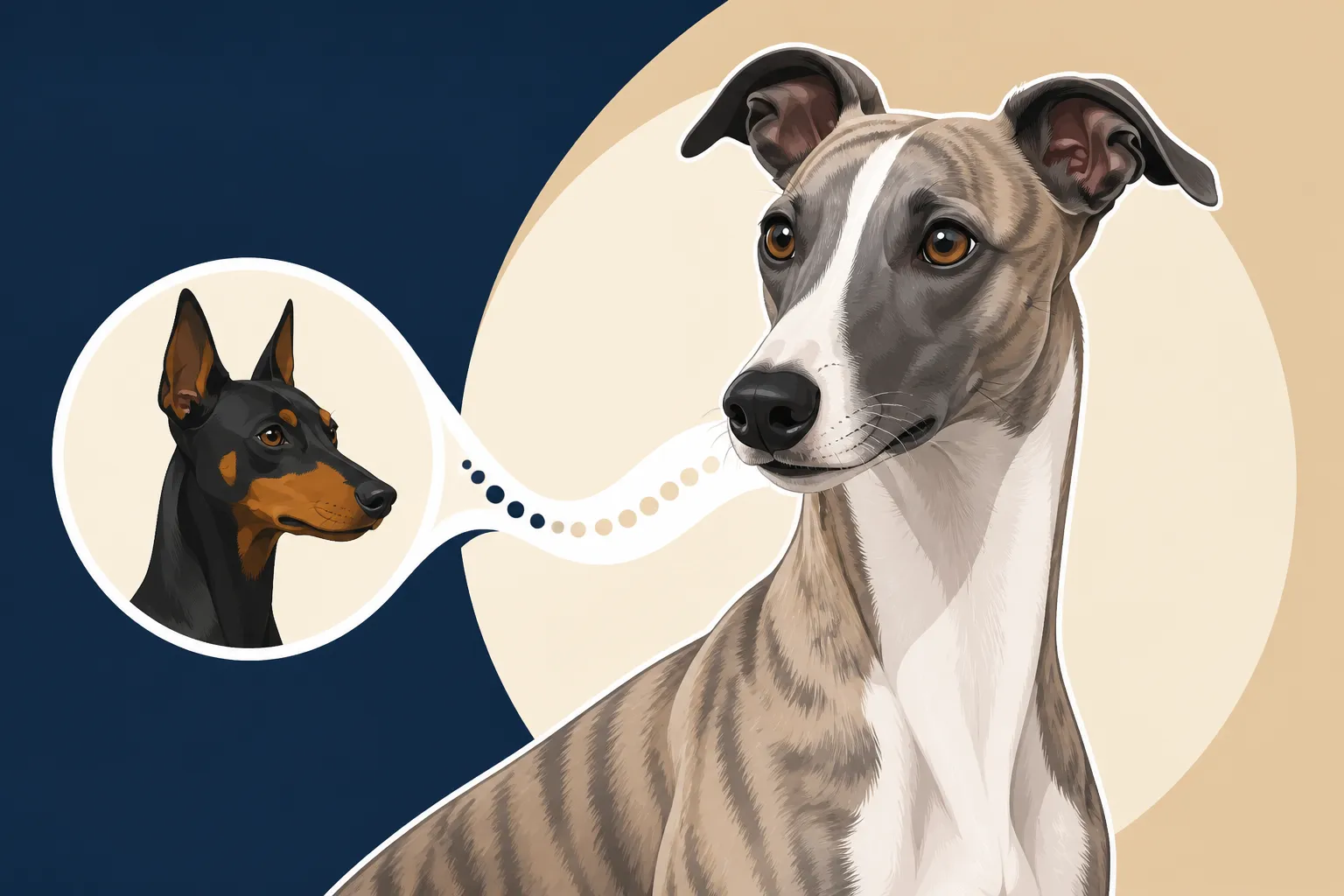
The Manchester Terrier in the Whippet
A Whippet’s sleek outline can look very different from a Manchester Terrier’s compact, upright build, so the idea that one helped shape the other may seem surprising. The historical connection is plausible, but the old records are incomplete and do not support a neat, certain family tree. This guide explains what is known, what remains uncertain, and what the connection means for Whippets today.
Why the Manchester Terrier is linked to Whippet history
The Whippet took shape among working people in northern England
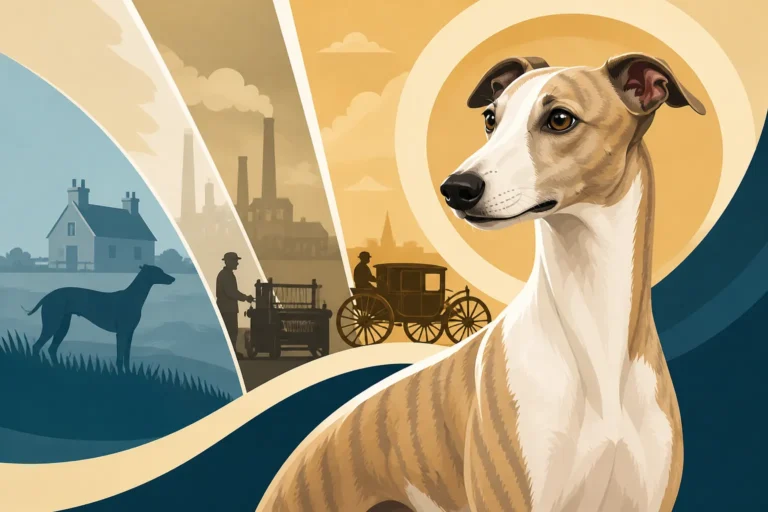
The Whippet developed in northern England, where working families valued a dog that could sprint after rabbits and compete in informal races without the expense of keeping a large Greyhound. The breed’s history is closely connected to mining and mill communities, especially in areas where people bred dogs for practical ability as well as sport. For more on that setting, see Where the Whippet Was Developed and How Miners Built the Whippet From a Greyhound They Could Afford.
The dogs that eventually became recognizably Whippets were not created through a modern, carefully documented breeding program. People crossed and selected dogs based on what they needed: speed, agility, manageable size, and a strong instinct to pursue moving quarry. Greyhounds were an obvious influence, but local dogs and terriers may also have contributed to the type.
This context matters when considering the Manchester Terrier connection. Early Whippet development happened before today’s breed standards and closed registries made pedigrees easier to trace. The dogs involved were often identified by use or appearance, not by the precise breed names owners use now. A dog described as a terrier in an old account may not have been a Manchester Terrier in the modern sense.
Manchester Terrier ancestry is plausible, not proven in precise terms
The Manchester Terrier descends from the old Black and Tan Terrier type, a small, quick dog valued for catching rats and other vermin. Terriers of that general kind could have been useful in developing a smaller, nimble hunting dog. It is therefore reasonable to find Manchester Terriers, or related black-and-tan terrier types, discussed as possible influences on the Whippet.
That does not mean historians can point to a particular Manchester Terrier and establish that it was crossed with a particular early Whippet. The evidence does not provide a reliable recipe, a definite number of crosses, or a measurable share of Manchester Terrier ancestry in the modern breed. Claims that Whippets are a specific percentage Manchester Terrier should be treated with caution unless supported by verifiable pedigree evidence.
It is also easy to blur the distinction between a modern breed and an older type. The Manchester Terrier as a formally recognized breed emerged from a broader history of British terriers. Early breeders may have used dogs that resembled the ancestors of today’s Manchester Terrier without using the current breed name. That is why Whether Terrier Blood Is in the Whippet is a useful question, but the answer needs to leave room for uncertainty.
Historical crosses were about function
A terrier’s possible contribution would not have been to give the Whippet a terrier’s entire shape or temperament. Breeders selected dogs for particular qualities, and those qualities could be mixed over generations. A small terrier might have contributed toughness, quick reactions, or compact size, while Greyhound-type dogs supplied much of the long-legged, high-speed sighthound form.
The early Whippet’s role also helps explain why people may have considered a range of crosses. These dogs needed to be fast enough to chase rabbits, but small enough to keep and feed economically. The goal was not simply to miniaturize a Greyhound. It was to create a useful, fast dog suited to the people and conditions of its time. For a fuller look at the breed’s possible contributors, see Which Breeds Went Into the Whippet.
| Question | What the history supports | What it does not establish |
|---|---|---|
| Could terriers have influenced Whippets? | Yes. Terriers or terrier-like dogs are widely discussed as part of the breed’s development. | A complete, documented list of the individual dogs used |
| Could Manchester Terrier ancestors have been involved? | It is plausible, given the relationship between old Black and Tan Terrier types and the Manchester Terrier. | A confirmed, measurable Manchester Terrier percentage in modern Whippets |
| Does a modern Whippet behave like a Manchester Terrier? | Both breeds can be alert and energetic in different ways. | That a Whippet’s present-day behavior proves terrier ancestry |
| Does appearance reveal the historical cross? | Some traits can resemble traits seen in other breeds. | A reliable genetic or pedigree conclusion based on looks alone |
What a terrier influence might have contributed
Speed and size were shaped by selective breeding
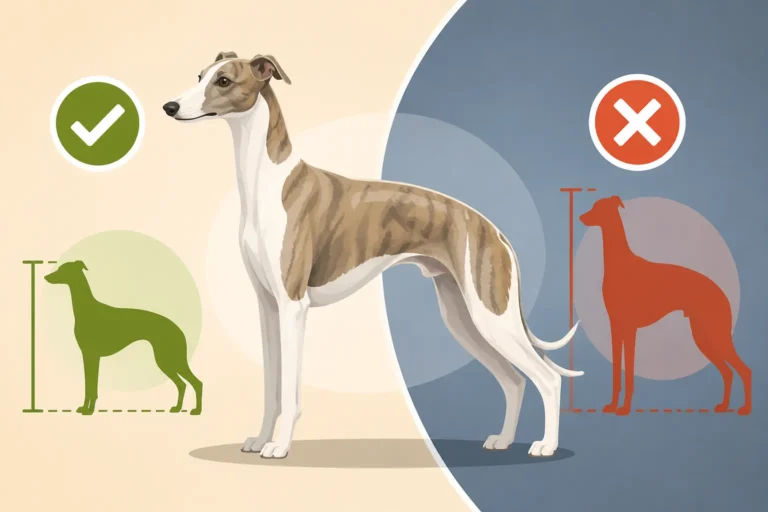
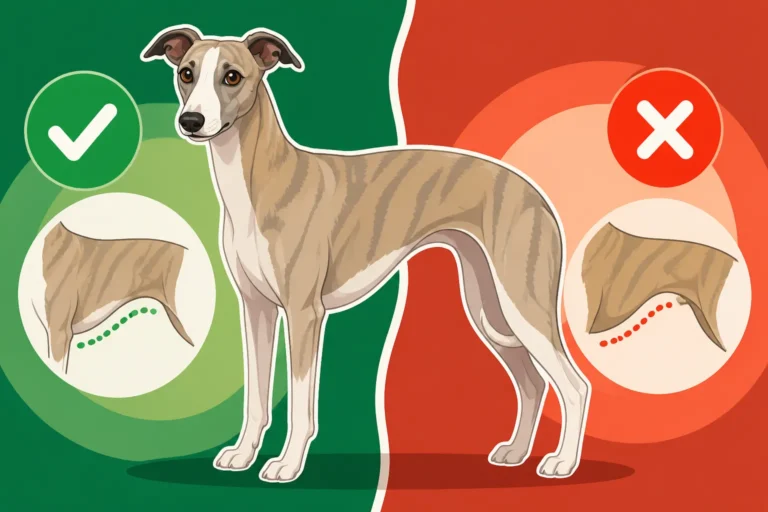
The Whippet’s distinctive body reflects generations of selection for rapid acceleration and a flexible, efficient gallop. Long legs, a deep chest, a narrow waist, and a flexible back support the breed’s athletic movement. Those characteristics are strongly associated with sighthound function, rather than with the compact outline of a Manchester Terrier.
A terrier contribution, if present in particular early crosses, would have been incorporated into a broader breeding population and then reshaped by selection. If breeders wanted a smaller dog that could still run effectively, they would keep dogs that combined the desired size with speed and hunting drive. Over time, the traits that best suited the job would become more common.
This is one reason the phrase “a Whippet is part Manchester Terrier” can be misleading. It suggests a simple, direct cross, as if today’s breed were a predictable blend of two modern breeds. The Whippet’s development was more gradual and less neatly recorded. The historical role of the Manchester Terrier’s ancestors is best understood as one possible thread in a complicated story, not as a complete explanation of the Whippet.
A similar trait does not prove a shared ancestor
People often try to infer ancestry from a dog’s behavior. A Whippet that is alert, persistent, or keen to chase may seem terrier-like. But chasing moving animals is also central to a sighthound’s inherited hunting style. Whippets pursue by sight, and a sudden movement can catch their attention even when they have been relaxed moments before. How a Whippet Hunts by Sight explores why that instinct matters in everyday life.
Physical resemblance can be just as deceptive. A Whippet may be small, athletic, or energetic, but those traits appear across many breeds. A black-and-tan coat, for example, does not prove Manchester Terrier ancestry. Nor does a narrow head or a lively expression. Similar features can arise through shared ancestry much farther back, selective breeding, or simple coincidence.
For a pet owner, the practical takeaway is that breed history can explain broad patterns, but it cannot diagnose an individual dog’s ancestry or personality. A Whippet’s behavior is shaped by inherited tendencies, early experiences, training, health, and the environment it lives in. Two littermates can have noticeably different confidence levels or interests, even though they share the same parents.
Other terrier connections complicate the story
The Manchester Terrier is not the only terrier mentioned in discussions of Whippet origins. Some accounts also consider other regional terrier types, including the Bedlington Terrier. These discussions reflect how local breeding worked: owners used dogs available to them, and the names and types were not always as standardized as they are today. The Bedlington Terrier in the Whippet looks at another proposed connection.
It is more accurate to think of early Whippet development as a population of working dogs gradually becoming a more consistent type. That type drew heavily on Greyhound-like sighthounds, while terrier influence is plausible but difficult to pin down. The exact contribution of each older dog type may never be settled, because the records are not complete enough to reconstruct every cross.
The Whippet’s later development also included a growing divide between dogs bred for performance and dogs bred to meet show standards. Those lines can differ in build and emphasis, but both remain Whippets. For context, see The Split Between Racing and Show Whippets. This later history should not be confused with the earlier question of which local dogs helped establish the breed.
How the Manchester Terrier differs from the Whippet today
Their body shapes reflect different jobs
The Manchester Terrier is a small, alert terrier with a compact build and a coat commonly associated with a black-and-tan pattern. It was developed for vermin control and related work. The Whippet is a medium-sized sighthound with a streamlined frame, deep chest, long limbs, and a flexible spine, built for short bursts of speed and visual pursuit.
Those differences are not minor variations on the same body type. A Manchester Terrier’s proportions suit close, active work around small quarry. A Whippet’s proportions are adapted for covering ground quickly in an extended gallop. Both can be athletic, but they are not built for identical movement or tasks.
A Whippet’s slim appearance is also sometimes mistaken for evidence of mixed ancestry or poor condition. In a healthy Whippet, visible waist definition and some outline of the ribs can be normal. That does not mean every thin-looking dog is fit, but appearance should be assessed with the dog’s body condition and veterinary guidance rather than by comparing it with a stockier terrier.
Their instincts can overlap without being the same
Both breeds may be lively, observant, and interested in movement, but the reasons and expression of those behaviors can differ. A Manchester Terrier’s terrier background is associated with close-range pursuit and vermin work. A Whippet’s sighthound background makes fast-moving visual targets especially compelling.
That distinction can affect daily management. A Whippet may suddenly fixate on a rabbit or a small animal across an open space, then accelerate before an owner has time to react. Reliable recall is difficult to count on once a chase begins, so secure fencing and thoughtful leash use matter. The breed’s speed and chase instinct are explored further in The Whippet Against the Greyhound and the Italian Greyhound.
No owner should assume that a Whippet will be easy to live with around small pets simply because it has been raised in a home. Early introductions, supervision, and individual temperament all matter. A dog’s historical ancestry does not make a safe prediction about how it will respond to a specific cat, rabbit, or other small animal.
A suspected ancestor does not make a modern Whippet a crossbreed
Whippets are a recognized breed with established standards and pedigrees. A breed’s distant development may include crosses with other dog types without making every modern member a crossbreed in the everyday sense. Many established breeds were shaped from multiple populations before breeding practices became more formal.
If you are trying to understand a particular dog’s background, start with its pedigree and breeder records where available. Appearance alone cannot confirm that a Whippet has recent Manchester Terrier ancestry. Consumer DNA tests may offer ancestry estimates, but those estimates depend on the reference populations and methods used; they are not substitutes for documented pedigree records or a definitive account of early breed history.
For an owner, the most useful approach is to treat the dog in front of you as an individual Whippet. Learn its preferences, manage its chase instinct, provide appropriate exercise, and use humane, consistent training. Historical theories can make the breed more interesting, but they should not override what your own dog’s behavior and needs are showing you.
What to take from the Manchester Terrier connection
The Manchester Terrier connection is best described as a plausible historical influence within a much broader and poorly documented period of Whippet development. Older Black and Tan Terrier types may have contributed to the dogs that became Whippets, but the surviving evidence does not provide a precise, universally accepted family tree. The breed’s recognizable modern shape and purpose were formed through generations of selection, especially for speed and athletic ability.
That balanced answer avoids two common extremes: claiming that Manchester Terriers had no possible role at all, or presenting them as the proven source of a large, measurable share of the Whippet’s ancestry. The more useful picture is a working breed that emerged from local dogs and deliberate selection, with Greyhound-like sighthounds and possible terrier influences among the threads in its history.
For present-day owners, the distinction between the breeds is much clearer than the details of their distant relationship. A Whippet is a sighthound, with a body and chase instinct shaped for visual pursuit. A Manchester Terrier is a terrier with a different build and working background. Understanding that difference helps set realistic expectations about exercise, training, and safe handling—without treating a historical theory as a prediction of an individual dog.
Disclaimer
This article is for general informational purposes only and does not constitute professional advice. Laws, prices and regulations vary by location and change over time. Consult a qualified professional for guidance on your specific situation.