How Well a Whippet Follows a Scent
A Whippet may spot a rabbit across a field before you do, yet seem to miss a treat tucked under a blanket. That contrast can make owners wonder whether Whippets have a poor sense of smell. They don’t: they can follow scent, but their instincts and breeding tend to favor finding movement with their eyes over tracking a trail for a long time.
How a Whippet Uses Its Nose
Whippets are sight-focused, not scent-blind
Whippets are sighthounds. Their characteristic way of hunting is to notice movement, orient quickly, and chase what they see. That doesn’t mean their noses are weak or that they can’t investigate a smell. It means they were not primarily developed to follow a ground trail patiently over distance, as scent hounds such as Beagles are.
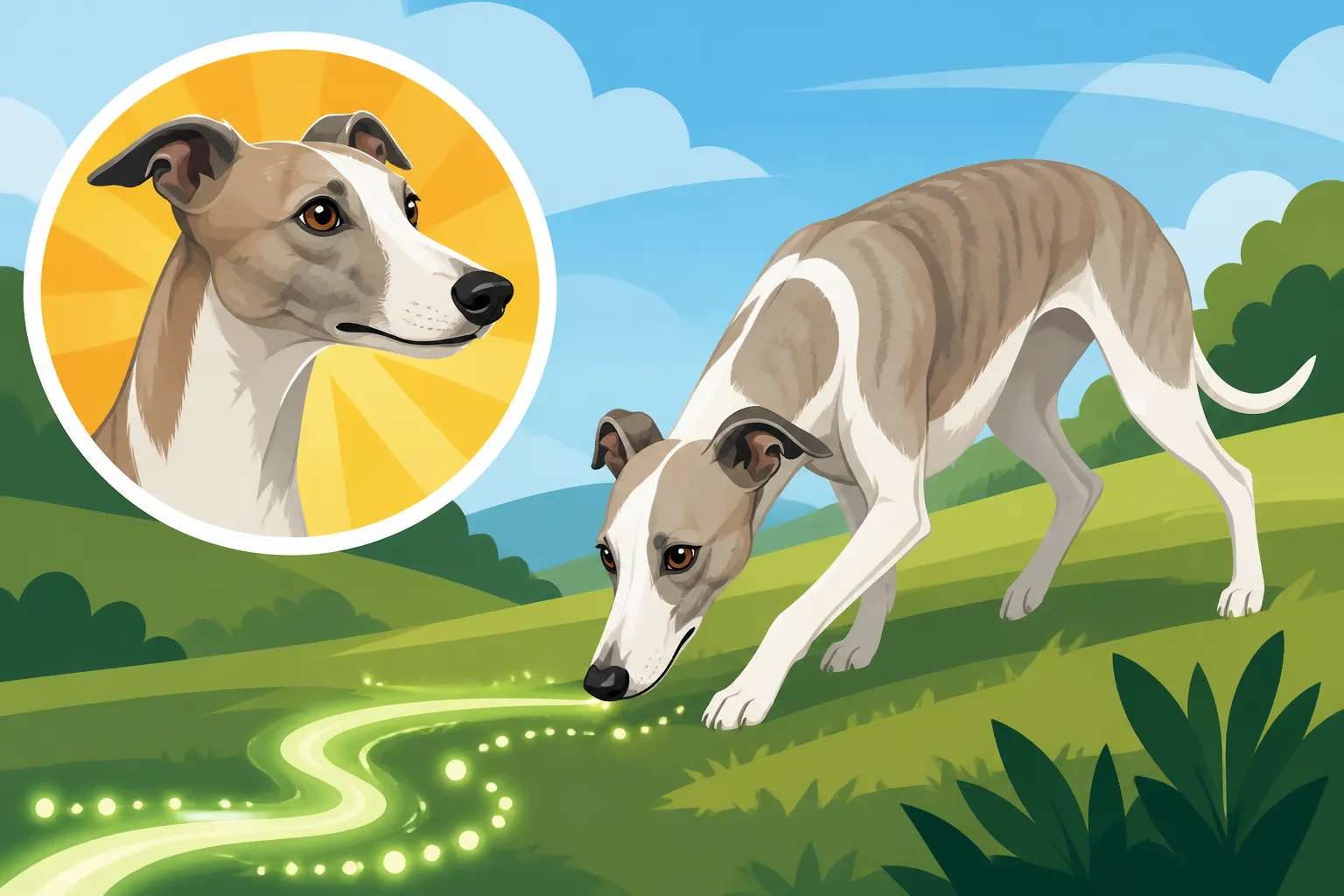
A Whippet out on a walk may stop to sniff a hedge, inspect a patch of grass, or linger over a spot where another dog has been. Those ordinary behaviors are a reminder that the nose is part of everyday canine life. A Whippet might also use scent to locate a hidden toy or follow a short trail of treats. What may be less reliable is expecting every Whippet to stay absorbed in a long scent trail when there are birds, squirrels, or a moving dog nearby.
This difference between smelling and being especially motivated to track is easy to overlook. Dogs use scent to gather information, but breed tendencies influence what they do with that information. A Whippet can notice an interesting odor and then turn toward movement in an instant. Their visual attention and chase instinct can be powerful distractions, not evidence that their nose has stopped working. For more on that visual hunting style, see How a Whippet Hunts by Sight.
What scent work may look like in daily life
At home, a Whippet may search for food hidden beneath a towel or sniff out a familiar person in another room. Outside, they may investigate scent marks, follow a short route another dog has walked, or locate a toy that has been placed in grass. These are all forms of scent use, even if they don’t resemble the focused trailing associated with breeds bred for that work.
Some Whippets enjoy nose-led games right away; others need an easy introduction. A dog who seems uninterested in one setup may simply prefer a different reward, a quieter room, or a shorter session. Try a few small, low-pressure games before deciding your dog “isn’t a sniffer.” A soft treat hidden in a cardboard box may be more appealing than a toy hidden outdoors, especially if the surroundings are busy.
Smell can also help your Whippet explore at a comfortable pace. On a walk, give them time to sniff safe areas rather than pulling them from every stop. That doesn’t mean every sniff needs to become a long detour: it’s fine to keep moving when needed. But allowing some nose-led pauses can make a walk more engaging, particularly for a dog who is not able to run freely.
Can Whippets Learn Scent Work
Start with a simple search game
You don’t need special equipment to see whether your Whippet enjoys searching. Begin somewhere calm, such as a familiar room, and let your dog watch you place a treat just behind a chair leg or under an easy-to-lift towel. Use a release cue such as “find it,” then give them time to investigate.
Keep the first searches obvious. If the treat is difficult to locate, your dog may give up or start looking to you for help. When they find it, let them eat it and praise them in a relaxed way. Repeat with a few easy hiding places, then gradually make the searches more challenging. Stop while your dog is still interested rather than stretching the game until they wander away.
If food is a strong motivator, small training treats can make it easier to reward each successful find. Chewy is one place owners may look for treats or simple enrichment supplies, but the reward itself can be whatever suits the dog’s diet and preferences. Check that treats are an appropriate size and count them as part of your Whippet’s daily food.
Build on success without rushing
Once your Whippet understands the game indoors, change one thing at a time. You could move the hiding place to another room, use a small number of boxes, or ask your dog to find a familiar toy. If your dog gets frustrated, make the next search easier. A successful, short session is more useful than a complicated setup that leaves the dog disengaged.
Some dogs enjoy searching for food, while others prefer a toy or a familiar scent. You can experiment with safe, ordinary household objects and rewards your dog already knows. Avoid using unfamiliar substances or strong scents that might irritate your dog or encourage them to lick or eat something unsafe. If you plan to join an organized scent activity, ask the instructor what materials are used and what the dog will be expected to do.
Scent work is a possible enrichment activity, not a test of whether a Whippet is “good” or “bad” at using their nose. Interest can vary by dog, setting, reward, and training history. If your Whippet prefers a short search and then wants to curl up on the sofa, that’s still useful information about what they enjoy. For more ideas about activities and enrichment, read The Job a Whippet Actually Needs and Whether a Whippet Takes to Scent Work.
Scent Tracking, Safety, and Whippet Instincts
A scent trail does not guarantee a dependable recall
A Whippet may follow a scent with enthusiasm, but that does not mean it is safe to rely on them to track while off leash. A sudden glimpse of prey can quickly take priority, and a dog absorbed in a chase may not respond to a familiar cue. Scent games in a secure, controlled space are very different from letting a Whippet roam in an unfenced area.
Use a leash or a secure enclosed space whenever the environment could put your dog at risk. A long line can give a Whippet room to investigate while keeping you connected, though it should be handled carefully to avoid tangles or sudden stops. Check the area for hazards before setting up a search outdoors, and avoid placing food near roads, wildlife, or anything your dog might swallow.
Recall training is worthwhile, but even a well-practiced cue is not a guarantee in every situation. Whippets are built to accelerate quickly, so a few seconds of hesitation can matter. Learn more about the challenge in How a Whippet's Chase Instinct Overrides Its Recall and Proofing a Whippet's Recall Against Prey. For a broader look at why open spaces require extra caution, see Why a Whippet Cannot Be Let Off Leash in an Open Field.
Distinguish ordinary sniffing from a sudden change
Sniffing is normal, and a Whippet who pauses to investigate the ground is usually just gathering information. You may see them sniff longer in a new place or after rain, when odors in the environment seem especially interesting. A change in where or how often your dog sniffs is not automatically a medical problem, but it is useful to notice alongside other changes in behavior.
Contact your veterinarian if your Whippet suddenly seems unable to smell familiar food, has nasal discharge, sneezes persistently, paws at the nose, or appears distressed. Don’t try to treat nasal symptoms with human medication or put anything into your dog’s nostrils without veterinary guidance. A veterinarian can assess whether the behavior reflects irritation, illness, or something else.
It’s also sensible to supervise food-based search games. Keep small objects, wrappers, and unsafe foods out of hiding places, and use rewards your dog can safely eat. If you use a snuffle mat or similar enrichment item, watch how your Whippet handles it and put it away if they chew or swallow parts of it. Chewy may carry enrichment products such as treat-dispensing toys, but choose a size and design that suit your dog’s habits, and follow the maker’s safety instructions.
What to Expect From Your Whippet
Compare the activity, not just the breed label
The practical question is often not whether Whippets can smell, but whether a particular dog enjoys searching. A Whippet who noses around the garden, sniffs every post on a walk, and eagerly hunts for treats is clearly making use of scent. A dog who gives a search game a brief try and then loses interest may simply prefer another kind of enrichment.
| Activity | What it asks of your Whippet | A sensible way to try it |
|---|---|---|
| Finding treats indoors | Searching a small, familiar area | Begin with an easy, visible hiding place |
| Searching boxes | Checking several safe containers | Use a few boxes and reward the correct one |
| Following a short trail | Staying with a simple scent path | Keep the trail brief and the area secure |
| Sniffing during a walk | Exploring scents at the dog’s pace | Allow safe pauses while maintaining leash control |
| Outdoor searching | Working around distractions and hazards | Use a secure enclosure or a suitable long line |
Whippets vary. One may be delighted by a treat hunt, while another would rather chase a lure in a fenced setting or practice a different game. You can explore more about their visual instincts in Why the Whippet Is a True Sighthound, and about their athletic background in How Closely the Whippet Descends From the Greyhound.
The simplest approach is to offer choices and watch your dog’s response. Start with a quiet, easy search; use a reward your Whippet values; and keep sessions short enough that success feels effortless. If your dog enjoys it, gradually add variety. If not, there’s no need to turn scent work into a chore. The goal is an enjoyable activity that fits your Whippet, not proving that every dog of the breed should love tracking.
Disclaimer
This article is for general informational purposes only and does not constitute professional advice. Laws, prices and regulations vary by location and change over time. Consult a qualified professional for guidance on your specific situation.