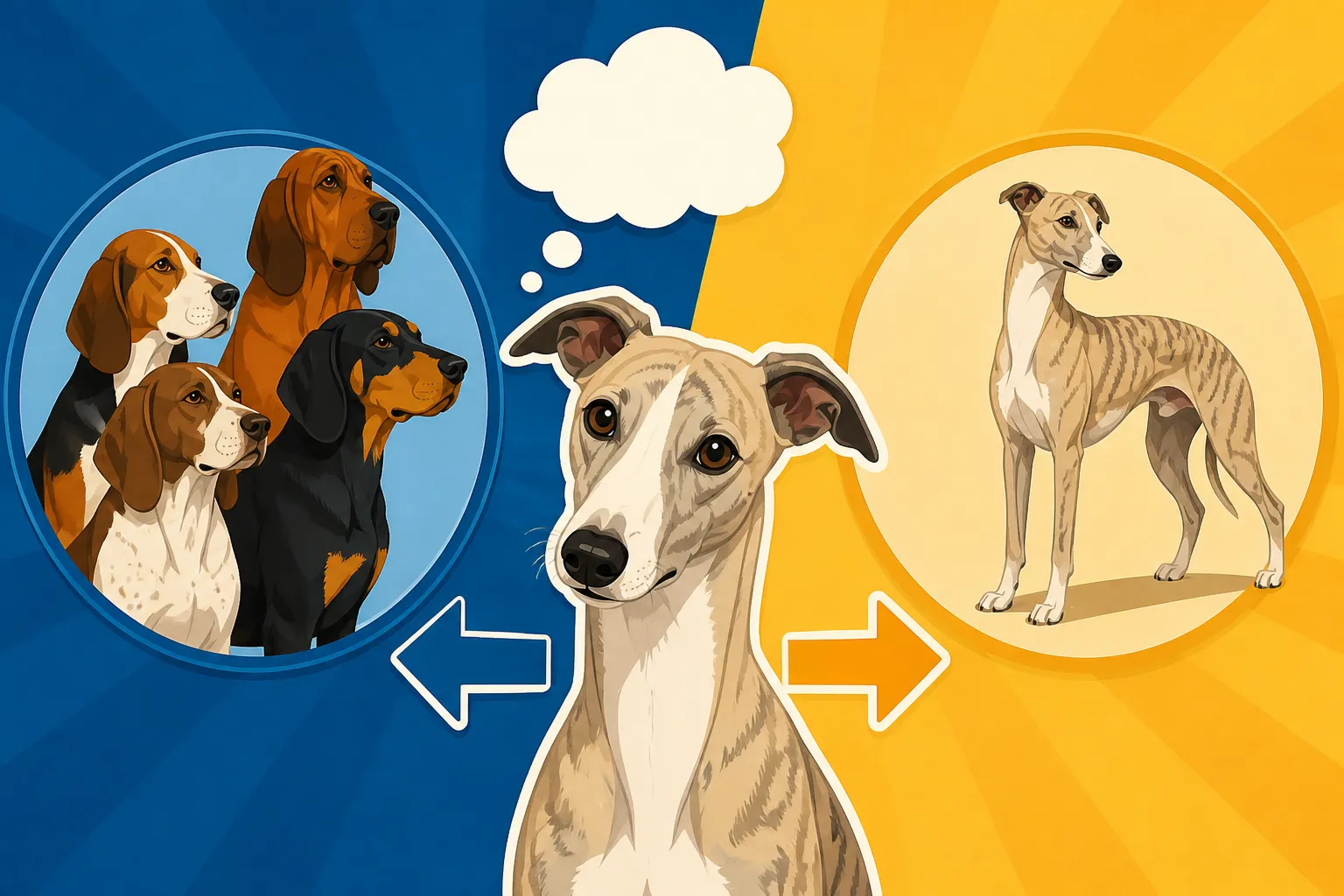
Whether the AKC Puts the Whippet in the Hound Group
The American Kennel Club places the Whippet in its Hound Group, alongside breeds developed to hunt using sight or scent. That label can be confusing if you think of a hound only as a dog that follows a smell. Here’s what the AKC classification means, how Whippets fit among sighthounds, and what the group label does—and does not—tell you about living with one.
Yes, the AKC puts the Whippet in the Hound Group
What the AKC group label means
The AKC divides recognized breeds into groups based on shared histories, traits, and traditional roles. The Whippet belongs to the Hound Group. That is its official group classification for AKC purposes, including conformation events where dogs are judged against the standard for their breed.
“Hound” is a broad category, not a description of one single hunting style. Some hounds were developed to follow scent trails, while others were bred to spot and pursue moving animals. Whippets belong to the latter tradition: they are sighthounds. Their keen vision, quick acceleration, and ability to run at speed are central to their historic role.
So the short answer is straightforward: the AKC classifies the Whippet as a Hound, and more specifically, the Whippet is a sighthound. It is not placed in a separate AKC “Sighthound Group.” That distinction helps explain why a Whippet may seem very different from a scent hound, even though both breeds share the Hound Group designation.
If you have seen Whippets described as “sporting” or “working” dogs, those descriptions may be referring informally to their athletic abilities or activities. They do not change the AKC group. For a closer look at the hunting style behind the label, see How a Whippet Hunts by Sight.
Why “hound” does not mean “follows a scent”
It’s easy to picture a Beagle with its nose down when someone says “hound.” That image fits many scent hounds, but it doesn’t describe every breed in the group. Whippets were developed to notice movement and pursue what they see, rather than to trail a scent for long distances.
That difference can show up in everyday life. A Whippet may be relaxed on the sofa one moment, then intensely focused on a rabbit or squirrel moving across an open area the next. The dog’s attention is drawn to motion, and the instinct to chase can be powerful. That does not mean every Whippet will chase every moving thing, but it is a practical part of understanding the breed.
This is also why an AKC group label should not be treated as a full behavior forecast. It gives useful context about a breed’s history, but it cannot tell you exactly how an individual dog will behave around wildlife, cats, or other pets. If you are comparing the Whippet with its larger relative, The Whippet Against a Greyhound explains some of the similarities and differences.
How Whippets fit among sighthounds
The Whippet’s history helps explain its classification
Whippets were bred for speed and visual pursuit. Their lean build, flexible spine, long legs, and deep chest support fast running. Historically, they were valued as working dogs as well as companions, and their ability to chase small game was part of their role. The Hound Group classification reflects that heritage, even though modern Whippets may spend much more time relaxing indoors than pursuing prey.
The breed’s history also helps make sense of the Whippet’s distinctive combination of traits. Many owners describe a dog that is athletic outside and surprisingly content to curl up at home afterward. That contrast is not a contradiction: a breed can have a strong capacity for speed without needing to be constantly active. For more about the qualities that make a Whippet a sighthound, read Why a Whippet Is a True Sighthound.
The term “sighthound” describes a type of hound, not a separate AKC group. It is a helpful way to distinguish Whippets from scent-focused breeds while still recognizing their official placement. In other words, “Hound” answers the AKC group question; “sighthound” describes the kind of hound the Whippet is.
The AKC is not the only organization with breed categories
Breed organizations do not all arrange breeds in exactly the same way. The AKC places Whippets in the Hound Group, while other kennel organizations may use different structures or group names. A classification in one organization’s system should not be assumed to apply identically in another.
For example, international systems may separate sighthounds into a group of their own. That can make it seem as though different organizations disagree about what a Whippet is, when they are often using different organizational frameworks. The dog’s history and physical traits remain the same; the category labels vary according to the registry’s system.
This distinction matters if you are looking up show eligibility, breed standards, or event rules. Check the organization running the event rather than relying on a general description from a breed article or retailer. If you are learning about the breed’s background, Which Breeds Went Into the Whippet offers more context on its development.
| Question | Answer |
|---|---|
| What AKC group is the Whippet in? | The Hound Group |
| Is the Whippet a sighthound? | Yes |
| Does the AKC have a separate Sighthound Group? | No; sighthounds such as Whippets are included in the Hound Group |
| Does the Hound label mean a Whippet is scent-driven? | No; Whippets primarily pursue by sight |
| Does group placement tell you exactly how an individual dog will behave? | No; it offers breed context, not a guarantee about temperament |
What the Hound Group label means in everyday life
It offers context, not a complete temperament description
A group classification can help explain why a Whippet has particular instincts, but it cannot substitute for meeting the dog or learning about its individual temperament. Whippets vary. Some are bold and outgoing; others are more reserved. A dog’s early experiences, health, training, and home environment all matter.
The sighthound background is still useful when planning for safety. A Whippet that spots a rabbit may become absorbed in the chase, so owners should take care around open spaces and traffic. A reliable recall is valuable, but it is sensible to manage the environment rather than assume a dog will respond perfectly when its chase instinct is engaged.
That same instinct can affect introductions to smaller animals. Some Whippets live peacefully with cats, particularly when introductions are managed carefully, while others may find a running cat difficult to ignore. The Hound Group label does not determine the outcome, but the breed’s visual chase style is worth considering. For more on that household question, see Whether a Whippet Suits a Household With Cats.
It does not determine care, diet, or the right home
The group label is not a care plan. It does not tell you what food to buy, how much exercise a particular Whippet needs, or whether a specific dog will suit your household. It is one piece of background information to combine with the dog’s age, health, behavior, and daily routine.
For instance, a Whippet’s need for warmth is better understood through its short coat and lean body than through the word “hound.” A dog’s nutrition should be chosen for its individual needs, not simply because it belongs to a group. If you are browsing general care products at a retailer such as Chewy, use the product information as a starting point and ask your veterinarian about diet or health concerns specific to your dog.
Likewise, the label does not say whether a Whippet is right for a first-time owner. A prospective owner should consider safe exercise, secure outdoor spaces, training expectations, and the dog’s need for comfortable places to rest. A retailer such as Chewy may be one place to explore everyday supplies, but equipment and food choices should suit the individual Whippet rather than its AKC group. For a broader look at the ownership question, see Whether a Whippet Suits a First Time Owner.
Common misunderstandings about the Whippet’s AKC group
“If it is a hound, it must have a strong nose”
This is the most common mix-up. The Hound Group includes both scent hounds and sighthounds, so the shared group name does not mean every breed hunts in the same way. A Whippet’s visual focus is an important part of its identity.
That does not mean Whippets never use their noses. Dogs naturally investigate scents, and an individual Whippet may enjoy sniffing games or follow an interesting trail. The distinction is about the breed’s traditional specialization, not a claim that it has no sense of smell.
“The group tells me how much exercise it needs”
Group membership cannot give you a precise exercise prescription. Whippets can be fast and athletic, but their needs vary with age, fitness, health, and temperament. A young dog, an older dog, and a dog recovering from an injury should not automatically be given the same routine just because they share a breed group.
A safer approach is to build activity around the individual dog. Provide suitable walks and opportunities for movement, and use a secure area for running rather than relying on an open field. If you are considering dog sports, ask a veterinarian and an experienced Whippet club or trainer how to introduce activity appropriately.
“The AKC group label settles every breed question”
It settles one specific question: the Whippet is in the AKC Hound Group. It does not answer every question about breed history, behavior, health, or suitability. Those topics need their own information and, when appropriate, advice from a veterinarian or qualified behavior professional.
The label is most useful when you are navigating AKC breed information or events. For day-to-day ownership, it works best as a small piece of context: Whippets are sighthounds with a history of visual pursuit, and that history can inform how you manage exercise and safety. It should not be used as a shortcut for judging any one dog.
Disclaimer
This article is for general informational purposes only and does not constitute professional advice. Laws, prices and regulations vary by location and change over time. Consult a qualified professional for guidance on your specific situation.