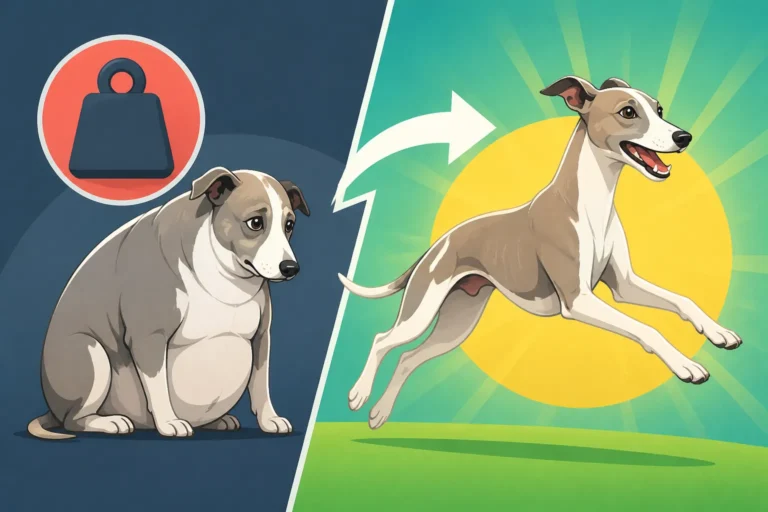
The Split Between Racing and Show Whippets
A racing Whippet and a show Whippet can look like two versions of the same breed, yet their breeding priorities, daily routines, and the communities around them may differ. That can make puppy listings confusing: “racing bred” and “show bred” sound like guarantees, but they describe tendencies, not a dog’s whole personality or potential. This guide explains what the split means and how to assess an individual Whippet.
What the racing and show split means
Two different breeding goals
Whippets were developed as quick, athletic sighthounds, and speed remains part of the breed’s identity. But breeders and owners may place different emphasis on how that ability is expressed. Racing lines are generally selected with performance in mind: breeders may consider speed, drive, athletic movement, race results, and the qualities that help a dog compete in a particular form of Whippet racing.
Show breeding focuses on how closely a dog conforms to the written breed standard. Judges assess features such as outline, proportions, movement, and overall balance. The goal is not simply to produce a beautiful dog in isolation; it is to preserve the characteristic Whippet type described by the standard.
These priorities can overlap. A show-bred Whippet may be keen and athletic, while a racing-bred dog may have a balanced outline and make a lovely companion. The labels describe the focus of a breeding program more than a strict divide between “fast” and “pretty.” For more on how these traditions developed, see How Show Whippets Differ in Size From Racing Whippets and The Shift to Breeding Whippets for Show.
A split in emphasis, not separate breeds
Racing and show Whippets belong to the same breed, but breeding communities can become distinct over time. When dogs are repeatedly selected for different priorities, their family lines may develop recognizable tendencies. Those tendencies are not universal, and there is no single physical feature that reliably identifies every dog’s background.
A racing pedigree may include relatives with records in a specific competition, while a show pedigree may include dogs recognized for success in the ring. Neither type of record tells you everything about the puppy in front of you. Temperament, health, structure, early socialization, and the breeder’s choices all matter.
It also helps to ask what “racing” means in a particular listing. A dog may come from lines used for organized straight racing, oval racing, lure coursing, or other sighthound sports. Those activities have different formats, and a breeder’s use of the word may refer to family history rather than a promise that the puppy will race. Ask for specifics instead of assuming that every racing-bred Whippet has the same background.
How racing and show Whippets may differ
Build, movement, and athletic style
People often expect racing Whippets to be visibly leaner and show Whippets to be heavier or more substantial. There can be differences in average type between particular lines, but appearance alone is not a reliable way to judge a dog’s breeding or ability. Whippets naturally have a slim outline, tucked-up waist, and visible muscle definition. A fit dog may look strikingly lean without being underweight.
A show Whippet is evaluated against a standard for the breed’s overall shape and movement. That does not mean it should be clumsy, inactive, or incapable of running. A racing-bred Whippet may be selected for competitive performance, but that does not mean every such dog will be faster than every show-bred dog. Individual genetics, conditioning, soundness, motivation, and training all play a part.
The useful question is not “Which type looks faster?” but “Is this dog sound, healthy, and suited to the activity I have in mind?” A puppy with a racing pedigree still needs to grow gradually before demanding athletic work. Likewise, a show prospect benefits from sensible exercise and a healthy body condition rather than being treated as a decoration. The breed’s outline is discussed in Why the Whippet Standard Cares So Much About the Topline and Whether a Racing Whippet Is Leaner Than a Show One.
Temperament, drive, and life at home
A Whippet’s breeding background can offer clues about likely interests, but it cannot guarantee a particular temperament. Some dogs from racing families may show strong enthusiasm for chasing a lure or sprinting. Some show-bred dogs may be just as energetic and interested in movement. Within any litter, puppies can differ in confidence, sensitivity, sociability, and activity level.
At home, many Whippets enjoy a lively burst of exercise followed by a long rest in a comfortable spot. A dog with racing relatives is not automatically impossible to live with, and a show pedigree does not guarantee a quiet, easygoing pet. Ask the breeder how adult relatives behave in ordinary settings: around visitors, other dogs, household sounds, and time alone.
Both types retain the instincts of a sighthound. A moving squirrel or rabbit can be more compelling than a familiar recall cue, so safe management matters whatever the pedigree says. A securely fenced area, thoughtful leash habits, and realistic expectations are more useful than relying on a label. For context, read Why a Whippet Cannot Be Let Off Leash in an Open Field and How a Whippet's Temperament Compares With a Greyhound's.
| What you are comparing | Racing-focused background | Show-focused background |
|---|---|---|
| Common breeding priority | Performance in a particular racing or athletic activity | Conformation to the written breed standard |
| Useful records to ask about | Competition history, athletic soundness, and relatives’ working experience | Show results, health information, and relatives’ structure |
| What the label cannot promise | That a puppy will be fast, competitive, or easy to manage | That a puppy will succeed in the show ring or be calm at home |
| Questions for the breeder | What sport the family participates in and how the dogs live outside competition | How the breeder evaluates temperament, health, and structure |
| Suitability as a companion | Depends on the individual dog, home, and exercise plan | Depends on the individual dog, home, and exercise plan |
Choosing a Whippet for your home or sport
Match the individual dog to your plans
If you hope to participate in racing, lure coursing, or another sport, ask breeders what their dogs actually do. Find out whether adult relatives enjoy the activity, how they are conditioned, and what support the breeder offers new owners. A pedigree associated with racing may be a useful starting point, but it cannot substitute for an honest conversation about the puppy’s temperament and development.
If your main goal is a companion, look beyond show or racing terminology. Ask how the parents behave in the home, whether they are comfortable with visitors, and how they respond to other dogs. Talk about your schedule and experience. A good breeder should be willing to discuss potential challenges as well as attractive qualities, including chase instinct, sensitivity, and the need for secure exercise.
You may also meet Whippets whose families have participated in more than one activity, or dogs that do not fit a neat category. Before making a decision, consider Whether a Show Whippet Can Still Race. The title is a useful reminder that the distinction is not always a wall between two worlds.
Evaluate breeders and puppies, not just labels
Ask for health information and learn what testing is appropriate for the lines you are considering. Request details about parents and close relatives, including age, general health, temperament, and any relevant sport or show experience. A strong conversation should leave you with a clearer sense of what the breeder is trying to produce—not just a list of titles or claims.
Be cautious of statements that sound absolute, such as “all racing Whippets are too intense for pets” or “show Whippets are always calmer.” Those broad claims flatten a breed with plenty of individual variation. Ask for examples: How does a typical adult settle after exercise? What happens when the dog sees wildlife? How are young dogs introduced to new people and environments?
Think about practical care, too. Whippets have short coats and little body fat, so many need warm layers in cold weather and soft places to rest. If you are putting together a basic kit, retailers such as Chewy may be one place to compare dog coats, blankets, and padded beds; check fit and construction carefully, especially around the chest and shoulders. Chewy can also be a convenient place to browse everyday supplies, but the right gear depends on your dog’s measurements and routine.
Living with either type of Whippet
Training and exercise should fit the dog
Neither pedigree category means a Whippet should be pushed into intense exercise as a puppy. Growing dogs need age-appropriate activity, and repetitive high-impact work is not a shortcut to fitness. As your dog matures, build exercise thoughtfully and seek guidance from a veterinarian or knowledgeable sport instructor if you plan to compete.
For everyday life, a combination of walks, opportunities to sniff, short training sessions, and safe chances to run can suit many Whippets. The balance varies. One dog may be thrilled by a lure-coursing field; another may be happiest with a brisk walk and a comfortable sofa. Watch how your dog recovers after activity rather than assuming that a racing pedigree means it needs constant exertion.
Positive, consistent training is valuable for both. Practice coming when called in low-distraction settings, but do not treat recall as a guarantee around prey. Teach practical habits such as waiting at doors, settling on a bed, and accepting handling. For more on meeting a Whippet’s needs, see The Job a Whippet Actually Needs.
Comfort and everyday supplies matter
A Whippet who races, shows, or does neither still needs comfortable bedding, sensible protection from cold, and a routine that respects its build. It is common for owners to keep a coat by the door for chilly walks and a warm blanket in the car. Fit matters: a coat should allow free movement and should not rub under the legs or restrict the shoulders.
Chewy may help you compare beds or cold-weather layers alongside local pet stores and specialist Whippet makers. Look for a bed with enough padding to protect bony pressure points, and check that the coat covers the areas your dog needs protected without becoming cumbersome. For a dog traveling to events, pack water, a familiar blanket, and any equipment needed for safe transport.
The difference between racing and show Whippets is best understood as a difference in breeding emphasis, not a ranking of worth or a guarantee of personality. Learn what the terms mean, ask clear questions, and choose the individual dog whose needs and temperament fit your household. Whether your Whippet ends up in a show ring, on a race track, or curled up at home, thoughtful breeding and realistic care matter more than the label.
Disclaimer
This article is for general informational purposes only and does not constitute professional advice. Laws, prices and regulations vary by location and change over time. Consult a qualified professional for guidance on your specific situation.