How a Whippet Was Handicapped by Weight
Anyone who has delved into the rich history of Whippet racing, particularly the early days of "rag racing" in the coalfields, will quickly stumble upon the intriguing, and perhaps a little surprising, practice of handicapping these incredible dogs by weight. It wasn't about making a heavy dog run faster, but about leveling the playing field in a sport where every fraction of an ounce could mean the difference between a win and a devastating loss for a working-class family. This guide will explore exactly why and how Whippets were handicapped by weight in their formative years, and what that tells us about their unique history.
The Origins of Whippet Rag Racing and the Need for Fair Play
Imagine a time when leisure was hard-earned, and entertainment often revolved around community events where stakes could be surprisingly high. For the working men of the Northern English coalfields and factory towns, the Whippet was more than just a pet; it was a companion, a hunter, and a source of both pride and potential income. This environment gave birth to rag racing, a sport that captured the hearts and hopes of many.
A Working-Class Sport
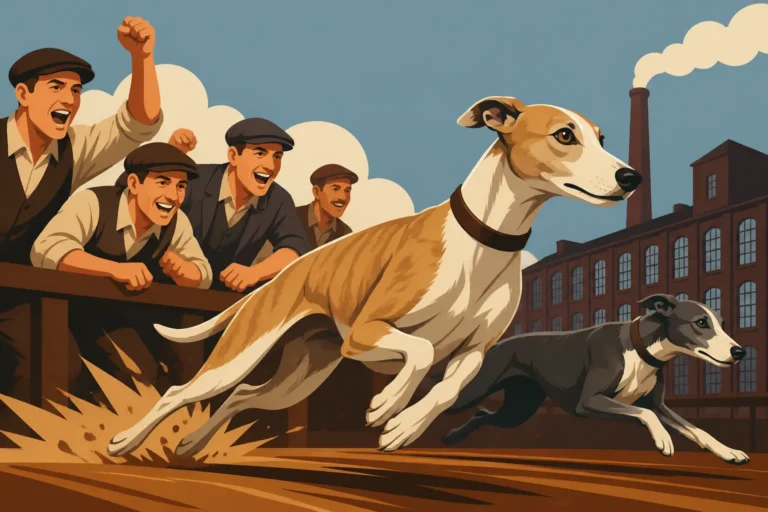
Whippet racing began as a grassroots phenomenon, deeply embedded in the culture of industrial communities. Miners and textile workers, often with very little disposable income, poured their affection and their spare shillings into their dogs. These Whippets were true members of the family, often sleeping in their owners' beds to stay warm in drafty cottages. On Sundays, after a grueling week, the local fields transformed into makeshift race tracks. These weren't grand, purpose-built stadiums, but often just stretches of open ground where men would stand at one end, waving a rag (hence "rag racing") to entice their Whippets to sprint towards them. It was a simple, yet intensely competitive, sport that offered excitement and a communal focus in tough times.
The Stakes Were High
While today we might see dog racing as purely recreational, in its origins, Whippet racing had very real economic implications. For many families, betting on their dog was a gamble, not just on bragging rights, but on actual wages. A win could mean putting food on the table, repairing a leaky roof, or simply making it through another week with a little less worry. This immense pressure meant that fairness was paramount. No one wanted to lose their hard-earned money to a perceived unfair advantage. If one dog was significantly larger or more muscular, it could be seen as having an inherent edge, and this is where the concept of weight handicapping came into play. It was a crude but effective way to try and ensure that the competition was based on speed, training, and the dog's spirit, rather than simply its physical size. Rag Racing and the Week's Wages Riding on a Whippet dives deeper into the financial pressures involved.
Understanding Weight Handicapping in Whippets
The notion of handicapping racehorses is well-known, but applying it to dogs, specifically by adding weight, might seem counterintuitive for a breed renowned for its lean athleticism. However, understanding the context of early Whippet racing illuminates why this practice was so central to the sport.
Why Weight Mattered So Much
Whippets, by their very nature, are lean, athletic creatures, built for speed and agility. However, even within the breed, there are natural variations in size, bone structure, and muscle mass. Some dogs might be slightly heavier-boned, others more delicate. While a few pounds might not seem like much on a larger dog, on a Whippet, whose average weight typically ranges from 18 to 42 pounds, even a small difference can be significant. A heavier, more muscular Whippet, particularly one that had been conditioned well, could potentially have an advantage in terms of power and initial acceleration over a lighter, more delicate dog. Without a system to account for these natural variances, the races risked becoming predictable, with the largest dogs consistently dominating, which would quickly diminish the excitement and fairness for those with smaller, equally loved companions.
The Mechanics of the Handicap
So, how exactly did they handicap a Whippet by weight? It was a straightforward, if somewhat rudimentary, process. Before a race, each dog would be weighed on a scale, usually an old-fashioned set of balance scales. Why Whippets Were Weighed Before a Race offers more context on this step. Based on its weight, the dog might then be assigned a handicap. The method was typically to add weight to the lighter dogs to bring them up to a competitive threshold, or sometimes to the heavier dogs to slow them down. This added weight wasn't a sophisticated, aerodynamic device; it often consisted of small, lead weights sewn into a racing blanket or waistcoat that the dog wore during the race.
Imagine little pouches, perhaps filled with sand or lead shot, carefully distributed across a special vest. The goal was to add just enough weight to balance the perceived advantage of a naturally heavier dog, without unduly hindering the lighter dog's ability to run. The process required a certain amount of trust and community agreement, as there were no official governing bodies with precise regulations in the earliest days. It was a system born out of necessity, a testament to the workingman's ingenuity to ensure that everyone, regardless of their dog's inherent size, had a fair shot at winning. This ensured the races remained exciting and unpredictable, which was crucial for maintaining public interest and the betting pool. For a broader look at the race format, see How a Whippet Rag Race Was Run.
The Impact and Legacy of Weight Handicapping
The practice of weight handicapping, while no longer prevalent in modern Whippet events, left an indelible mark on the sport's early development and reflects a unique aspect of its cultural heritage. It highlights the importance placed on competitive balance and community participation.
Ensuring Competitive Balance
The primary motivation behind weight handicapping was to create a level playing field. In a sport where a family's weekly income might be riding on the outcome, genuine fairness was paramount. Without such measures, races would likely have been dominated by the largest or most powerful dogs, discouraging owners of smaller, equally swift Whippets. By equalizing the perceived physical advantage of weight, the focus was shifted more squarely onto the dog's natural speed, its drive, and the skill of its "caller" (the person enticing the dog at the finish line). This meant that more dogs, from a wider range of physical builds within the breed standard, could participate and have a realistic chance of winning. This inclusive approach fostered a strong sense of community and rivalry, making the sport accessible and engaging for all working-class enthusiasts. It was less about brute strength and more about the innate athleticism and spirit of the individual Whippet.
A Glimpse into Early Breeding Practices
While weight handicapping directly influenced how races were run, it likely had an indirect, subtle effect on early breeding practices. Breeders, always keen to produce winners, might have considered a dog's "make weight" ability. Perhaps there was less emphasis on breeding for extreme size and more on producing dogs with good conformation and drive that could perform well with a handicap if necessary, or dogs that were naturally in a mid-range weight class that needed less adjustment. This focus would have inadvertently contributed to the Whippet's consistent medium size, a crucial characteristic that distinguishes it from both the larger Greyhound and the more delicate Italian Greyhound. The overall aim was not necessarily to breed for the heaviest or lightest dog, but for one that was competitive within the established handicapping system, ensuring longevity for the sport and fairness for participants.
Evolution of Racing Rules
As Whippet racing evolved from informal rag races to more organized events, the methods of ensuring fairness also changed. Modern Whippet racing, whether under organizations like the National Oval Track Racing Association (NOTRA), American Sighthound Field Association (ASFA) for lure coursing, or the American Kennel Club's Fast CAT, has moved away from weight handicapping. Instead, these events rely on standardized courses, strict breed standards, and often, classification by gender or age rather than arbitrary weight additions. The dogs compete as they are, with their natural build. While breeders still select for traits that enhance performance, like speed and drive, the focus is now on optimizing a dog's natural ability through genetics, nutrition, and training, rather than physically altering its race-day weight. This shift reflects a move towards celebrating the pure, unadulterated athleticism of the Whippet as it naturally exists, without artificial modifications. For anyone interested in racing a Whippet today, What Lure Coursing and Fast CAT Cost a Whippet Owner provides a good overview of modern events.
Modern Day Whippet "Weight Management" for Performance
While adding lead weights to a Whippet's racing blanket is a historical curiosity, the concept of managing a Whippet's weight for optimal health and performance remains incredibly important today, albeit for very different reasons. Modern approaches focus on ideal body condition rather than artificial handicapping.
Optimal Body Condition for a Whippet
Today, a Whippet's weight is carefully managed to ensure peak health, longevity, and athletic ability, not to handicap it. A healthy Whippet should be lean, with ribs easily felt, but not prominently visible from a distance, and a clear "tuck-up" where the abdomen rises sharply behind the rib cage. The spine should be palpable, but individual vertebrae should not protrude sharply. This ideal body condition allows them to move freely, without extra strain on their joints or cardiovascular system, which is crucial for a breed renowned for its explosive speed. Maintaining this lean physique helps prevent common ailments associated with excess weight in dogs, such as arthritis and heart strain. Regularly assessing your Whippet's body condition score is key. You can learn more about this in Feeling a Whippet's Ribs and Hip Bones.
Nutrition and Conditioning
Achieving and maintaining this optimal body condition relies heavily on appropriate nutrition and a consistent conditioning program. Whippets, despite their athletic prowess, are generally not difficult to keep weight on, provided they are fed a high-quality diet appropriate for their activity level. For an active Whippet, this often means a diet rich in protein and healthy fats to support muscle mass and energy levels. Companies like Chewy offer a wide range of premium dog foods and supplements tailored to active breeds, making it easier for owners to find suitable options.
Regular exercise, including opportunities for safe, controlled sprints, helps build and maintain lean muscle. This combination of proper diet and exercise ensures that a Whippet is conditioned to perform at its best, whether that's in modern competitive events like Fast CAT or simply enjoying a spirited run in a securely fenced area. The goal is to optimize their natural abilities through health and fitness, celebrating their inherent design for speed and grace. Understanding their dietary needs for an active lifestyle is explored further in Feeding a Whippet That Sprints and Then Sleeps. Chewy also provides excellent resources for understanding dog nutrition to support athletic performance.
Here’s a look at how historical weight handicapping differs from modern weight management:
| Feature | Historical Weight Handicapping (Rag Racing) | Modern Weight Management (Health & Performance) |
|---|---|---|
| Purpose | To equalize competitive advantage between dogs of different natural weights; to ensure fairness for betting. | To achieve optimal health, prevent disease, and maximize natural athletic ability. |
| Method | Adding physical weights (e.g., lead shot in vests) to lighter dogs or to heavy dogs to slow them down. | Balanced nutrition, controlled portions, regular appropriate exercise. |
| Goal Outcome | A more unpredictable race outcome, increasing participation and betting interest. | A lean, healthy dog with excellent muscle tone, free from weight-related health issues. |
| Primary Focus | External manipulation of weight for race day. | Internal physiological optimization through diet and exercise. |
| Governing Bodies | Informal community agreement, local rules. | Veterinary guidelines, breed standards, nutritional science. |
| Impact on Dog | Potentially uncomfortable or cumbersome during the race. | Enhanced well-being, improved joint health, sustained energy. |
While the methods have certainly evolved, the underlying principle of ensuring Whippets can perform at their best, in a fair and healthy manner, remains a constant thread from the rag racing fields of the past to the lure coursing fields of today. And whether you're looking for specialized performance food or just daily kibble, places like Chewy are excellent resources for keeping your Whippet in prime condition.
Disclaimer
This article is for general informational purposes only and does not constitute professional advice. Laws, prices and regulations vary by location and change over time. Consult a qualified professional for guidance on your specific situation.