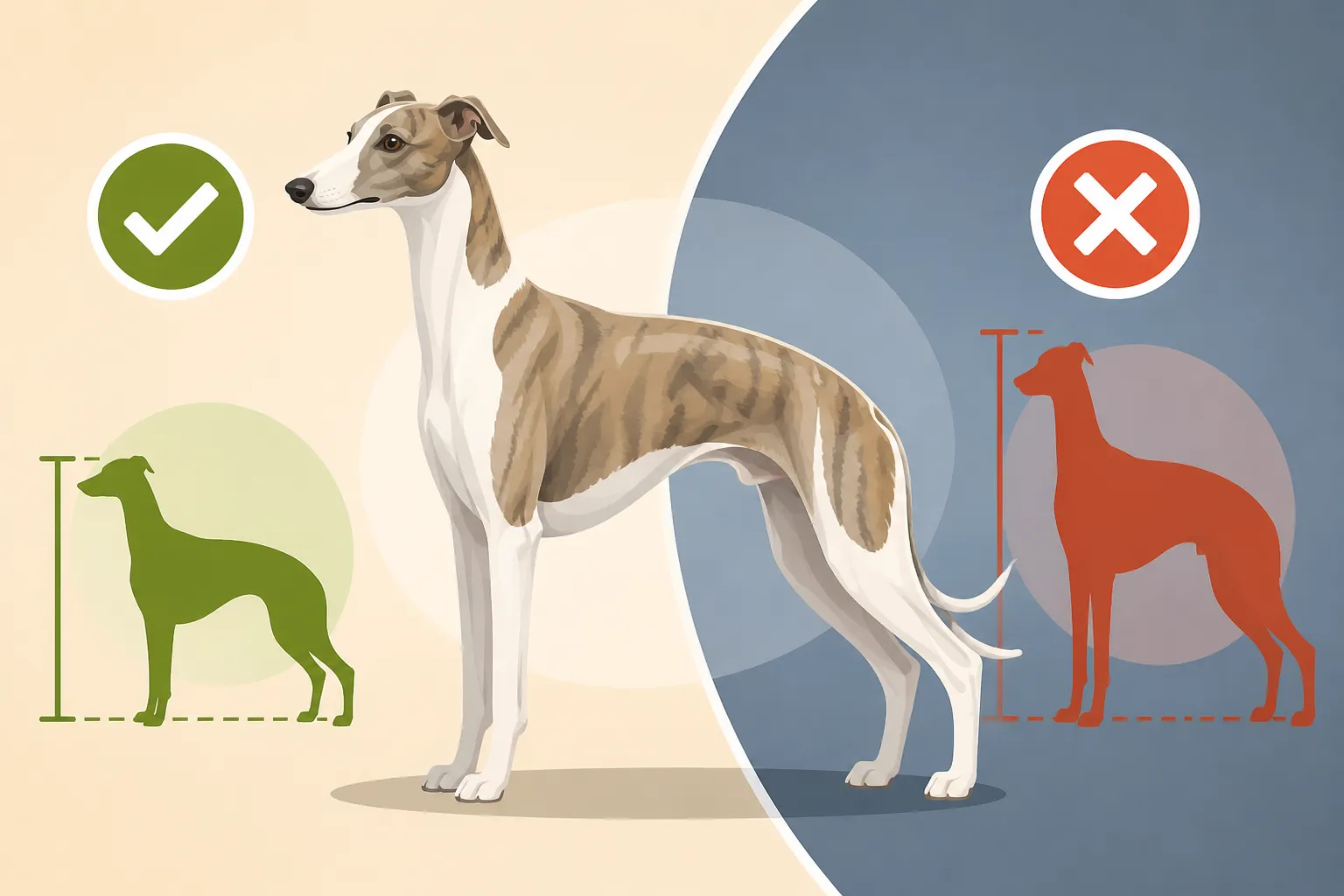
Whether the Whippet Standard Sets a Height Limit
A Whippet’s height can look surprisingly variable, especially when you compare a rangy adolescent with a compact adult at a dog show. The breed standard does set height expectations, but it does not give every registry the same wording or turn a measuring tape into a verdict on a dog’s quality. This guide explains the limits, how to measure correctly, and what height means for pet owners.
What the Whippet height standard actually says
The standard gives a range, not one perfect height
For the American Kennel Club standard, the preferred height range is 19 to 22 inches for dogs and 18 to 21 inches for bitches, measured at the withers. Those figures describe a range rather than a single ideal number: a Whippet does not have to land at the midpoint to be a good example of the breed.
It is also useful to separate a preferred range from a disqualification limit. Under the AKC standard, a dog or bitch measuring under 18 inches or over 22 inches is disqualified. That means a female between 21 and 22 inches is above the preferred female range but not automatically beyond the stated outer limit. The exact effect depends on the wording of the standard and the rules of the registry or event involved.
Standards can differ across countries and organizations, so it is best not to apply one country’s numbers to every Whippet. If you are preparing for a particular show, check that organization’s current breed standard and measurement rules. For a broader look at typical proportions, see How Tall a Whippet Stands.
Height is measured at the withers
The withers are the highest point of the shoulder blades, where the neck transitions into the back. Height is measured vertically from the floor to that point. It is not measured to the top of the head, the ears, or the highest point of a curved topline.
A dog standing with its legs unevenly placed can appear taller or shorter than it really is. So can a soft surface, a sloping floor, or a measuring stick held at an angle. In a formal setting, trained people use a prescribed measuring procedure and equipment; a home measurement is useful for a rough estimate, not a replacement for an official one.
If you are measuring at home, stand your Whippet on a firm, level surface and encourage a natural, balanced stance. Don’t stretch the neck upward or press the shoulders into a position your dog would not hold comfortably. Even a small change in posture can affect a close measurement, which is one reason a borderline result should not be treated as conclusive.
Registry rules matter when the number is close
A casual measurement can help you understand your dog’s size, but it cannot settle every question about show eligibility. An official measurement may follow specific rules about the dog’s position, measuring device, and who is authorized to take the measurement. If a dog is near a limit, the procedure matters as much as the number.
That is especially relevant if you are comparing information from different sources. A breeder may describe a dog’s height informally, a veterinarian may record a measurement for clinical reasons, and a show official may measure under event rules. Those figures can differ without anyone necessarily having made a mistake.
If you are considering conformation showing, ask the breeder or relevant club which standard and measurement process apply. If you are simply curious about your pet’s size, there is usually no need to chase an exact official figure. A Whippet’s height is one part of the picture, not a complete assessment of structure or health.
| Situation | What the height range tells you | What it does not tell you |
|---|---|---|
| Pet ownership | Whether your dog is broadly within a familiar breed-size range | Whether your dog is healthy, well bred, or correctly proportioned |
| Conformation showing | Whether a measurement may fall within that organization’s standard | Whether the dog will be judged favorably overall |
| Puppy growth | A rough reference for adult size, alongside family history and development | A guaranteed adult height |
| Choosing equipment | A starting point for thinking about fit and space | The correct size of a collar, harness, bed, or crate |
Why Whippets do not all measure the same
Sex, family lines, and individual variation
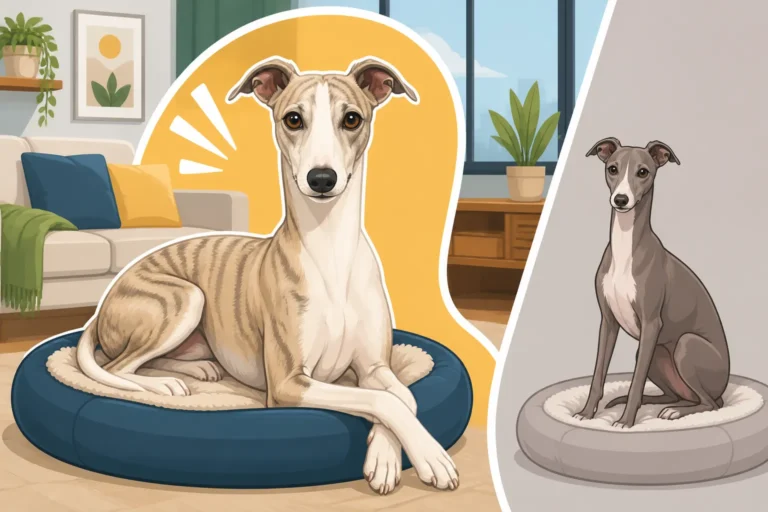
The standard recognizes a difference between the preferred ranges for males and females. Even within those ranges, Whippets vary. One may be taller and more lightly built, while another is shorter and more substantial. Their outlines can look quite different even when both fall within the expected height range.
Family history can offer a useful clue, but it is not a promise. A puppy’s parents, grandparents, and close relatives may help a breeder estimate likely adult size, yet individual puppies do not develop in perfectly predictable ways. Nutrition, general health, and normal variation all contribute to how a young dog grows.
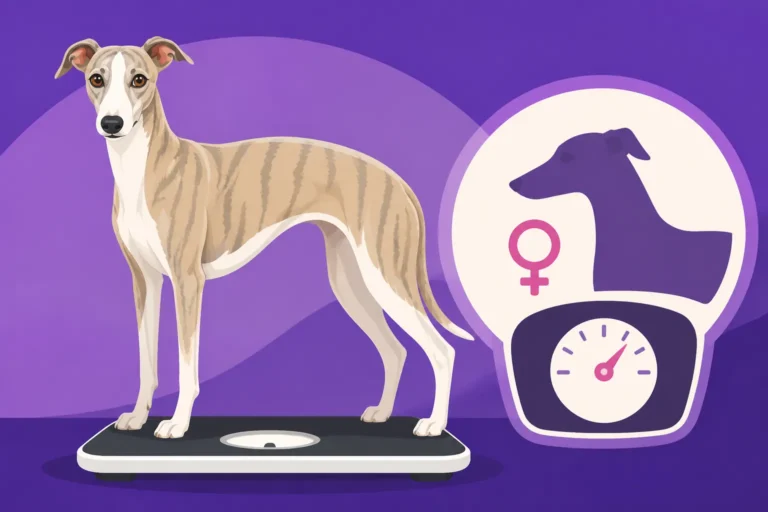
Height also does not tell you how much a Whippet weighs. Two dogs of similar height may differ in build and muscle, and a number on the scale needs context. What a Whippet Actually Weighs explains why weight is best considered alongside body condition and the dog’s overall frame.
Puppies keep changing as they mature
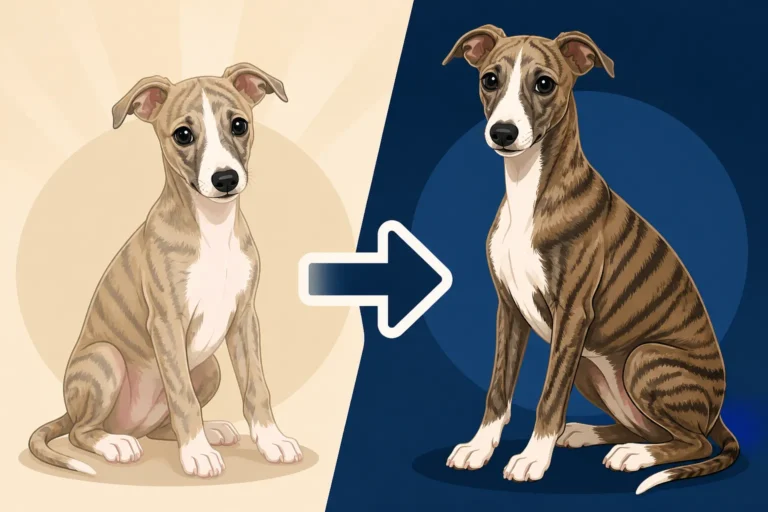
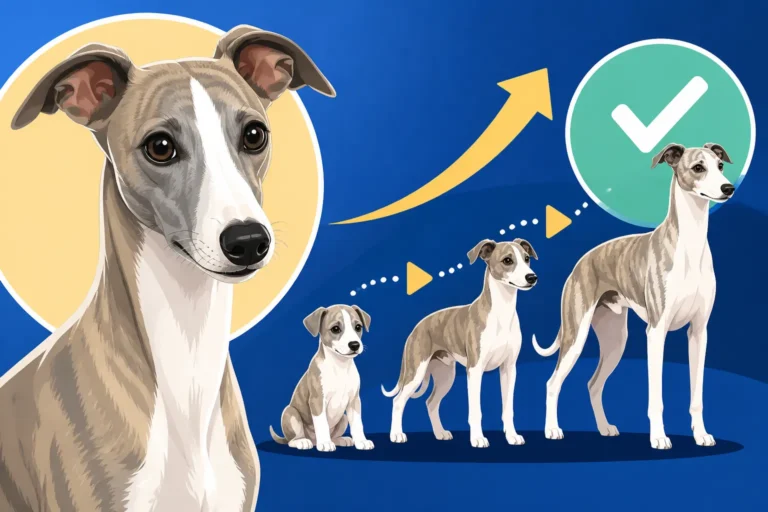
A puppy may look leggy during one stage and more balanced later. Growth is not a smooth, visually tidy process: different parts of the body can seem to change at different rates, and a young Whippet can temporarily look as if its legs are too long for its body. That appearance alone does not predict the final adult outline.
Avoid using an adult height range to judge a puppy as though it were already finished growing. A young dog that currently looks unusually tall or small may change in proportion as it matures. If you are concerned about growth, appetite, mobility, or development, talk with your veterinarian rather than trying to diagnose a problem from a tape measure.
A breeder who knows the puppy’s family can often explain what kind of adult size is plausible. Still, estimates are not guarantees. For another part of the “still growing” question, Whether a Whippet Fills Out After Two looks at how adult Whippets can continue changing in build after their height has largely settled.
Show and racing backgrounds can shape what you notice
People sometimes compare show-bred and racing-bred Whippets and assume that one group has a single, fixed size. In real life, variation exists within both backgrounds. Breeding priorities, individual ancestry, and the particular dog all influence appearance; labels alone do not tell you exactly how tall a Whippet will be.
A dog bred for racing may look especially lean and athletic, while a show dog may draw attention for its outline and overall balance. Neither impression gives you a precise measurement. A Whippet’s height should be discussed in relation to the applicable standard, rather than guessed from how muscular, slender, or fast the dog appears.
The comparison is explored further in How Show Whippets Differ in Size From Racing Whippets. And if your dog seems smaller than the range you expected, Whether an Undersized Whippet Is Still Purebred can help separate questions of size from questions of ancestry and registration.
What the height limit means for owners and breeders
Height alone does not determine a dog’s quality
A standard is a description of the breed for a particular purpose, especially in conformation judging. It is not a complete report card on a dog. A measurement inside the preferred range does not automatically mean a Whippet has sound movement, good health, or an ideal temperament. Likewise, being outside a preferred range does not by itself explain a dog’s health or character.
For pet owners, a Whippet’s day-to-day needs are usually shaped more by its individual health, behavior, age, and activity than by whether it stands a fraction of an inch above or below a preferred figure. A smaller Whippet is still a Whippet with a sighthound’s speed and chase instinct; a taller one still needs thoughtful handling and a safe place to run.
The standard is also not a reason to try to change a dog’s growth. Do not restrict food or overexercise a growing puppy in an attempt to influence adult height. Provide appropriate nutrition and exercise, and ask a veterinarian about a growth concern. Responsible care supports normal development; it does not aim to engineer a measurement.
Height can guide equipment decisions, but measurements of the body matter more
A dog’s height may help you picture how much space it takes up, but it is not enough to choose every piece of equipment. For a harness, chest and neck measurements matter. For a bed, sleeping posture and length may matter more than shoulder height. For a crate, your dog needs enough room to stand, turn around, and lie down comfortably.
When browsing everyday gear at Chewy or another retailer, use the manufacturer’s sizing instructions rather than choosing based on a breed label alone. Whippets have deep chests and narrow waists, so a product described as suitable for a dog of a certain height may still fit poorly. Measure your own dog, check the return policy, and inspect the fit once the item arrives.
The same principle applies to coats and collars. Two Whippets of identical height can have different chest measurements, and a collar that fits securely on one may be loose on another. Chewy can be one place owners look for general dog supplies, but the dog’s actual measurements—not the breed name on a listing—should guide your choice.
Breeding decisions need more than a height reading
Breeding decisions should not be reduced to whether a dog fits inside a height range. Responsible planning considers health, temperament, structure, family history, and the welfare of the dogs and puppies. A measurement can be relevant to conformation goals, but it cannot replace broader evaluation or appropriate health testing.
If a breeder discusses a dog’s size, ask what standard they are using and whether the measurement was official or informal. You can also ask about the sizes of close relatives and how the breeder evaluates overall structure. Clear, specific answers are more useful than vague promises that a puppy will become exactly a certain height.
Be cautious of anyone presenting an unusually large or small size as proof that a Whippet is rare, superior, or automatically more valuable. Height alone does not establish quality or make a dog a better fit for a home. The wider breed conversation about increasing size is covered in The Push to Breed Bigger Whippets, which puts those claims in context.
How to interpret your Whippet’s measurement
If your dog is within the preferred range
If an adult Whippet measures within the preferred range for its sex under the relevant standard, that simply means the measurement aligns with that particular part of the description. It does not certify every other feature, and there is no need to keep remeasuring a healthy pet unless you have a practical reason.
For a show prospect, consult the applicable club or show organization about official procedures. For a pet, use height as background information rather than a reason to worry. If your dog is comfortable, moving normally, and maintaining a healthy condition, an everyday measurement is rarely a cause for concern on its own.
If your dog seems outside the range
First, make sure the measurement was taken at the withers on a level surface, with the dog standing naturally. If the number is close to a boundary, a small difference in posture, equipment, or technique could change the result. A home measurement should not be used to declare that a dog is formally eligible or ineligible for an event.
If the number remains outside a preferred range, remember that “outside the preferred range” and “disqualified under a specific standard” are not always the same thing. Check the exact wording that applies. For questions about your dog’s health or growth, ask your veterinarian; for breed-standard or show questions, speak with a knowledgeable breeder or the relevant organization.
Keep the number in perspective
Whippet height is useful for understanding the breed standard and making rough decisions about space or equipment, but it is only one measurement. It cannot predict personality, athletic ability, lifespan, or how well a dog will fit into your household. A Whippet’s individual needs are always more important than an isolated figure.
When buying supplies through Chewy or elsewhere, measure the relevant part of the dog and follow the product’s fitting guidance. When discussing breed type, identify which standard you mean. And when a measurement prompts a health worry, bring the concern to a qualified professional rather than trying to draw a diagnosis from height alone.
Disclaimer
This article is for general informational purposes only and does not constitute professional advice. Laws, prices and regulations vary by location and change over time. Consult a qualified professional for guidance on your specific situation.