Whether a Whippet Deters an Intruder
It's a common question for many Whippet owners, often whispered with a hopeful smile: "Could my sleek, sweet companion actually deter an intruder?" We adore our sighthounds for their gentle nature, their couch-potato tendencies, and their incredible bursts of speed, but deep down, we might wonder if they offer any real protection. This guide aims to realistically explore whether your beloved Whippet truly acts as a deterrent against unwanted visitors, balancing their natural instincts with their less-than-intimidating appearance.
The Whippet's Natural Instincts vs. Guard Dog Roles
Let's be honest, when you think of a "guard dog," breeds like German Shepherds, Rottweilers, or Dobermans usually come to mind. These dogs are often bred and trained for protection, exhibiting territoriality, aggression towards strangers, and a formidable physical presence. Our Whippets, however, were bred for entirely different purposes, and understanding their lineage is key to understanding their role (or lack thereof) in home security.
A Sighthound's Primary Drive
Whippets, like all sighthounds, were developed to chase. Their very essence is built around spotting movement, initiating a lightning-fast pursuit, and bringing down small game. This instinct is so ingrained that it often overrides everything else. When they see a squirrel or a rabbit, their world narrows to that singular focus, and the idea of "protecting" a human or a home simply isn't part of that hardwired program. This is why Why a Whippet's Chase Instinct Overrides Its Recall is such a critical read for any owner; their prey drive is paramount.
An intruder, to a Whippet, isn't necessarily a threat to be confronted but rather a novel moving object. While a sudden, unexpected human might startle them, their instinct isn't to defend territory or family. Instead, it's often to investigate, perhaps with curiosity, or even to retreat if they perceive danger. Their loyalty is deep, but it manifests more as seeking comfort and companionship rather than standing guard. They're far more likely to cuddle up with you than to confront an unknown person approaching your home.
The Friendly Nature of Most Whippets
One of the most charming, yet least "guard dog-like" traits of a Whippet is their generally friendly and non-aggressive demeanor. Most Whippets are social butterflies who greet new people with enthusiastic tail wags, a sniff, and perhaps an invitation for a cuddle. The idea of them snarling, barking ferociously, or positioning themselves aggressively to protect their territory is, frankly, quite alien to the breed's typical temperament.
They thrive on human connection and are often delighted by visitors, seeing them as potential sources of attention and affection. This gentle disposition is wonderful for families and makes them fantastic companions, but it certainly doesn't lend itself to deterring intruders. A determined individual might even find a Whippet's friendly approach more of an amusing distraction than a serious threat. Some Whippets might even roll over for a belly rub if given the chance, which isn't exactly the image of a fearsome guardian!
Barking: A Whippet's Most Likely "Warning" System
While a Whippet isn't likely to tackle an intruder, they do possess a vocal cord, and sometimes, that's enough to provide some level of warning. However, it's crucial to distinguish between a "guard dog bark" and a "Whippet bark." They are not the same thing.
The Doorbell Effect
Many Whippets are excellent "doorbell dogs." This isn't because they're protecting the house; it's often a combination of being startled by a sudden noise and excitement over the potential arrival of a new person or the chance to investigate. That distinct ring, a knock, or an unexpected car pulling up can trigger a burst of barking. This can be surprisingly loud and sudden, especially when coming from a dog you usually hear little from. Why a Whippet Barks at Anything really delves into the nuances of their vocalizations, and it's less about aggression and more about communication or startlement.
This initial burst of noise could certainly alert you to an unwelcome presence. If you're home and hear your Whippet erupt, it gives you a heads-up that someone is at your door or near your property. It’s an invaluable early warning system, even if the intent behind the barking isn't hostile. However, it's important to understand that this alarm system is often short-lived and doesn't usually escalate into sustained, aggressive baying.
The Limitations of Whippet Barking
The problem with relying on a Whippet's bark for deterrence is its inconsistency and lack of perceived threat. While they might bark at a doorbell or a stranger approaching, this barking often lacks the deep, resonant, and continuous quality of a true guard dog. It might be a few sharp barks, followed by silence, or a more excited, high-pitched vocalization.
A determined intruder, especially one who has scoped out a property, isn't likely to be scared off by a short burst of sound from what they might perceive as a smaller dog. They're looking for signs of active defense, and a Whippet's bark rarely signals that. Moreover, some Whippets, particularly those that are shy with strangers, might actually retreat silently rather than bark if confronted with an unexpected, imposing figure inside the home. This silent retreat, while understandable for their sensitive nature, obviously offers no deterrent effect. If you're looking for ways to manage the initial barking, sometimes a good positive reinforcement approach using training treats from a site like Amazon can help redirect their focus once the initial alert is given, but it won't turn them into a guard dog.
Physical Presence and Intimidation Factor
A significant part of a traditional guard dog's effectiveness comes from its imposing physical presence. They are large, muscular, and often carry themselves with an air of confidence and readiness to confront. How does a Whippet measure up in this regard?
The Appearance of a Whippet
Whippets are undeniably striking dogs. Their lean, athletic bodies, deep chests, and often intense gaze when focused can make them look powerful and fast. They are the epitome of canine athleticism, and watching them run is breathtaking. If an intruder were to see a Whippet in full sprint across a yard, they might certainly be impressed by its speed and grace. However, this impressive athleticism doesn't translate into an intimidating presence in a confrontational scenario.
Their elegant build, while perfect for speed, lacks the bulk and heft that most people associate with a protective animal. They appear more delicate than dangerous, more graceful than aggressive. While a first-time visitor might pause at the sight of any dog, the "fear factor" associated with a Whippet is likely to be minimal, especially for someone intent on breaking in.
The Reality of Their Size
Let's be realistic. While a Whippet is a medium-sized dog, they are incredibly light-boned and lean. Their build is designed for speed and agility, not for taking down or restraining a person. They typically weigh in the range of 20-40 pounds, which, compared to a fully grown human, isn't particularly threatening. An intruder, especially one prepared for confrontation, would likely see a Whippet's size as a minor inconvenience at best.
Furthermore, their thin skin, which makes them susceptible to The Thin Skin That Sends a Whippet to the Vet for Stitches, also means they are physically vulnerable. Owners instinctively protect their Whippets from rough play or sharp objects, knowing how easily they can get injured. This inherent fragility means a Whippet is simply not equipped to engage in a physical confrontation without risking serious harm to themselves. Putting them in such a situation would be unfair and dangerous for the dog.
What a Whippet Does Contribute to Home Security
While it's clear a Whippet isn't going to be your valiant guardian, they aren't entirely useless in the realm of home security. They offer a different, more subtle kind of contribution.
Alerting the Household
As mentioned with their barking, a Whippet's most significant contribution to home security is as an alarm system. Their keen senses are attuned to changes in their environment. They might hear a suspicious noise long before you do, or notice an unfamiliar figure lurking outside. Their sudden bark, or even a subtle change in their demeanor – a prick of the ears, a focused stare towards a window, a low growl – can be your cue that something is amiss.
This early warning allows you precious moments to assess the situation, lock doors, call for help, or prepare yourself. It shifts the element of surprise from the intruder to you. This is especially valuable if you live alone or have children, as it gives you time to gather loved ones and move to a safer location within the house. For training a reliable "alert" command, positive reinforcement is key. Programs like BAXTER & Bella, which focus on positive, reward-based methods, can be very effective in channeling a Whippet's natural attentiveness into a useful alert system rather than uncontrolled barking.
The Element of Surprise
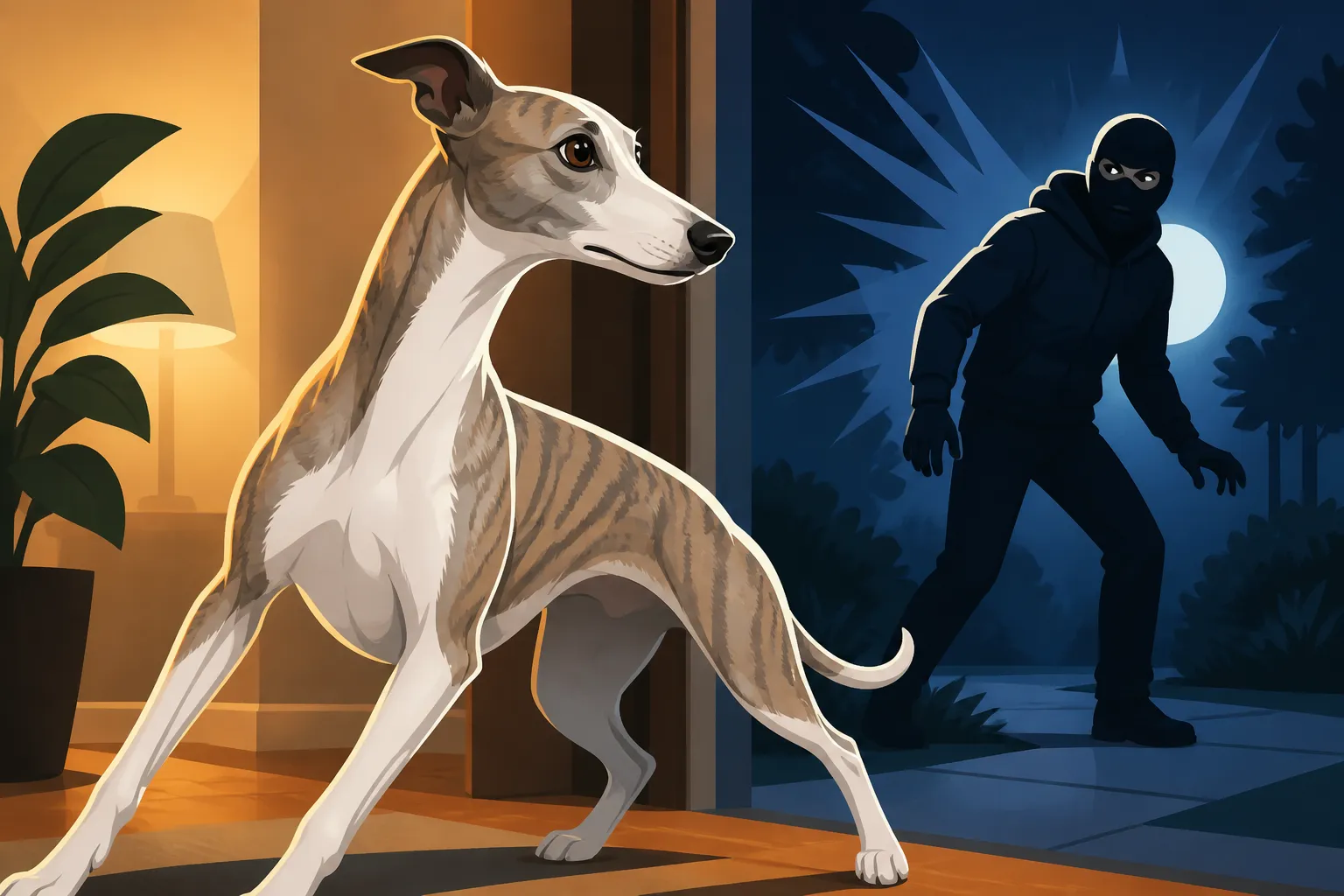
Imagine an intruder quietly trying to jimmy a window or pick a lock. They expect a silent entry. Suddenly, a Whippet, roused from a deep snooze, springs to attention and lets out a sharp, unexpected bark right as they gain entry. That sudden noise and unexpected presence of any dog, regardless of size, can be incredibly startling.
The element of surprise can be a powerful disincentive. An intruder's primary goal is often a quick, undetected entry and exit. A barking dog, even a smaller one, immediately announces their presence and creates a risk. It forces them to reconsider whether the potential reward is worth the increased chance of being caught. Many opportunistic burglars will simply move on to an easier target rather than risk a confrontation or prolonged presence in a home where they've been detected. Even if your Whippet isn't physically intimidating, its unexpected appearance and vocalization can certainly throw a wrench in an intruder's plans.
Whippets vs. Traditional Guard Dogs: A Comparison
To further clarify the role of a Whippet in home security, here's a quick comparison of their typical traits versus those of a traditional guard dog.
| Trait | Typical Guard Dog (e.g., German Shepherd) | Whippet |
|---|---|---|
| Primary Instinct | Protection, territoriality, defense of family and property | Chase, prey drive, companionship |
| Temperament | Confident, watchful, wary of strangers, often dominant | Gentle, friendly, sensitive, eager to please, often shy with strangers |
| Barking | Deep, resonant, sustained, aggressive, meant to deter | Sharp, often intermittent, sometimes excited, primarily an alert |
| Physical Presence | Large, muscular, imposing, physically capable of deterrence/restraint | Lean, athletic, graceful, physically vulnerable, not built for confrontation |
| Reaction to Intruder | Confronts, challenges, holds ground, may engage physically | Alerts (barks), may investigate, more likely to retreat if intimidated |
| Motivation | Protects home and family | Alerts owner, investigates novelty |
| Training Focus | Obedience, protection work, bite work, territorial defense | Recall, manners, positive socialisation, desensitisation |
This table clearly illustrates that while both types of dogs can be beloved companions, their natural predispositions and capabilities for home security are vastly different. Understanding this difference is crucial for setting realistic expectations and ensuring your Whippet's safety.
Alternative Security Measures Beyond Your Whippet
Given that your Whippet is more of a charming companion than a fierce protector, it's wise to invest in other layers of home security. Think of your Whippet as a bonus alert system, not the primary defense.
Strong locks on all doors and windows are your first line of defense. Deadbolts, window latches, and even security film on vulnerable glass panes can significantly deter intruders. A well-maintained alarm system, whether professionally monitored or DIY, can instantly alert authorities and create a loud, disorienting sound that sends most criminals fleeing. Smart home devices, such as motion-activated lights, doorbell cameras, and indoor security cameras, can also provide surveillance and immediate alerts to your phone, no matter where you are. These tools, readily available from places like Amazon, provide the real deterrence and evidence gathering that a Whippet simply cannot.
Finally, a clearly visible "Beware of Dog" sign, even if it refers to your gentle Whippet, can sometimes be enough to make an intruder think twice. They don't know what kind of dog is inside, and the uncertainty might just be enough to send them looking for an easier target. After all, the goal is often to prevent the break-in altogether, not to rely on your precious sighthound to be the hero in a dangerous situation. Your Whippet's job is to fill your life with love, zoomies, and quiet cuddles, not to fend off criminals.
Disclaimer
This article is for general informational purposes only and does not constitute professional advice. Laws, prices and regulations vary by location and change over time. Consult a qualified professional for guidance on your specific situation.