Why a Flat Collar Slides Off a Whippet’s Neck
It’s a scenario many Whippet owners know all too well: you’re out on a walk, perhaps your beloved sighthound spots a squirrel, gives a mighty lunge, and suddenly, that seemingly secure flat collar is slipping right over their head. This guide is here to explain precisely why standard flat collars are ill-suited for the unique Whippet physique and, more importantly, what safe and effective alternatives exist to keep your speedy companion secure on walks.
The Unique Whippet Anatomy: A Collar's Worst Nightmare
Whippets are built for speed and agility, and their sleek, aerodynamic design is a marvel of nature. However, this very design, while beautiful and functional for a sighthound, presents a significant challenge when it comes to standard dog collars. It's not just a matter of finding the "right size" – it's about understanding the fundamental differences in their bone structure compared to many other breeds.
The Tapered Head and Neck Design
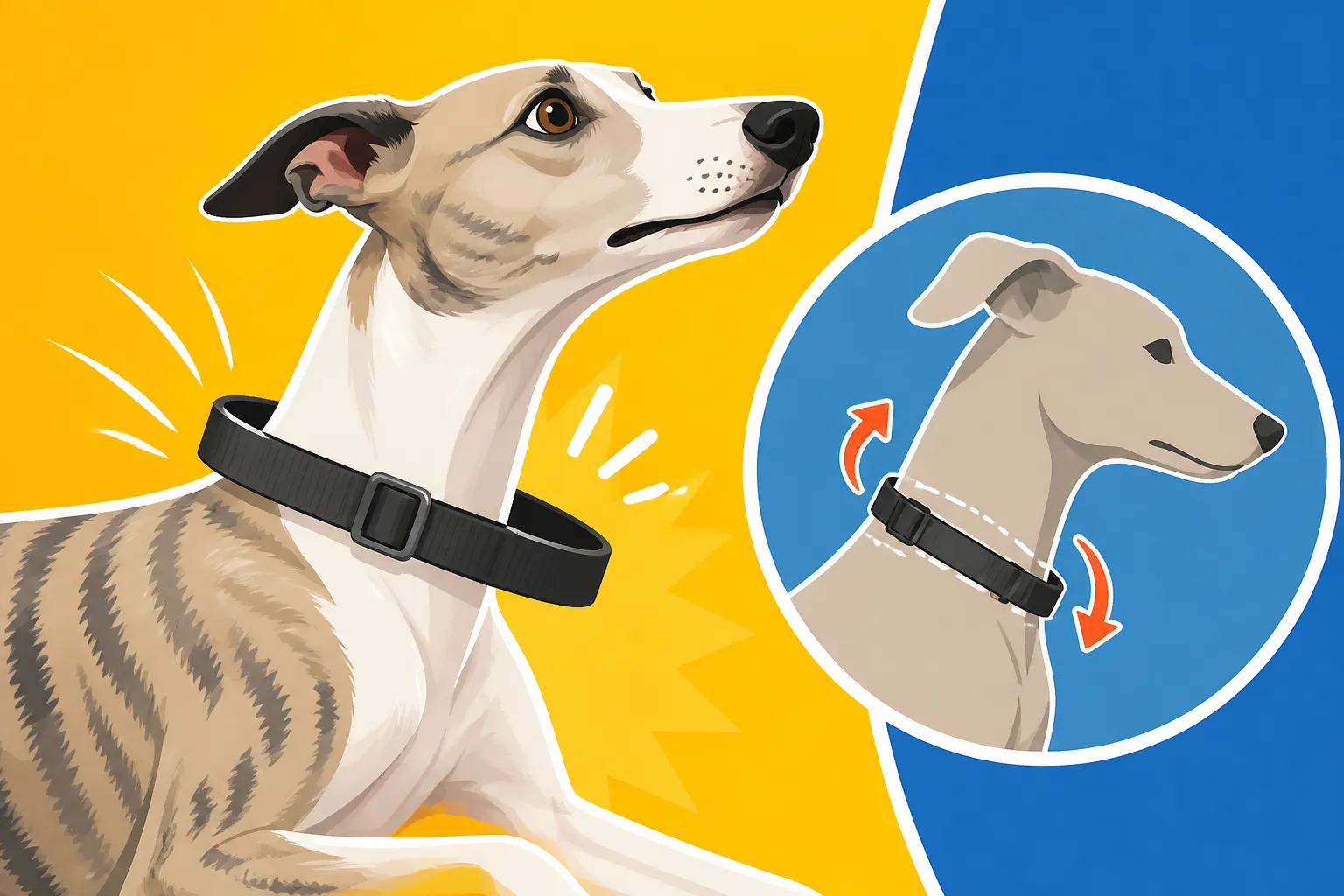
If you look closely at a Whippet's head and neck, you’ll notice a distinct taper. Their skull is narrow, and their neck widens gradually from the head towards the shoulders, creating an almost inverted cone shape. Think about it: most standard dog collars are designed for breeds with a more pronounced "stop" (the indentation between the eyes) and a thicker neck that doesn't narrow significantly behind the ears. For these dogs, once a collar is past the widest point of their head, it's generally secure.
But for a Whippet, this isn't the case. Their heads are often no wider, or even narrower, than the circumference of their neck further down. This means that a collar that fits comfortably around their neck when they are relaxed can easily be pulled forward and slip right over their ears and off their head if they pull back, twist, or simply drop their head in the right way. It's an unnerving experience when your dog is suddenly free, especially if it happens in a busy park or near a road. They don't mean to escape; it's simply a design flaw in the equipment when applied to their specific build.
The Deep Chest and Slender Build
Beyond their unique head and neck, Whippets also boast a remarkably deep chest and a very slender, tucked-up body. This combination further exacerbates the flat collar problem. A collar that is just snug enough to prevent it from slipping over their tapered head might then feel incredibly tight and uncomfortable around their trachea, or worse, still allow too much slack around their body.
Many breeds have a more cylindrical neck and a thicker layer of fat or muscle around their shoulders and chest that helps to "fill out" a collar. A Whippet, with its minimal body fat and lean muscle, doesn't have this natural padding. This means there's less material to hold a collar in place. Even if the collar doesn't slip over their head, a determined Whippet pulling hard on the leash can often cause a flat collar to shift and wiggle its way free, sometimes by contorting their body in surprising ways. It's like trying to keep a ring on a finger that’s significantly wider at the knuckle but then narrows considerably—it just doesn't stay put under pressure.
The Dangers of a Slipping Collar and Why It Matters
The problem of a slipping collar isn't just an inconvenience; it carries significant risks for your Whippet and your peace of mind. Losing control of your dog, even for a split second, can lead to dangerous situations, especially given the Whippet's natural instincts.
Immediate Safety Concerns
The most immediate and terrifying consequence of a collar slipping off is the risk to your Whippet's safety. Imagine walking in a suburban area, and your Whippet, known for its incredible speed, suddenly sees a rabbit or a squirrel dart across the road. Their prey drive, honed over centuries, is instantly activated. They'll be off in a flash, and without a secure connection to you, they can easily run into traffic. We often talk about Thirty Five Miles an Hour and No Brakes on a Whippet's Recall – it's not an exaggeration. Their instinct to chase is incredibly powerful, and once they're off, getting them back can be incredibly difficult, if not impossible, until the chase has ended.
Furthermore, a loose Whippet can become disoriented or get lost. They might bolt into unfamiliar territory, where they could encounter other aggressive dogs, get tangled in fences, or simply become frightened and unable to find their way home. The fear and panic this induces in an owner are immense, and preventing such an incident is paramount. This is why understanding Why a Whippet Cannot Be Let Off Leash in an Open Field is so critical, even when you think you have a secure collar.
The Behavioral Impact of an Insecure Collar
Beyond the immediate physical dangers, an insecure collar can have a detrimental effect on your Whippet's behavior and your relationship. Dogs are incredibly perceptive, and if every walk is a potential escape artist act, it can breed anxiety in both of you. A Whippet that constantly feels it might slip its collar can become more nervous or reactive on walks, anticipating the moment of escape or the feeling of vulnerability.
This insecurity can also hinder crucial training efforts. Imagine trying to teach your Whippet to walk politely on a leash or working on Teaching a Whippet an Emergency Recall, when the very tool you use for control is unreliable. The inconsistent pressure and the repeated sensation of almost slipping free can confuse your dog and erode their trust in the equipment. For a sensitive breed like the Whippet, who responds poorly to harsh corrections and thrives on positive reinforcement, an unreliable collar can create negative associations with walks and training, making them less enjoyable and less effective for everyone involved.
The Right Collar for a Whippet: Martingales and Beyond
Given the inherent challenges with flat collars, what's a responsible Whippet owner to do? The good news is there are specially designed collars that cater perfectly to their unique anatomy, providing both security and comfort.
Understanding the Martingale Collar
The most widely recommended and effective collar for a Whippet is the martingale collar, often referred to as a "sighthound collar" or a "limited-slip collar." This isn't just a fancy name; it's a design specifically crafted to prevent escape without causing undue pressure or choking. A martingale collar consists of two loops: a larger loop that slips over your dog's head and rests on their neck, and a smaller loop with a D-ring where you attach your leash.
When your Whippet pulls on the leash, the smaller loop tightens, which in turn gently and evenly cinches the larger loop around their neck. Crucially, it only tightens to a predetermined point – usually to the circumference of their head at its widest point – which means it can't choke them. Instead, it creates a snug fit that prevents it from slipping over their head. When the pressure is released, the collar loosens again, resting comfortably without constant tension. This design makes it incredibly difficult for a Whippet to back out of or slip free, offering a level of security that flat collars simply cannot. Many owners find these collars to be a game-changer for walking their Whippets. Why a Whippet Needs a Sighthound Collar goes into even more detail on the specific design elements that make these collars ideal. You can find a wide variety of martingale collars on platforms like Amazon, from basic nylon to beautifully decorative options.
Other Secure Options and Training Considerations
While the martingale is a cornerstone for many Whippet owners, other tools can also contribute to safe and effective leash walking. Harnesses are another popular option, especially for puppies, dogs prone to tracheal issues, or those who need extra security. However, not all harnesses are created equal for sighthounds. Their deep chests and narrow bodies mean that many standard harnesses, particularly those with a loose chest strap, can be backed out of surprisingly easily. We’ve all heard stories about The Harness a Whippet Backs Out Of! Look for "sighthound-specific" or "escape-proof" harnesses that are designed with an extra strap around the waist or a more secure fit to prevent backing out.
Beyond the equipment itself, training plays a vital role. Positive reinforcement methods, focusing on rewarding good leash manners and attentive behavior, will complement any secure collar or harness. Programs like those offered by BAXTER & Bella, which focus on positive, reward-based training, can help you build a strong foundation of communication and trust with your Whippet, making leash walks more enjoyable and less prone to bolting incidents. Remember, the equipment is a tool, but your connection and consistent training are what truly make a difference.
Choosing and Fitting Your Whippet's Collar Safely
Finding the right collar is only half the battle; ensuring it fits correctly is just as important for your Whippet's safety and comfort. A poorly fitted martingale, though superior to a flat collar, can still be ineffective.
Sizing Up the Perfect Martingale
Measuring your Whippet correctly for a martingale collar is crucial. You'll need two measurements:
- Around the widest part of their head: Use a soft measuring tape and measure around their skull, just in front of their ears. This is the absolute minimum circumference the collar needs to be able to expand to, so it can slip over their head.
- Around their neck: Measure the circumference of their neck where the collar will naturally sit, typically lower on the neck than where their head is widest.
When you're fitting the martingale, with the leash attached and a gentle pull, the two metal (or nylon) slides in the smaller control loop should meet or almost meet, with a couple of fingers' width of space between them. This ensures the collar is tight enough to prevent escape but not so tight that it chokes your dog. When the leash is slack, the collar should be loose and comfortable, allowing for easy breathing and movement. Always remember that a martingale is a training and walking tool, not a permanent ID collar to be left on unsupervised, as it could snag on something if it gets caught.
Here's a quick comparison of common collar and harness types for a Whippet:
| Collar/Harness Type | Primary Purpose | Pros | Cons | Whippet Suitability |
|---|---|---|---|---|
| Flat Buckle Collar | ID tags, home wear | Inexpensive, wide variety of styles, lightweight | Very prone to slipping over head, high escape risk | Poor for walks |
| Martingale Collar | Leashed walks, training, security | Prevents escape without choking, comfortable when slack | Requires proper fitting, not for tie-out, can't be left on unattended | Excellent |
| Standard Back-Clip Harness | Walks, car travel | Reduces neck pressure, generally comfortable | Can be easily backed out of by a determined Whippet; poor control for strong pullers | Fair (if well-fitted and escape-proof) |
| Front-Clip Harness | Leash training, reduces pulling | Helps redirect pulling, less escape risk than back-clip | Can restrict shoulder movement if ill-fitting | Good (check for proper fit for sighthound chest) |
| Sighthound-Specific Harness | Walks, car travel, ultimate security | Designed for deep chests and narrow bodies, highly escape-proof | Fewer styles available, can be more expensive | Excellent |
Best Practices for Leashed Walks
Even with the perfect martingale, being vigilant on walks is key. Before stepping out the door, always double-check that your Whippet’s collar is properly adjusted. It takes just a few seconds and can prevent a lifetime of regret. For an extra layer of security, especially if your Whippet is particularly prone to backing out or you are in a high-traffic or unfamiliar area, consider using a double-ended leash. One clip attaches to their martingale, and the other to a well-fitting sighthound harness. This gives you two points of contact and significantly reduces the chance of an accidental escape.
Always be aware of your surroundings. Whippets are sighthounds, and their attention can be instantly captured by movement. A sudden squirrel, a plastic bag blowing across the street, or even a distant dog can trigger their chase instinct. Anticipating these triggers and being prepared to manage your leash and your dog's attention can prevent a lunge that might test even the most secure collar. Understanding concepts like How Far a Whippet's Recall Can Be Trusted and the impulse control challenges they face will empower you to be a more effective and proactive handler, making every walk safer and more enjoyable for both of you.
Disclaimer
This article is for general informational purposes only and does not constitute professional advice. Laws, prices and regulations vary by location and change over time. Consult a qualified professional for guidance on your specific situation.