How Tall a Fence a Whippet Needs
It’s a tale as old as time for Whippet owners: you want to give your graceful gazelle of a dog the space to zoom and stretch its legs in safety, but a tiny part of you is always wondering if that fence you have is actually tall enough. It’s a genuine concern because our Whippets are incredible athletes, built for speed and powered by a strong prey drive. This guide is all about giving you peace of mind, exploring exactly how tall a fence a Whippet needs to keep them safely contained and happy in their own yard.
Understanding Your Whippet's Athleticism and Drive
Whippets are magnificent creatures, slender and elegant, but beneath that delicate exterior lies a powerhouse of speed and instinct. Owners often underestimate just how athletic and determined a Whippet can be when a tempting target appears.
The Whippet's Natural Prey Drive
Let's be real, our Whippets are sighthounds, and that means they were quite literally bred to hunt by sight. They see something move – a squirrel, a leaf, a neighborhood cat, even a piece of blowing trash – and a switch flips. In that instant, every ounce of their being is focused on the chase. It’s an ancient, hardwired instinct, incredibly powerful, and it completely overrides anything else in their brain. When that chase instinct kicks in, things like "stay in the yard" or "come when called" often go right out the window.
This isn't them being disobedient or trying to defy you; it's simply their genetics taking over. Their eyes are exceptional, designed to spot movement from a distance, and their acceleration is breathtaking. One moment they're lounging, the next they're a blur, totally engrossed in their pursuit. Understanding this deep-seated drive is the first step in appreciating why fence height is so critical. A fence isn't just a physical barrier; it's a test of whether it can withstand that intense, single-minded focus. This is why when that switch flips, Why a Whippet's Chase Instinct Overrides Its Recall can make all the difference.
How High Can a Whippet Really Jump?
This is the million-dollar question for many new Whippet owners, often met with a mix of awe and terror. Can a Whippet jump a six-foot fence? The answer is… it depends on the Whippet, and more importantly, on their motivation. For a casual hop to greet you or grab a forgotten toy, a Whippet might only clear a couple of feet. But when their prey drive is fully engaged, and they really want to get to whatever caught their eye, their jumping ability can be truly surprising.
We're not talking about them scaling a fence like a border collie, but a strong, athletic Whippet can easily clear a four-foot fence if they are determined. Some can even manage a five-foot hurdle, especially if they have something to "launch" from, like a snowdrift or a strategically placed garden bench. It's a combination of their powerful hindquarters, light build, and sheer willpower. It's not an everyday occurrence for most, but it’s a capacity they possess. So, while your Whippet might be a perfect angel 99% of the time, that 1% of intense motivation is what you're really fencing against. This incredible athleticism is also why you might wonder How High a Whippet Clears a Fence.
Assessing Your Property and Surroundings
Before you start pricing out new fencing, it’s vital to take a good, hard look at your yard and the world just beyond its borders. What surrounds your property plays a huge role in determining how secure your fence needs to be.
The Lure of the Outside World
Think about it from your Whippet's perspective. What exciting, chase-worthy things are on the other side of your fence? Is there a park where other dogs are walked? A wooded area bustling with squirrels, rabbits, and deer? Do your neighbors have a cat that likes to sunbathe on their fence line? All these factors create a powerful magnetic pull for a sighthound. A high-traffic area with constant visual stimulation will present a much greater escape risk than a quiet, secluded yard backing onto open farmland (though even then, a rabbit sighting is all it takes!).
Consider noise as well. Is there a school nearby with kids playing loudly? A busy road with cars whizzing by? While primarily sighthounds, unexpected noises can also startle a Whippet or pique their curiosity, sometimes driving them to investigate. If your yard offers endless entertainment in the form of wildlife or other dogs, your fence needs to be especially robust, not just in height, but in its ability to block views and dampen sound, if possible. Remember, a bored Whippet is an inventive Whippet, and a stimulated Whippet is a determined one.
Existing Fence Types and Their Limitations
Different fence materials offer different levels of security, and what works for one breed might not cut it for a sleek, agile Whippet.
- Wood Fences: These are often great for privacy and blocking sightlines, which is a huge plus for containing sighthounds. However, if the planks are horizontal, they can sometimes provide toe-holds for climbing, especially for younger, more agile dogs. Gaps between boards, or rotten sections, are also easy escape routes.
- Chain Link Fences: While durable, chain link is often seen as a climbing ladder for many dogs. For a Whippet, it's less about climbing and more about potentially exploiting weaknesses or even squeezing through if the mesh is too wide, or the fence is damaged. The biggest drawback is that they offer zero visual barrier, meaning every squirrel and passing dog is a direct temptation.
- Vinyl Fences: Similar to wood, vinyl fences offer good visual blocking and are generally slick, making them difficult to climb. They tend to be sturdy and require less maintenance. However, like any fence, installation quality and the security of gates are paramount.
- Invisible Fences (Electronic Containment): This is a tricky one for Whippets. While they provide a barrier of sorts, they rely on a psychological deterrent (a static correction) rather than a physical one. For a Whippet's intense prey drive, the urge to chase often outweighs the unpleasant sensation of the collar. They might blast through the boundary in pursuit, and then be hesitant to re-enter, leaving them stranded and vulnerable outside the yard. Most experienced Whippet owners and sighthound rescues strongly advise against relying on invisible fences for this breed.
Each type has its pros and cons, but the key is to consider how a Whippet's unique physical and mental attributes interact with the material.
Recommended Fence Heights for Whippets
So, what's the magic number? While there's no single perfect answer for every single Whippet on the planet, we can certainly give you some solid guidelines based on their typical capabilities.
The Absolute Minimum Height
For many average Whippets in a relatively low-stimulus environment, a 5-foot fence is often considered the absolute minimum. This height is generally enough to deter casual jumping attempts and provides a reasonable psychological barrier. It's often high enough that a Whippet won't see clearing it as an easy feat without extreme motivation.
However, this "minimum" comes with a significant caveat: it assumes your Whippet isn't an exceptional jumper, isn't left unattended for long periods, and doesn't have a constant stream of tempting targets parading past the fence line. It's for a scenario where your Whippet is mainly using the yard for quick potty breaks and supervised play. If your dog is particularly athletic, or if there's a constant stream of squirrels, you might find this minimum isn't quite enough to provide true peace of mind. Remember, this minimum is less about "they can't jump this high" and more about "they probably won't want to jump this high under normal circumstances." For a truly safe and enjoyable outdoor experience, you should consider finding places Where a Whippet Can Safely Run Off Leash, even with a decent fence at home.
The Ideal and Secure Height
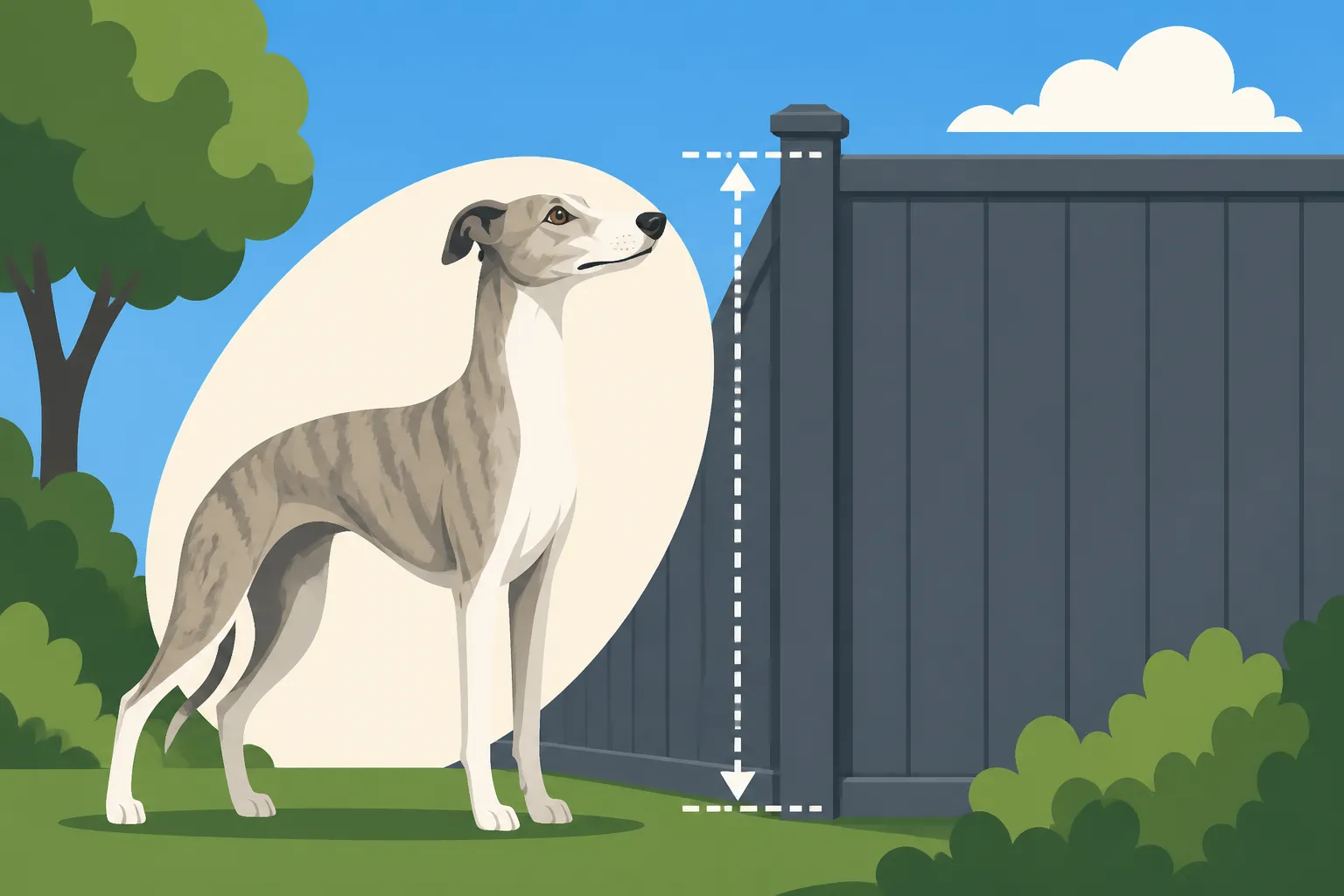
For optimal security and genuine peace of mind, most Whippet owners and experts recommend a 6-foot fence. This height provides a much more robust physical and psychological barrier against even a highly motivated Whippet. At six feet, the sheer height makes a successful jump very difficult for most Whippets, even those with significant spring. It creates a visual barrier that is harder to assess for jumping, and physically, it's just a much bigger ask.
If you have a particularly athletic Whippet, or if your yard has elements that could provide a boost (like retaining walls, large planters, or sloped ground right up to the fence), you might even consider fence extensions. These often take the form of lattice tops, angled extensions, or even "coyote rollers" that prevent a dog from getting purchase at the top of the fence. A secure, solid 6-foot fence, especially one that blocks sightlines, will be your best friend in keeping your Whippet safely contained.
Here's a quick comparison of fence types and how their features impact security for a Whippet:
| Fence Type | Visual Barrier | Climbing Deterrent | Digging Deterrent (Bottom) | Overall Whippet Security | Recommended Height |
|---|---|---|---|---|---|
| Solid Wood | Excellent | Good (if smooth) | Varies (needs reinforcement) | Very Good | 6 feet |
| Solid Vinyl | Excellent | Excellent (slick) | Varies (needs reinforcement) | Very Good | 6 feet |
| Chain Link | Poor | Poor (climbable) | Varies (needs reinforcement) | Poor to Fair | 6+ feet (with mods) |
| Wrought Iron/Metal | Poor | Fair (can climb) | Excellent (can bury) | Fair to Good | 6+ feet |
Beyond Height: Other Crucial Fence Considerations
While height is often the first thing people think about, a truly Whippet-proof fence involves more than just how tall it is. There are other critical elements that can turn an "okay" fence into a truly secure one.
Preventing Digging and Squeezing Through
Whippets aren't generally known as avid diggers in the same way some terriers or working breeds are. They're more likely to go over or through than under. However, if there's an existing weak spot, or if the ground is soft and they catch a scent, a motivated Whippet might exploit it. It’s not about them excavating a tunnel to freedom, but rather pushing through a loose panel or wriggling under a slight gap at the bottom.
To counter this, ensure your fence goes all the way to the ground, with no gaps where a slender Whippet could squeeze. For extra security, especially if you have an escape artist, consider burying a section of wire mesh (chicken wire or hardware cloth) along the bottom of the fence, extending it inward by about a foot. This "L-footer" makes it very difficult for a dog to dig right at the fence line. Also, periodically check for erosion or loose panels that could create new escape routes. Whippets are surprisingly adept at noticing and exploiting any small flaw.
Gate Security and Landscaping
The gate is often the weakest link in any fence. For a Whippet, a simple latch might not be enough. They are smart, and some can figure out basic gate latches. Consider installing a double-latching system or a sturdy padlock. The gate should fit snugly within the frame, leaving no gaps for a determined Whippet to squeeze through, and it should open inward, making it harder for a dog to push against it and force it open. It's amazing how quickly a curious dog can be out the door (see The Whippet That Bolts Through an Open Door) if the gate isn';t secure.
Beyond the gate, take a critical look at your landscaping. Do you have large shrubs, sturdy trees with low branches, or garden beds right up against the fence? While these might look aesthetically pleasing, they can provide a launching pad or stepping stones for a Whippet intent on escaping. Keep any potential climbing aids well clear of the fence line. Similarly, avoid placing outdoor furniture, storage bins, or even large rocks near the fence, as these too can be used as a boost. Regularly inspecting your fence line for new weaknesses or potential launch pads should be a routine part of your Whippet ownership.
Training and Supervision: The Human Element
Even the most robust, perfectly installed fence is only one part of the equation. Your Whippet’s safety in the yard is also heavily reliant on consistent training and vigilant supervision. No fence is truly foolproof if the human element is missing.
Training for a Reliable Recall (Even with a Fence)
A fence provides a boundary, yes, but it doesn't replace the fundamental need for training. Even within a securely fenced yard, having a solid recall is paramount. Why? Because accidents happen. A gate might be left ajar, a panel could come loose in a storm, or a delivery person might inadvertently open something up. In those moments, your Whippet’s ability to come back to you on command could be a literal lifesaver.
Work on a truly bomb-proof recall inside the house first, then in the fenced yard, and finally in more distracting environments while on a long line. Use high-value treats and enthusiastic praise. Make coming to you the most rewarding thing they can do. Consider investing in professional training resources, like those offered by BAXTER & Bella, which can provide structured guidance for developing a reliable recall. It’s a skill that builds trust and safety, no matter the physical barriers in place. Being able to successfully call your Whippet away from a tempting distraction is the essence of Proofing a Whippet's Recall Against Prey.
Constant Supervision and Environmental Management
A fenced yard should never be treated as a place to simply "turn out" your Whippet unsupervised for extended periods. Even with a 6-foot fence, things can go wrong. A bored Whippet might start looking for weaknesses, or a sudden, irresistible lure could push them to an unprecedented escape attempt. Direct supervision means you are actively watching your dog, aware of what they are doing and what is happening around them.
Environmental management also plays a huge role. Provide mental enrichment inside the fenced yard. Puzzle toys, interactive feeders, scent games, or even just engaging in a game of fetch with you can keep their minds occupied and reduce the likelihood of them seeking excitement beyond the fence. For those times when your Whippet is in the yard, ensure you have easy access to them and can intervene if needed. Keeping a leash handy – perhaps a brightly colored nylon leash found easily on Amazon – is always a good idea, even in a contained space, for those moments you need immediate control. Ultimately, even with a great fence, a Whippet should never be left to their own devices in an open area, because Why a Whippet Cannot Be Let Off Leash in an Open Field is a crucial lesson for every owner.
Addressing Common Fence Challenges
Even with the best intentions and the most thoughtful planning, you might encounter specific challenges when it comes to fencing for your Whippet. It’s important to understand these and have strategies in place.
The Determined Jumper or Climber
You might do everything right, install a tall, solid fence, only to find you have an exceptionally athletic or persistent Whippet who somehow still manages to find a way over or out. This isn't common, but it does happen. For these determined escape artists, you might need to go beyond the standard six feet. This could involve installing specific "coyote rollers" along the top of the fence – these are PVC pipes or similar materials that spin, preventing a dog from getting purchase to pull themselves over.
Another option is to angle the top section of your fence inwards by about a foot, making it even harder to clear. For those who are more climbers than jumpers (less common for Whippets, but possible), ensuring the fence surface is smooth and free of footholds is key. Remember, no fence can ever be 100% escape-proof for every single dog, especially one with extreme motivation and athletic prowess. It becomes a game of increasing the difficulty and reducing the reward of escaping.
Invisible Fences and Whippets: A Word of Caution
We touched on this briefly, but it bears repeating because it's such a common question for new dog owners. Invisible fences, which rely on a static correction collar to keep a dog within a boundary, are generally not recommended for Whippets. The fundamental issue lies in their sighthound nature: their prey drive is incredibly powerful.
If a Whippet spots a rabbit or a deer on the other side of that invisible boundary, the instinct to chase is usually far stronger than the deterrent of a static shock. They will often "blow through" the boundary, taking the momentary unpleasant sensation in exchange for the thrill of the chase. The real problem then arises: once they're outside the boundary, they've learned that crossing it means discomfort. Many Whippets will then be unwilling to re-enter the yard because they associate the entire area with the negative sensation, leaving them stranded outside, potentially lost, or worse, in danger. For a breed that can reach incredible speeds and is notoriously focused on the chase, this is a dangerous gamble. Relying on an invisible fence for a Whippet is putting them at unnecessary risk, especially when considering Why a Loose Whippet Runs Into Traffic after an escape.
Disclaimer
This article is for general informational purposes only and does not constitute professional advice. Laws, prices and regulations vary by location and change over time. Consult a qualified professional for guidance on your specific situation.